

Salary Deductions in Singapore: What Employers Can and Cannot Deduct
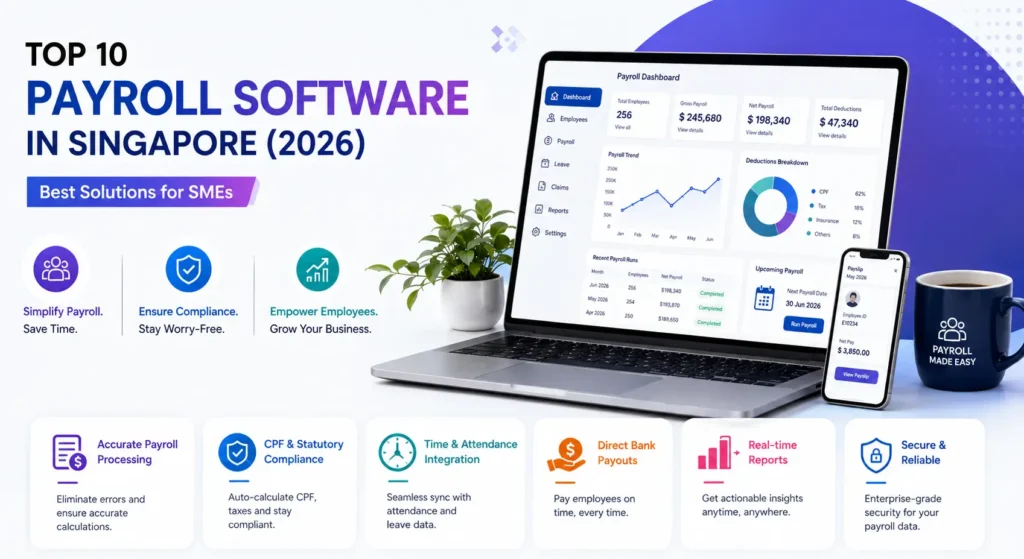
Salary Deductions in Singapore: What Employers Can and Cannot Deduct Payroll mistakes rarely come from complicated calculations. More often, they come from a well-meaning deduction that turns out to be against the rules — recovering a broken laptop in one go, or deducting a full month’s uniform cost from someone’s pay without realising there’s a cap on that. Singapore’s Employment Act sets out exactly which salary deductions employers can make, how much they can deduct, and what steps need to happen first. Get this wrong, even unintentionally, and it can lead to MOM enforcement action, back-payment obligations, and a fair bit of employee mistrust. This guide walks through what’s allowed, what isn’t, and how payroll processes — including payroll software — can help SMEs stay compliant without needing to memorise every clause of the Act. Salary Deductions in Singapore: What Employers Can Deduct Salary deductions are amounts an employer subtracts from an employee’s gross pay before releasing the net salary, and under Singapore’s Employment Act, these can only be made for specific reasons set out in law — such as absence, damage or loss, accommodation, recovery of advances or loans, CPF contributions, or with the employee’s written consent. Employers covered by the Act cannot deduct salary for any reason outside this list, and even permitted deductions are subject to caps and procedural requirements. [MOM – Allowable salary deductions] When Can an Employer Deduct an Employee’s Salary? Under the Employment Act, salary deductions fall into two broad categories: those an employer may be required to make, and those an employer is permitted to make under specific conditions. [Singapore Employment Act 1968 – Sections 26–32] Employers may be required to deduct salary when: Ordered by a court or other authority with the power to make such an order. The employer has been declared an agent for recovering income tax, property tax, or GST payable by the employee. Source: [MOM – Allowable salary deductions] Outside of these mandatory situations, an employer can only deduct salary for the reasons explicitly listed in the Act — not for any deduction the employer personally considers reasonable. This is a common misunderstanding among SMEs: unless a deduction fits one of the recognised categories, it isn’t lawful, even if both parties seem to agree it’s fair at the time. Types of Salary Deductions Allowed in Singapore The Employment Act permits deductions only for the following categories: [MOM – Allowable salary deductions] | [Employment Act 1968] Absence from work. For monthly-rated employees, salary can be deducted for days of unauthorised or authorised absence, calculated based on the applicable formula for incomplete months or unauthorised leave. Damage or loss of money or goods. This covers items like work equipment, tools, or vehicles that the employee is responsible for. Before deducting, the employer must hold an inquiry, give the employee a chance to explain, and cannot deduct more than 25% of one month’s salary as a lump sum. Accommodation that the employee has accepted from the employer. Amenities and services that the Commissioner for Labour has approved and the employee has accepted — for example, childcare or recreational facilities beyond what’s normally required. Employer approval from the Commissioner is required before this deduction can be made, and the deduction cannot exceed 25% of the salary for that period. Recovery of advances, loans, overpaid salary, or unearned employment benefits. Advances and loans must be recovered in instalments not exceeding 25% of salary per period, spread over a reasonable period. Overpaid salary and unearned benefits can be recovered in full. CPF contributions. The employee’s share of CPF must be deducted from the correct month’s salary under the CPF Act. Payments to a registered co-operative society, with the employee’s written consent. Other purposes with written consent, provided the deduction benefits the employee and the employer is in a position to collect the payment on their behalf. Deductions that don’t benefit the employee — such as liquidated damages — cannot be made this way, even with consent. Salary Deductions and Itemised Payslips Under MOM’s itemised payslip requirements, every deduction made from an employee’s salary must be clearly itemised on their payslip — not bundled into a vague “adjustments” line. This means the payslip should show each deduction separately: CPF contributions, any absence-related deduction, loan or advance recovery instalments, and so on, alongside the gross salary and resulting net pay. This isn’t just good practice — it’s a compliance requirement. An itemised payslip that omits or vaguely groups deductions can put an employer in breach of MOM’s payslip rules, separate from whether the underlying deduction itself was lawful. For SMEs, this makes accurate, itemised payroll records essential, not optional. Example of Salary Deductions on a Payslip How Payroll Software Helps Manage Salary Deductions Manually tracking deduction categories, caps, and consent records across a growing headcount is where errors tend to creep in. Payroll software can reduce this risk by applying deduction rules consistently and keeping records organised in one place. Based on verified capabilities, Adaptive Pay’s payroll software auto-calculates salary components — including allowances, deductions, and statutory CPF contributions — based on configured payroll rules, and generates itemised payslips showing detailed breakdowns of earnings, deductions, and contributions as required by MOM. Because the system compiles data from linked modules like leave, attendance, and claims, deductions such as no-pay leave can flow through automatically rather than being calculated by hand each cycle. This kind of automation doesn’t replace the employer’s responsibility to apply the Employment Act correctly — a payroll system still needs accurate rule configuration — but it does reduce the manual re-entry and calculation errors that often lead to compliance issues in the first place. FAQs 1.Is there a maximum amount an employer can deduct from salary in one month?Generally, total authorised deductions cannot exceed 50% of an employee’s salary payable in one salary period. Certain deductions — such as those for absence, or recovery of advances, loans, or overpaid salary — are excluded from this particular cap. Upon termination, the total deduction from