
AI Workforce Analytics for HR Teams Managing 1,000+ Employees
Learn how AI workforce analytics helps HR teams scale reporting, spot attendance and payroll risks early, and answer leadership questions faster—without drowning in dashboards.

Discover HRMS and HR technology insights for Singapore businesses, including payroll, attendance, leave management and employee management software.
Learn how AI workforce analytics helps HR teams scale reporting, spot attendance and payroll risks early, and answer leadership questions faster—without drowning in dashboards.

An integrated HR platform for SMEs can replace scattered spreadsheets and disconnected apps with one source of truth for payroll, time, leave, claims, and employee records. Here’s how to recognize the tipping point—and what a smart consolidation plan looks like.

Cloud HR software for SMEs isn’t just “HR in a browser.” It centralizes people data, automates routine workflows, improves security, and gives leaders real-time visibility—without adding headcount. Here are five practical reasons growing teams switch, plus what to check before you migrate.

An AI HR assistant can take repetitive HR admin off your plate—answering routine questions, guiding employees through self-service, and turning scattered data into clear actions. Here’s how it reduces everyday workload without adding chaos.
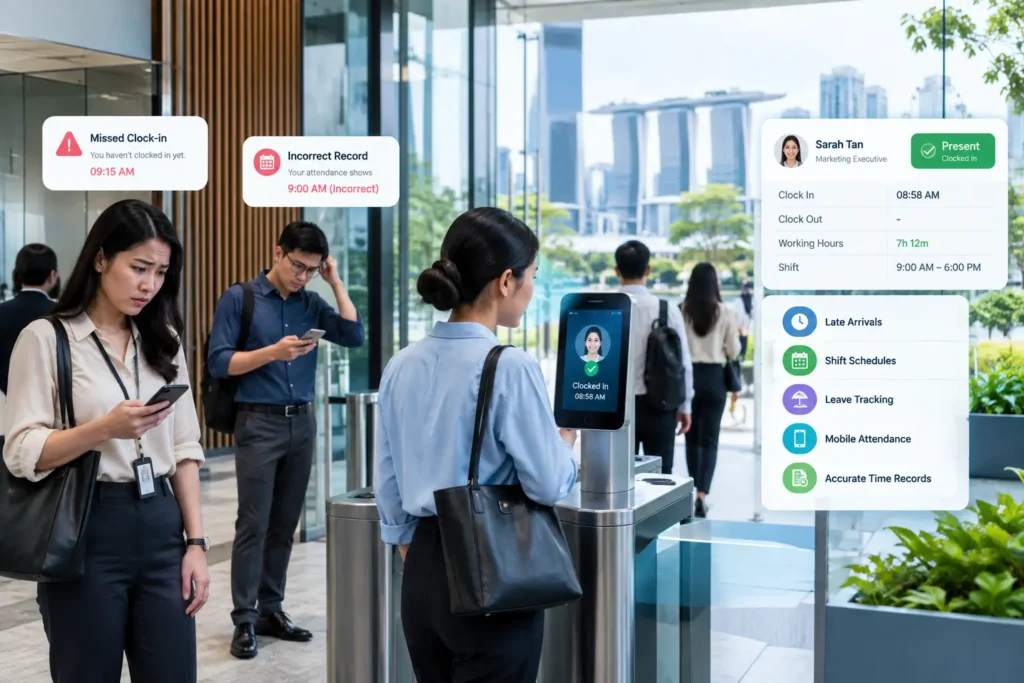
Attendance Management Challenges in Singapore: Common Issues & Solutions Attendance management challenges in Singapore can affect payroll accuracy, overtime tracking, shift planning, and employee records. Attendance sounds like it should be the simplest part of HR — people clock in, people clock out. In practice, it’s often where things quietly go wrong: a missed clock-out that turns into an overtime dispute, a shift swap that never made it into the roster, or a leave day that doesn’t match what payroll processed. This article walks through the attendance management problems Singapore SMEs run into most often, why they matter more than they might seem, and what a properly configured attendance system can actually do about them. These attendance management challenges in Singapore can become more difficult for SMEs when attendance records are maintained manually or across multiple systems. Connecting attendance, leave, and payroll data can reduce the need for repeated manual checks. Why Employee Attendance Management Matters Attendance data isn’t just a record of who showed up — it’s the foundation for payroll accuracy, overtime compliance, and workforce planning. When attendance records are incomplete or inconsistent, the effects ripple outward: Payroll accuracy depends on it. Salary calculations, especially for hourly or shift-based staff, rely directly on accurate time records. Errors here mean overpaying, underpaying, or having to make corrections after the fact. Overtime compliance depends on it. Singapore’s Employment Act sets specific rules under Part IV — a 44-hour work week, a 12-hour daily cap, and a 72-hour monthly overtime limit for covered employees, with overtime paid at least 1.5 times the hourly basic rate. Without accurate attendance data, it’s difficult to track whether these limits are being respected. Workforce planning depends on it. Knowing actual attendance patterns — who’s consistently late, which shifts are understaffed — helps managers make better scheduling decisions, rather than reacting to problems after they’ve already caused disruption. Trust depends on it. Employees rely on attendance records to be accurate, since disputes over hours worked or overtime pay can quickly damage morale if records are unclear or inconsistent. Common Attendance Management Challenges in Singapore A few recurring issues show up across SMEs, particularly those still relying on manual or semi-manual processes: Manual attendance records. Paper timesheets or basic spreadsheets require someone to manually collect, transcribe, and reconcile data — a process that’s slow and prone to transcription errors, especially across a growing team. Late arrivals and early departures. Tracking lateness or early leaving manually often means relying on a supervisor’s memory or a handwritten log, which makes consistent enforcement of company policy difficult. Overtime tracking. Without a system that captures exact clock-in and clock-out times, calculating overtime accurately — and staying within MOM’s caps — becomes a manual, error-prone exercise, particularly when multiple shift patterns are in play. Shift management. SMEs running multiple shifts, especially in retail, F&B, or logistics, often struggle to keep rosters updated and communicated when last-minute changes happen. Leave and attendance mismatches. If leave applications are tracked in one system (or not tracked digitally at all) while attendance is recorded elsewhere, discrepancies are common — an employee marked present who was actually on approved leave, for example. Remote or mobile employees. Field staff, delivery workers, or employees who don’t work from a fixed location are difficult to track with traditional time clocks, leaving gaps in attendance records. Attendance data errors. Manual re-entry of attendance data into payroll systems introduces a category of error that wouldn’t exist if the data flowed automatically between systems. Multiple locations. SMEs operating across several outlets or sites often lack centralised visibility into attendance, making it hard to get a single accurate picture of the whole workforce at once. Payroll discrepancies. All of the above tend to surface at the same point: payroll. An employee questioning why their pay doesn’t match their hours worked is often the first sign that attendance data wasn’t accurate to begin with. These attendance management challenges in Singapore can become more difficult for SMEs when attendance records are maintained manually or across multiple systems. Connecting attendance, leave, and payroll data can reduce the need for repeated manual checks. Time drain. Calculating CPF contributions, prorating salaries for partial months, and preparing payslips manually can take hours each cycle — hours that scale up as headcount grows. Error risk. Manual calculations, especially around CPF rates that vary by age and citizenship status, or overtime formulas, are easy to get wrong when done by hand in a spreadsheet. Compliance pressure. MOM’s itemised payslip requirements, CPF submission deadlines, and IRAS tax filing obligations all carry penalties for late or incorrect submissions — pressure that increases as the business and its payroll complexity grow. Disconnected data. When attendance, leave, and payroll live in separate spreadsheets, someone has to manually reconcile them each cycle, which is both time-consuming and a common source of errors. Scaling pain. A process that worked for 10 employees often breaks down at 30 or 50, forcing a rushed switch to software under time pressure rather than a considered evaluation. How Manual Attendance Tracking Affects Payroll Attendance and payroll are directly linked, which means an attendance problem rarely stays contained to attendance — it becomes a payroll problem too. Consider a simple example: if a supervisor forgets to log an employee’s late clock-in on a paper sheet, that missing record either goes unnoticed (meaning no deduction is applied when one arguably should be) or gets caught weeks later during a payroll review, requiring a correction and possibly a difficult conversation with the employee. Multiply this across a growing team, and manual reconciliation between attendance sheets and payroll spreadsheets becomes a significant, recurring source of both errors and administrative time. Overtime calculations compound this further. Since overtime pay must be calculated at 1.5 times the hourly basic rate and tracked against a monthly cap, inaccurate attendance data doesn’t just risk an incorrect payment — it risks a compliance issue if the actual hours worked exceeded MOM’s limits without anyone catching it in time. How Attendance
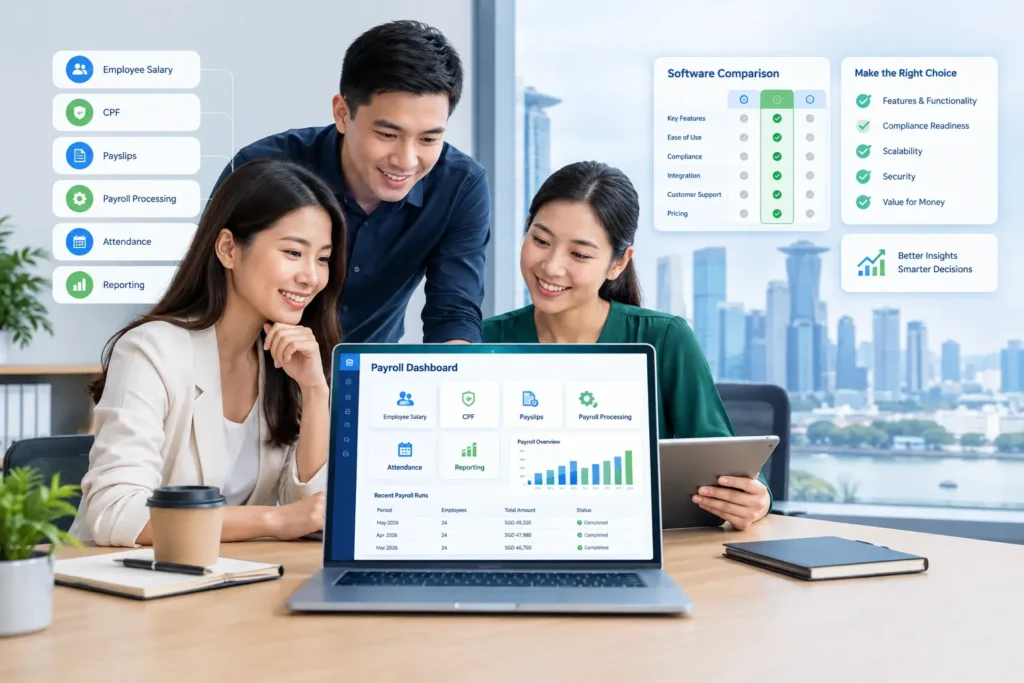
How to Choose the Right Payroll Software for Your Singapore SME Payroll Software Singapore can help SMEs move beyond spreadsheet-based payroll and manage salary calculations, statutory contributions, payslips, and related HR processes more efficiently. If you’re reading this, you’re probably past the “should we get payroll software” question and onto the harder one: which one, and how do you actually compare them without getting lost in feature lists that all start to sound the same? This guide walks through what payroll software actually does, the features worth prioritising, what drives the cost, and a practical process for evaluating vendors — so you can make a decision based on your business’s actual needs rather than whichever sales deck sounds the most impressive. Payroll Software Singapore: What SMEs Should Look For Payroll software is a system that automates the calculation of employee salaries, statutory contributions, and payslip generation, replacing manual spreadsheet-based payroll processing. Instead of an HR or finance team calculating CPF contributions, overtime, and deductions by hand each month, the software applies configured rules automatically and produces itemised payslips, statutory reports, and payment files. Most modern payroll software in Singapore is cloud-based, meaning it’s accessed through a browser or app rather than installed on a single office computer, and often integrates with related HR functions like leave, attendance, and claims. Why Singapore SMEs Need Payroll Software Manual payroll tends to work fine when a company has a handful of employees on a simple, fixed salary structure. The challenges usually start showing up as the business grows or payroll gets more complex: Time drain. Calculating CPF contributions, prorating salaries for partial months, and preparing payslips manually can take hours each cycle — hours that scale up as headcount grows. Error risk. Manual calculations, especially around CPF rates that vary by age and citizenship status, or overtime formulas, are easy to get wrong when done by hand in a spreadsheet. Compliance pressure. MOM’s itemised payslip requirements, CPF submission deadlines, and IRAS tax filing obligations all carry penalties for late or incorrect submissions — pressure that increases as the business and its payroll complexity grow. Disconnected data. When attendance, leave, and payroll live in separate spreadsheets, someone has to manually reconcile them each cycle, which is both time-consuming and a common source of errors. Scaling pain. A process that worked for 10 employees often breaks down at 30 or 50, forcing a rushed switch to software under time pressure rather than a considered evaluation. Manual Payroll vs Payroll Software Singapore Payroll Compliance Considerations Whichever software you choose, it needs to support — not just claim to support — a few core statutory obligations: CPF contributions. Employers must pay CPF for Singapore Citizen and Permanent Resident employees, at rates that vary by age, wage level, and citizenship status. The CPF Board publishes current contribution rate tables, which any payroll system should keep updated. Itemised payslips. Under the Employment Act, employers must issue itemised payslips within three working days of salary payment (or together with payment), listing prescribed items such as basic pay, allowances, deductions, and net salary. MOM’s guidance on itemised payslips sets out the specific requirements. Income tax reporting. Employers with five or more employees generally must join IRAS’s Auto-Inclusion Scheme (AIS), submitting employee income information electronically rather than issuing paper IR8A forms. Record keeping. Payroll and employment records generally need to be retained for a set period, covering both current and former employees. Cloud Payroll Software vs Traditional Payroll Systems The distinction here matters more than it might seem at first glance. Traditional payroll systems are typically installed on a single computer or local server, accessed only from that specific machine or network. Updates (including CPF rate changes) often require manual installation, and accessing payroll data remotely usually isn’t straightforward. Cloud payroll software is hosted online and accessed through a browser or app from any device with an internet connection. Updates, including statutory rate changes, are typically pushed automatically by the vendor. This also makes it easier for HR or finance staff to process payroll while working remotely, and for business owners to check payroll status without needing to be in the office. Most payroll software built for the Singapore SME market today is cloud-based, largely because it reduces the IT overhead of maintaining local infrastructure and keeps compliance updates centralised. Traditional on-premise systems still exist, particularly among older legacy setups, but they’re increasingly the exception rather than the norm for new SME purchases. How Much Does Payroll Software Singapore Cost? Pricing varies significantly between vendors, and this guide won’t invent specific figures — actual pricing depends on the provider and your requirements. That said, a few factors consistently influence cost: Number of employees. Most vendors price per employee or in employee-count tiers, so cost scales with headcount. Modules included. A payroll-only subscription typically costs less than a bundled HRMS covering payroll, leave, attendance, and claims together. Subscription model. Most Singapore payroll software is sold as a recurring subscription (monthly or annual) rather than a one-time licence purchase. Implementation. Initial setup — migrating employee data, configuring payroll rules, and testing the first few payroll runs — may involve a one-time cost or be bundled into onboarding. Support level. Basic email support versus dedicated account management or priority support can affect pricing tiers. Additional services. Add-ons like advanced reporting, API integrations with accounting software, or premium modules may carry separate costs. It’s also worth checking government support options. Under the Productivity Solutions Grant (PSG) administered by Enterprise Singapore, eligible SMEs adopting pre-approved digital solutions — including some payroll and HRMS software — can receive funding support toward the cost, subject to eligibility criteria. Since grant terms and eligible solutions change periodically, check current details directly on Enterprise Singapore’s site or with the specific vendor’s PSG status before assuming eligibility. Rather than comparing headline monthly prices in isolation, request quotes based on your actual employee count and required modules, and factor in the internal time saved versus your current manual process. How to Choose
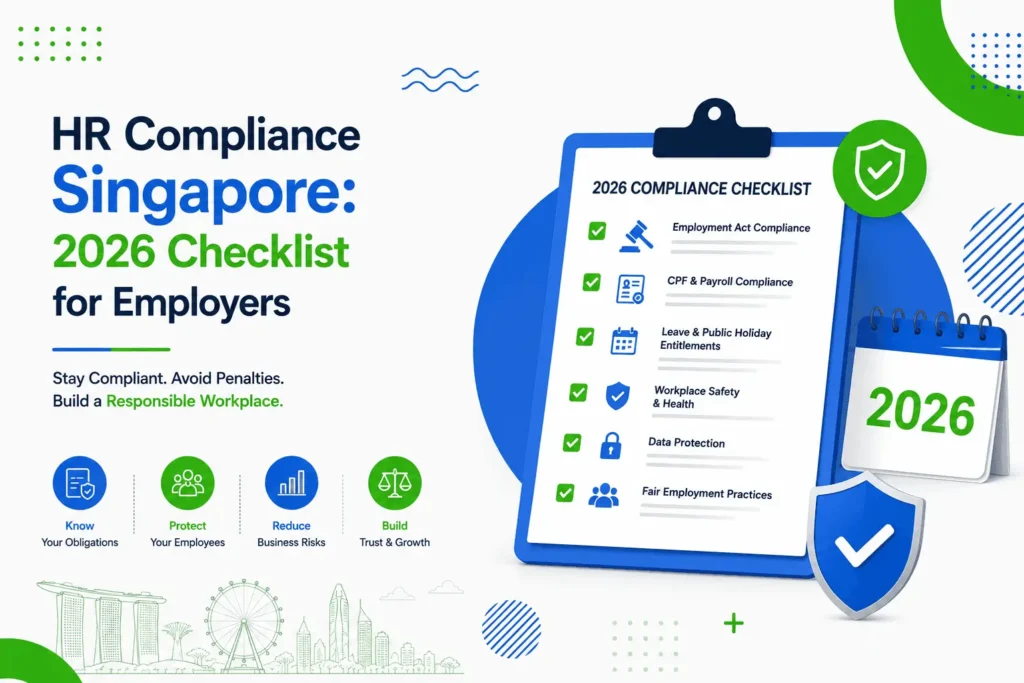
HR Compliance Singapore: 2026 Checklist for Employers A growing SME might have every basic in place — signed employment contracts, payroll running on schedule, employees applying for leave through some kind of system. And yet, when you actually look closely, there can still be gaps: employment records that are incomplete, payslips missing a required field, personal files scattered across old folders, or an offboarding process that was never really written down. HR compliance in Singapore isn’t only about paying salaries correctly, though that’s certainly part of it. It also covers documentation, record-keeping, leave administration, data handling and a handful of administrative processes that are easy to overlook once a company gets past its first few hires. This article walks through what HR compliance actually covers, area by area, so you can use it as a working checklist rather than a legal reference. A quick note before we go further: this article isn’t legal advice, and it doesn’t cover every obligation for every business. Requirements can depend on your employee types, industry, work arrangements, and other company-specific factors — so treat this as a starting point for review, not a substitute for checking directly with the relevant authority. What Is HR Compliance in Singapore? HR compliance in Singapore refers to following the employment laws, regulations and administrative requirements that apply to how a business manages its employees — from employment contracts and payslips to leave, CPF contributions and record-keeping. What applies to a given business can vary depending on its workforce composition, industry, and how it structures work arrangements, so HR compliance Singapore isn’t a single fixed checklist that fits every company identically. In practice, it means having the right documentation in place, keeping accurate and complete records, paying employees correctly and on time, and staying reasonably current on requirements as they’re updated. Singapore HR Compliance Checklist for Employers The following areas come up repeatedly when businesses review their HR processes. None of this replaces professional advice for your specific situation, but it’s a reasonable starting point for a self-review. 1. Employment Contracts and Key Employment Terms Employers are required to provide Key Employment Terms (KETs) in writing to employees covered by the Employment Act, generally within 14 days of the employee starting work. MOM’s key employment terms page sets out what needs to be included — things like job title, salary details, working hours, leave types and notice periods. It’s worth checking your current contract templates against this list rather than assuming an older template still covers everything required. 2. Employment Records Employers covered by the Employment Act are expected to maintain proper employment records, including basic employee information, salary details, and information such as leave taken. MOM’s guidance on what employee records you need to keep sets out what’s generally expected. For a growing SME, this is often where gaps first appear — leave records living in one spreadsheet, salary adjustments noted informally in emails, and no single place where a complete employee file actually sits. 3. Itemised Payslips Employers must provide itemised payslips to employees covered by the Employment Act. This isn’t just a courtesy document — it needs to include specific salary components. Rather than guessing at the format, it’s worth referring directly to MOM’s official guidance on itemised payslip requirements, and checking whether your current payslip template — whether generated manually or through software — actually includes everything expected. 4. Salary and Payroll Processing This covers the basics: calculating salary accurately, applying overtime correctly where it applies, handling deductions properly, running CPF-related payroll processes, and keeping the underlying salary records organised. None of this is unusual for a functioning payroll process, but it’s easy for small inconsistencies to creep in as headcount grows — a rate that wasn’t updated after a raise, a deduction applied inconsistently, or a payroll record that doesn’t quite match what was actually paid. 5. Working Hours, Overtime and Rest Days Requirements around working hours, overtime and rest days depend on which employees are covered under Part IV of the Employment Act — broadly, this doesn’t apply to managers and executives, and coverage depends on salary thresholds that can change over time. Rather than relying on a rule of thumb, it’s worth checking MOM’s page on hours of work, overtime and rest days directly, since coverage and thresholds can be updated. 6. Leave Administration Employers generally need to manage several leave categories — annual leave, sick leave, and other statutory leave types such as maternity, paternity or childcare leave where applicable — alongside any additional leave the company chooses to offer as a matter of policy. Exact entitlements and eligibility depend on factors like length of service and employee category, so rather than listing specific numbers here, it’s worth checking current details directly with MOM. What matters operationally is having a clear, consistent way to track and record leave. This is one of the areas where a dedicated Leave Management Software Singapore system tends to help — centralising applications, balances and approval records instead of leaving them scattered across email and spreadsheets. 7. CPF Contributions Employers are generally required to make CPF contributions for eligible Singapore Citizen and Permanent Resident employees. Contribution rates depend on factors like age group and wage level, and these rates are reviewed periodically — the CPF Board’s employer obligations page and its contribution rate guidance are the right place to confirm current figures rather than relying on a number from a previous year. What matters for HR is having a consistent monthly process: confirming CPF liability, submitting on time, and reconciling contributions against payroll records. 8. Fair Employment Practices Singapore employers are expected to follow the Tripartite Guidelines on Fair Employment Practices, which set out principles around merit-based recruitment, fair treatment, and non-discriminatory HR practices. This isn’t only a hiring consideration — it extends to how performance, promotion and other HR decisions are documented and applied consistently. 9. Employee Data and Privacy Employee personal data — NRIC numbers, salary details, medical information, and similar — falls
Overtime Pay in Singapore: A Practical Guide for SMEs (2026) Getting overtime right is one of the trickiest parts of payroll for SMEs in Singapore — get it wrong, and you’re looking at disputes with employees, compliance risks with Ministry of Manpower, and sometimes penalties that could’ve easily been avoided. Once you understand what Ministry of Manpower actually requires, though, it’s a lot more straightforward than it seems, and it goes a long way in keeping your team paid fairly and your payroll running smoothly. This guide breaks down Singapore’s overtime rules in plain language, walks through real examples, and shows how SMEs can make the whole process simpler to manage. What Is Overtime Pay in Singapore? Ministry of Manpower (MOM) defines overtime as any work an employee does beyond their normal contractual working hours — meal breaks and rest breaks don’t count toward this. Whether an employee is entitled to overtime pay depends on whether they’re covered under Part IV of the Employment Act. For employees who are covered, employers are required to pay at least 1.5 times the employee’s hourly basic rate for every hour of overtime worked. This payment can’t be delayed — it needs to reach the employee within 14 days of the end of the salary period it relates to. Who Is Eligible for Overtime Pay? Not every employee in Singapore qualifies for statutory overtime.Employees covered under Part IV of the Employment Act include: Non-workmen earning a monthly basic salary of $2,600 or less Workmen earning a monthly basic salary of $4,500 or less Managers and executives are generally not covered under Part IV of the Employment Act. Example: Administrative Executive Sarah works as an administrative assistant and earns a monthly basic salary of $2,400.Eligible for overtime pay because her salary falls within the non-workman threshold.Example: Operations ManagerJames earns $4,800 monthly and performs managerial duties.Generally not eligible for statutory overtime under Part IV. His employment terms will be governed by his employment contract. What Are the Normal Working Hours? MOM specifies that contractual working hours generally cannot exceed: Work Schedule Maximum Contractual Hours 5 days or fewer per week Up to 9 hours per day or 44 hours per week More than 5 days per week Up to 8 hours per day or 44 hours per week For alternative work arrangements, different averaging rules may apply.Example: When Does Overtime Start?ScenarioAn employee works: 8 hours per day, Monday to Friday,Total contractual hours: 40 per week, One day, the employee works until 8 PM instead of 6 PM.ResultNormal hours: 8, Additional hours worked: 2, Overtime claimable: 2 hours, Since the employee worked beyond contractual hours, the additional 2 hours are considered overtime. How Is Overtime Pay Calculated? MOM Overtime Formula Overtime Pay = Hourly Basic Rate of Pay × 1.5 × Overtime Hours Worked For monthly-rated employees, the hourly basic rate is calculated using: Hourly Basic Rate = (12 × Monthly Basic Salary) ÷ (52 × 44) Example: Overtime Pay Calculation Employee Details Monthly Basic Salary: S$2,400 Overtime Hours Worked: 10 hours Step 1: Calculate the Hourly Basic Rate Formula: Hourly Basic Rate = (12 × Monthly Basic Salary) ÷ (52 × 44) Calculation: = (12 × S$2,400) ÷ (52 × 44) = S$12.59 per hour Step 2: Calculate the Overtime Pay Formula: Overtime Pay = Hourly Basic Rate × 1.5 × Overtime Hours Worked Calculation: = S$12.59 × 1.5 × 10 = S$188.85 Result Monthly Basic Salary: S$2,400 Overtime Hours Worked: 10 hours Hourly Basic Rate: S$12.59 Total Overtime Pay: S$188.85 The employee should receive S$188.85 in overtime pay for 10 hours of overtime work, based on the Ministry of Manpower (MOM) overtime calculation formula. Note: Overtime pay is calculated using the employee’s basic salary only. Allowances, bonuses, commissions, incentives, and other variable payments are generally not included when calculating the hourly basic rate. Getting overtime right is one of the trickiest parts of payroll for SMEs in Singapore — get it wrong, and you’re looking at disputes with employees, compliance risks with Ministry of Manpower, and sometimes penalties that could’ve easily been avoided. Once you understand what Ministry of Manpower actually requires, though, it’s a lot more straightforward than it seems, and it goes a long way in keeping your team paid fairly and your payroll running smoothly. This guide breaks down Singapore’s overtime rules in plain language, walks through real examples, and shows how SMEs can make the whole process simpler to manage. Overtime Rate Cap Employers Should Know For eligible non-workmen, overtime calculations are capped at a salary level of $2,600, equivalent to an hourly overtime calculation cap of $13.60 per hour.ExampleAn employee earns $2,600 monthly and works 2 overtime hours.Calculation:1 $13.60 × 1.5 × 22 = $40.80This is the example provided by MOM. Maximum Overtime Hours Allowed Employers should monitor overtime carefully.MOM limits eligible employees to: Maximum 72 overtime hours per month Employers requiring additional overtime must apply for an exemption. Example: Retail SME During Peak SeasonA retail business experiences high sales during year-end promotions. Employee OT accumulated: 68 hours Additional OT requested: 10 hours Without an approved exemption, the employer risks exceeding the statutory monthly OT limit. SMEs should monitor overtime proactively to avoid compliance issues. Maximum Daily Working Hours Employees generally cannot work more than 12 hours per day. Exceptions may apply for emergencies, urgent machinery repairs, national security requirements, unforeseen interruptions, or approved overtime exemptions. Example: Manufacturing BreakdownA production machine unexpectedly fails and urgent repair work is needed to fulfil customer orders.The employer may require employees to work beyond normal hours due to unforeseen operational interruptions, subject to MOM requirements. Understanding Rest Day Rules Employers must provide: One rest day every week A full day from midnight to midnight Maximum gap of 12 days between rest days Shift workers may have a continuous 30-hour rest period instead. How Is Pay Calculated for Work on a Rest Day? MOM differentiates between:Work requested by the employer, Work requested by the employeeHours worked beyond normal daily working hours. Example: Employer Requests Work on a Rest DayEmployee’s normal workday: 8 hours Employee

Doing your payroll manually may seem manageable at first, but as your team grows and compliance rules evolve, it becomes much harder to avoid mistakes and delays. So if you’re still using spreadsheets or relying on outsourced payroll providers, it might be time to switch to cloud payroll software. The costs are surprisingly affordable even for smaller businesses. Cloud payroll software lets you keep your payroll processes securely in-house while automating key tasks, improving accuracy, and reducing the administrative load on your HR team. More importantly, integrating payroll with your accounting system gives you real-time visibility into labour costs and your overall financial performance. Here’s why more Singaporean businesses are switching to cloud-based systems — and how you can benefit, too. Avoid the hidden costs of payroll mistakes When payroll errors pile up, the issues do not stay hidden in the back office — they ripple across your entire organisation: Adaptive Pay’s Cloud payroll software can automate calculations, sync employee data, and apply the correct CPF and tax rules based on local requirements. Fix payroll issues with one connected system Adaptive Pay streamlines all your HR and payroll tasks in one integrated system. You’ll reduce manual entry and make fewer mistakes — all while keeping your data accessible, secure, and up to date. Here’s what you can do with our cloud payroll software: And because Adaptive Pay is an IRAS-listed vendor, you can send Annual Income Statements directly to IRAS from the system. Give employees easy access, anytime Employees can download their payslips through a mobile app, a web portal, or email. They also receive notifications when their payslips are ready, and every document is formatted to MOM standards. That means fewer HR queries and better transparency. Why choose cloud-based payroll software, in particular? Cloud payroll software gives you flexibility without the high upfront costs of on-premise systems. Start simplifying payroll today Adaptive Pay’s cloud payroll software is built to help you stay compliant and simplify HR workflows. Designed to be scalable, our cloud payroll software can make it so much easier to grow your operations while taking care of your employees. Book a demo to see how Adaptive Pay works.