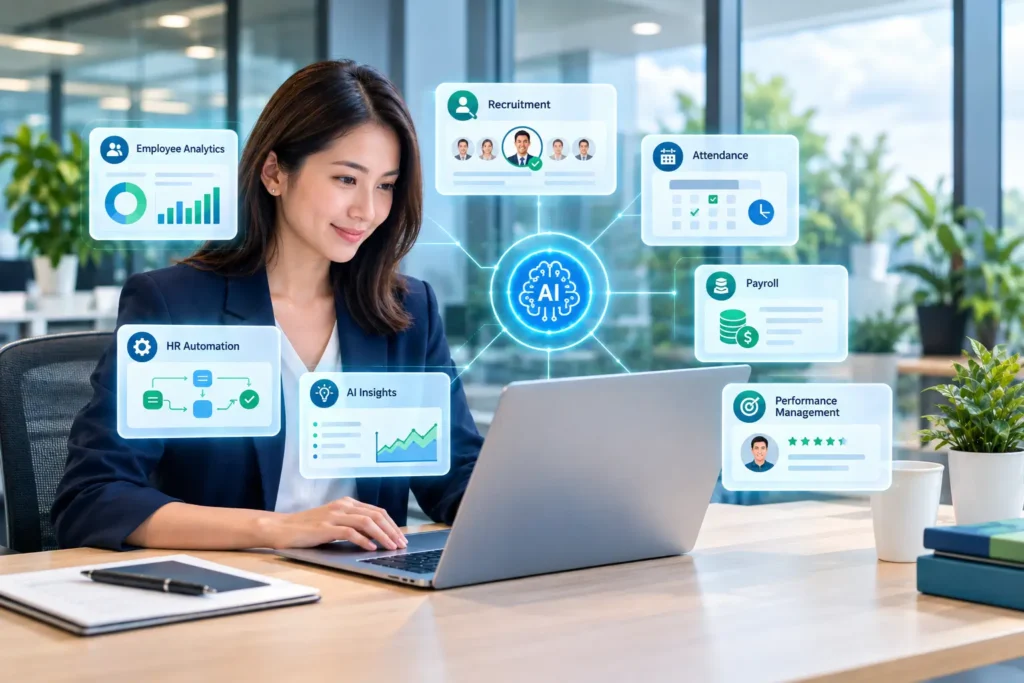
AI-Enabled HRMS in Singapore: How AI Is Transforming HR Management An AI-enabled HRMS in Singapore can help SMEs reduce repetitive HR administration, improve access to workforce information, and support employees through self-service tools. Instead of replacing HR judgement, AI-enabled HRMS platforms can handle repetitive, data-heavy tasks so HR teams can spend more time on work that requires human decision-making. Walk into many Singapore SME HR offices five years ago, and you might have found someone manually cross-checking attendance sheets against payroll or searching through email threads to answer a simple leave balance question. Today, automation and AI-assisted HR tools can reduce much of this manual work. This article explains what an AI-enabled HRMS actually means, where AI genuinely adds value versus where it’s just automation with a new label, and what Singapore SMEs should look for before choosing one. What Is an AI-Enabled HRMS in Singapore? An AI-enabled HRMS is a human resource management system that uses artificial intelligence — such as machine learning, natural language processing, or predictive analytics — to interpret HR data and support decisions, rather than simply executing pre-set rules. This is a meaningful distinction from standard HR automation, which follows fixed logic (if X happens, do Y) without adapting or offering insight beyond what was explicitly programmed. It’s worth being precise about the difference: Standard automation calculates CPF contributions using a fixed formula, generates a payslip on a set schedule, or sends a reminder when leave hasn’t been approved after two days. The logic is rule-based and doesn’t change based on patterns in the data. AI capabilities go a step further — surfacing patterns across data, answering natural-language questions, flagging anomalies that don’t fit expected patterns, or generating insights that a rule-based system wouldn’t be programmed to catch on its own. Many platforms marketed as “AI HRMS” blend both — a strong automation backbone with AI layered on top for specific tasks like analytics or employee queries. It’s a useful distinction to keep in mind when evaluating vendor claims, since not every “AI” feature is doing something meaningfully different from well-built automation. How AI Is Changing HR Management The practical shift AI brings to HR management tends to show up in a few concrete ways, rather than a dramatic overhaul of how HR departments function: Turning raw data into readable insight. Instead of an HR manager manually compiling attendance trends across departments, an AI-assisted system can surface patterns — such as which team has the highest overtime — without a manual data pull. Answering routine employee questions instantly. Rather than employees emailing HR to ask about leave balances or payslip details, AI-driven assistants can respond directly, freeing HR staff from repetitive queries. Flagging anomalies for human review. AI can highlight unusual patterns — like a payroll figure that deviates from an employee’s typical pay — so a human can check it before it becomes an error, rather than catching it after the fact. Supporting, not replacing, HR decisions. AI tools generally present information and flag patterns; the actual HR decision, such as approving leave or resolving a compliance question, still needs human judgement, particularly where Singapore employment law is involved. None of this means HR becomes hands-off. It means less time is spent gathering and reconciling data manually, and more time is available for the judgement calls that data alone can’t make. Traditional HR Management vs AI-Enabled HRMS Benefits for Singapore SMEs For SMEs specifically — where HR is often handled by a small team wearing multiple hats — the practical benefits tend to show up as: For Singapore SMEs, an AI-enabled HRMS in Singapore can bring these capabilities together in one connected HR environment, reducing the need to manage attendance, leave, payroll, and employee information across separate processes. Reduced administrative workload. Less time spent manually compiling data across attendance, leave, and payroll systems that don’t talk to each other. Faster HR processes. Approvals, payslip generation, and reporting can happen closer to real time rather than waiting for a manual batch process. Better data visibility. HR and management can see workforce data — headcount, leave trends, payroll costs — without requesting a custom report each time. Reduced manual errors. Automating repetitive calculations (like CPF contributions or overtime pay) reduces the chance of manual re-entry mistakes. Improved employee experience. Employees get faster answers to routine questions and self-service access to their own records, rather than waiting on HR. We haven’t included specific percentage improvements or ROI figures here, since actual results vary significantly by company size, existing processes, and how well the system is implemented. AI and Payroll Automation Payroll is one of the areas where automation delivers the most consistent value, because the calculations themselves are governed by clear rules — CPF rates, overtime formulas, statutory deductions — that don’t require judgement once configured correctly. Automation handles the calculation itself: applying CPF rates based on age and citizenship status, computing overtime at the statutory 1.5x rate, and generating itemised payslips. Where AI can add a further layer is in reviewing the output — for example, flagging a payroll run where an employee’s net pay deviates unexpectedly from their usual pattern, prompting a human check before the payment goes out. This kind of anomaly detection supports payroll accuracy without replacing the need for someone to review and approve the final run. AI and Employee Self-Service Self-service portals let employees handle routine tasks themselves — checking payslips, applying for leave, submitting claims, and viewing their attendance record — through a web portal or mobile app, without needing to go through HR for each request. Where AI can extend this is through conversational interfaces: an employee asking “how many annual leave days do I have left?” and getting an instant answer, rather than emailing HR and waiting for a reply. This reduces the volume of repetitive queries HR fielded before, though it works best for straightforward, data-based questions rather than judgement calls that still need a human — like an unusual leave request or a payroll dispute.