
September 24, 2026
PSG Support Ends 29 Sep 2026 ! | SFEC Support Ends 30 Nov 2026. Get 1-Year FREE AdaptivePay Subscription. (T&C Apply)
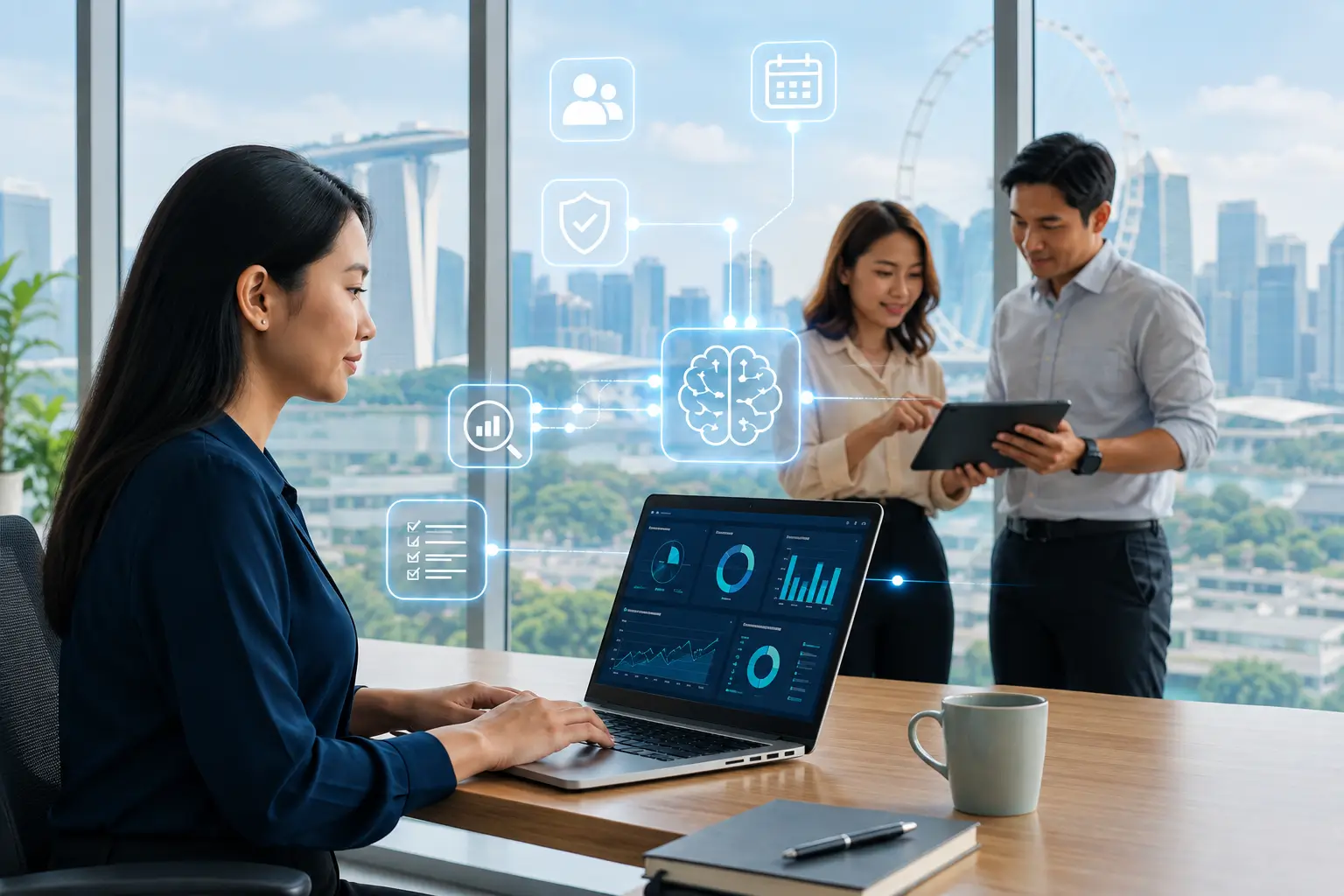
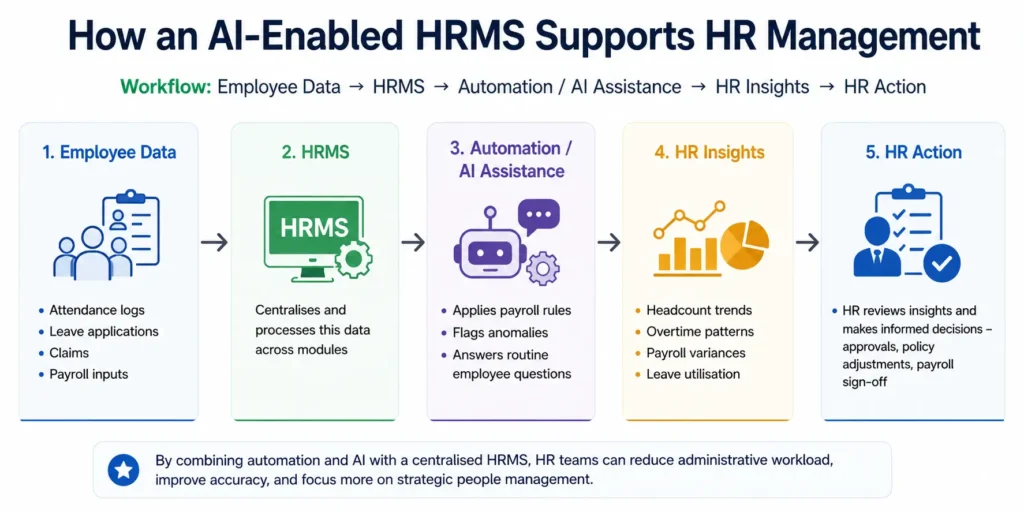
An AI-enabled HRMS in Singapore can help SMEs reduce repetitive HR administration, improve access to workforce information, and support employees through self-service tools. Instead of replacing HR judgement, AI-enabled HRMS platforms can handle repetitive, data-heavy tasks so HR teams can spend more time on work that requires human decision-making.
Walk into many Singapore SME HR offices five years ago, and you might have found someone manually cross-checking attendance sheets against payroll or searching through email threads to answer a simple leave balance question. Today, automation and AI-assisted HR tools can reduce much of this manual work.
This article explains what an AI-enabled HRMS actually means, where AI genuinely adds value versus where it’s just automation with a new label, and what Singapore SMEs should look for before choosing one.
An AI-enabled HRMS is a human resource management system that uses artificial intelligence — such as machine learning, natural language processing, or predictive analytics — to interpret HR data and support decisions, rather than simply executing pre-set rules. This is a meaningful distinction from standard HR automation, which follows fixed logic (if X happens, do Y) without adapting or offering insight beyond what was explicitly programmed.
It’s worth being precise about the difference:
Many platforms marketed as “AI HRMS” blend both — a strong automation backbone with AI layered on top for specific tasks like analytics or employee queries. It’s a useful distinction to keep in mind when evaluating vendor claims, since not every “AI” feature is doing something meaningfully different from well-built automation.
The practical shift AI brings to HR management tends to show up in a few concrete ways, rather than a dramatic overhaul of how HR departments function:
None of this means HR becomes hands-off. It means less time is spent gathering and reconciling data manually, and more time is available for the judgement calls that data alone can’t make.
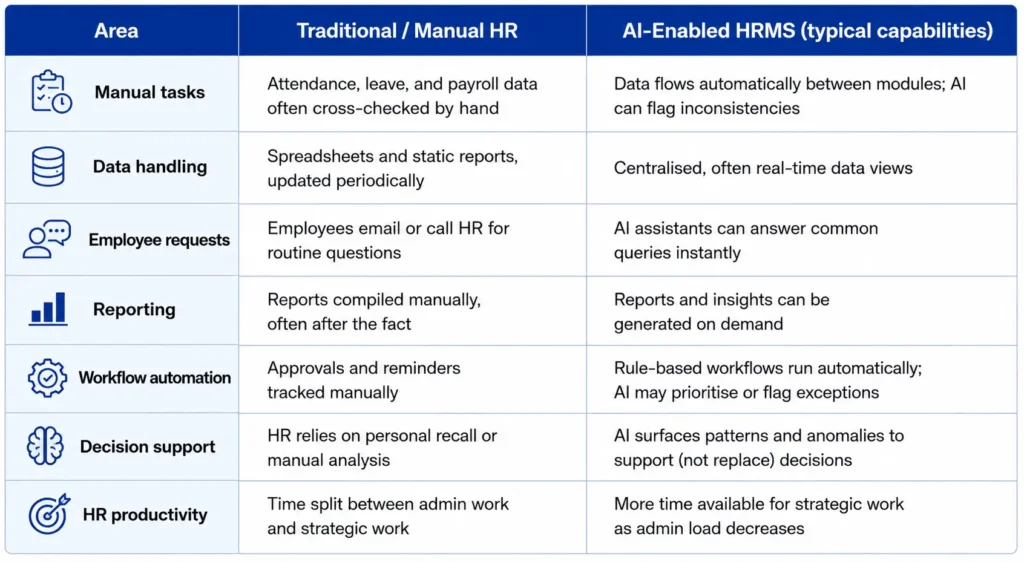
For SMEs specifically — where HR is often handled by a small team wearing multiple hats — the practical benefits tend to show up as:
For Singapore SMEs, an AI-enabled HRMS in Singapore can bring these capabilities together in one connected HR environment, reducing the need to manage attendance, leave, payroll, and employee information across separate processes.
We haven’t included specific percentage improvements or ROI figures here, since actual results vary significantly by company size, existing processes, and how well the system is implemented.
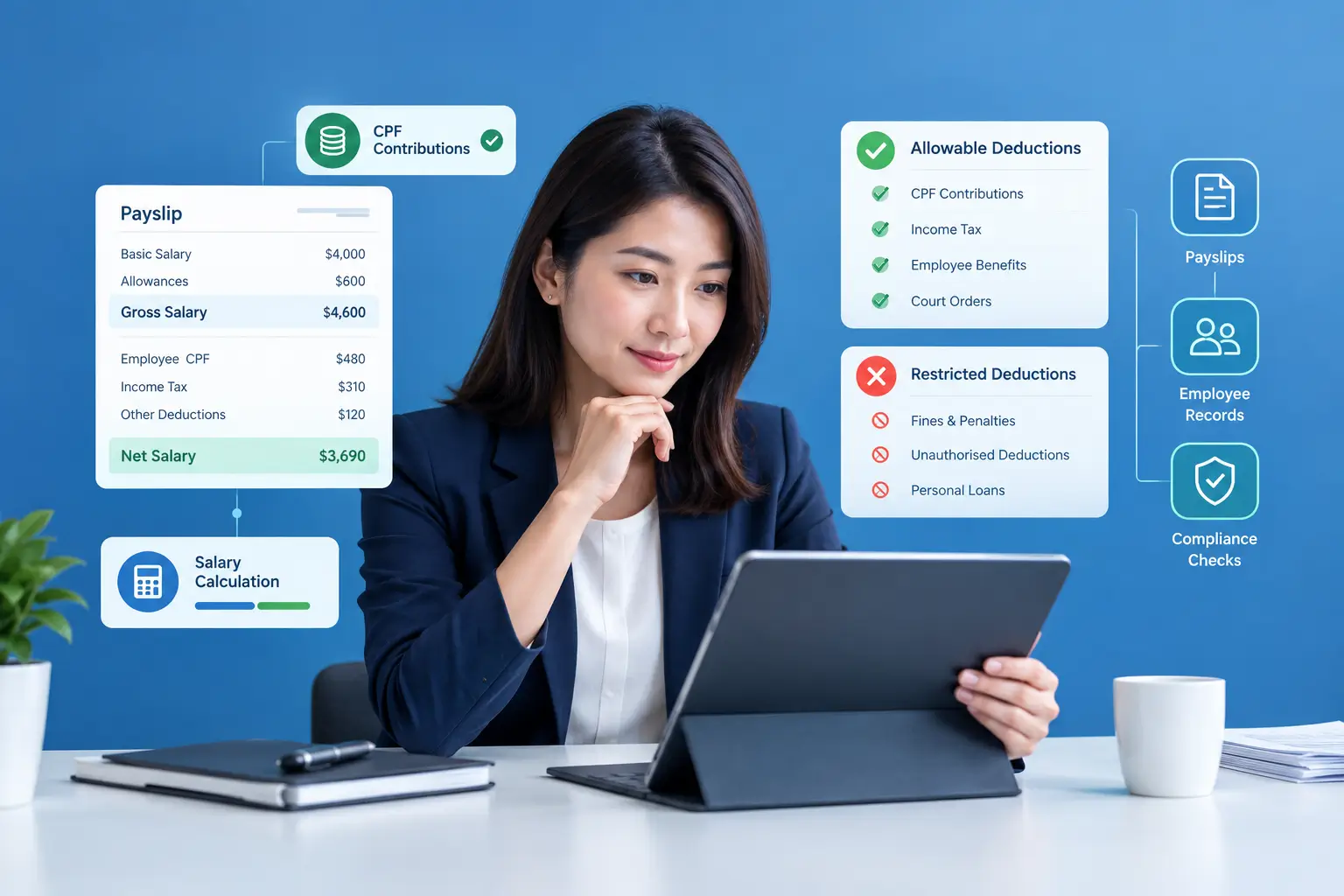
Payroll is one of the areas where automation delivers the most consistent value, because the calculations themselves are governed by clear rules — CPF rates, overtime formulas, statutory deductions — that don’t require judgement once configured correctly.
Automation handles the calculation itself: applying CPF rates based on age and citizenship status, computing overtime at the statutory 1.5x rate, and generating itemised payslips. Where AI can add a further layer is in reviewing the output — for example, flagging a payroll run where an employee’s net pay deviates unexpectedly from their usual pattern, prompting a human check before the payment goes out. This kind of anomaly detection supports payroll accuracy without replacing the need for someone to review and approve the final run.
Self-service portals let employees handle routine tasks themselves — checking payslips, applying for leave, submitting claims, and viewing their attendance record — through a web portal or mobile app, without needing to go through HR for each request.
Where AI can extend this is through conversational interfaces: an employee asking “how many annual leave days do I have left?” and getting an instant answer, rather than emailing HR and waiting for a reply. This reduces the volume of repetitive queries HR fielded before, though it works best for straightforward, data-based questions rather than judgement calls that still need a human — like an unusual leave request or a payroll dispute.
Any HRMS — AI-enabled or not — processes sensitive employee data: NRIC numbers, salary details, bank information, and sometimes biometric data for attendance tracking. In Singapore, this falls under the Personal Data Protection Act (PDPA), administered by the Personal Data Protection Commission (PDPC).
A few considerations are particularly relevant when evaluating an AI-enabled HRMS:
None of this is legal advice — SMEs should consult the PDPC’s guidance directly or a data protection professional when evaluating specific vendor arrangements, particularly for anything involving cross-border data transfer.
1.Is AI HRMS the same as HR automation?
Not quite. Automation follows fixed rules — calculating CPF, generating scheduled pay slips, sending reminders — without adapting based on patterns. AI adds a layer on top, such as recognizing patterns in data, answering natural-language questions, or flagging anomalies that a rule-based system wouldn’t catch.
2. Can AI replace HR staff in an SME?
No, not in any meaningful sense for compliance-heavy work. AI can reduce the time spent on repetitive tasks like answering routine queries or compiling reports, but decisions involving employment law, disputes, or nuanced situations still require human judgement.
3. Is AI HRMS suitable for small businesses?
Yes, in principle — many AI-assisted features, like employee self-service and automated reporting, are designed to reduce administrative load, which particularly benefits small teams without dedicated HR specialists.
4.How is AI used in payroll processing?
AI can support payroll by identifying unusual payroll patterns, flagging potential anomalies, and helping HR teams review payroll data. Core calculations such as CPF contributions, statutory deductions, and overtime should still be based on the applicable rules and correctly configured payroll processes. AI can provide an additional review layer rather than replacing payroll controls and human approval.
AI-enabled HRMS platforms aren’t about replacing HR judgement — they’re about reducing the manual, repetitive work that eats into an HR team’s time, and surfacing patterns that would otherwise go unnoticed until they become a problem. For Singapore SMEs, the practical wins tend to be faster processes, better visibility into workforce data, and fewer manual errors, rather than a wholesale reinvention of how HR operates.
When evaluating any AI-enabled HRMS, it’s worth separating genuine AI capability from standard automation dressed up with the label, and checking that the core compliance functionality — payroll, CPF, MOM payslip requirements — is solid before anything else. Adaptive Pay’s platform, for instance, includes Ivy AI for real-time analytics and workforce insights and Ava AI for employee support, layered on top of its core HRMS, payroll, attendance, and leave management modules. Whichever platform an SME chooses, the goal should be the same: less time spent on manual admin, and clearer visibility into the workforce data that actually drives decisions.
Manage HR, payroll, attendance, leave, and employee operations in one powerful HRMS platform to improve efficiency and simplify workforce management.
A smarter way to manage payroll, attendance, claims and appraisals – all in one seamless platform



Copyright © 2026 – Adaptive Cloud Systems Pte Ltd