
🇸🇬 2026 National Day Offer : 1-year free subscription!!!! Offer Valid only until: August 31 2026

Terms and conditions apply*

Singapore HR Updates

Keep up with the latest Singapore HR updates, employment regulations, workplace policies and important changes affecting employers and employees.

Complete Guide to Singapore Public Holidays in 2026
Singapore HR Updates

Complete Guide to Singapore Public Holidays in 2026

Keeping track of public holidays is an important part of managing manpower planning and payroll in Singapore because it lets you prepare for busy periods and adjust your staffing needs as required. You can also plan company-wide schedules more effectively. Need a quick list? We’ve gathered the full list of Singapore’s public holidays for 2026 — along with upcoming long weekends — so that you can align leave policies with shift planning. Key Takeaways • Singapore has 11 gazetted public holidays in 2026, which employers should incorporate into workforce planning and payroll.• Public holidays affect employee scheduling, overtime calculations, and payroll processing.• Employees covered by the Employment Act are generally entitled to paid public holidays and applicable compensation if they work on those days.• Using HR and payroll software can simplify holiday scheduling, attendance tracking, and payroll calculations. Singapore public holidays in 2026 Date Day Public holiday Notes 01-Jan-26 Thursday New Year’s Day Start of the new year; you and your employees can enjoy a 4-day break by taking Friday, 2 Jan, off. 17-Feb-26 Tuesday Chinese New Year First day of Chinese New Year. 18-Feb-26 Wednesday Chinese New Year Second day of Chinese New Year. 21-Mar-26 Saturday Hari Raya Puasa Muslim festival. The final date depends on moon-sighting confirmation. 03-Apr-26 Friday Good Friday Creates a 3-day long weekend (Friday to Sunday). 01-May-26 Friday Labour Day 3-day long weekend (Friday to Sun). 27-May-26 Wednesday Hari Raya Haji Muslim festival. The date may change depending on moon-sighting. 31-May-26 Sunday Vesak Day The following Monday is a public holiday. 01-Jun-26 Monday Vesak Day Holiday In-lieu holiday for Vesak Day falling on a Sunday; results in a 3-day long weekend (Saturday to Monday). 09-Aug-26 Sunday National Day The following Monday is a public holiday. 10-Aug-26 Monday National Day Holiday In-lieu holiday; 3-day long weekend (Saturday to Monday). 08-Nov-26 Sunday Deepavali The following Monday is a public holiday. 09-Nov-26 Monday Deepavali Holiday In-lieu holiday; 3-day long weekend (Saturday to Monday). 25-Dec-26 Friday Christmas Day 3-day long weekend (Friday to Sunday). What are the long weekends in Singapore in 2026?   Holiday Dates Weekend Length Good Friday 3–5 Apr 3 Days Labour Day 1–3 May 3 Days Vesak Day 30 May–1 Jun 3 Days National Day 8–10 Aug 3 Days Deepavali 7–9 Nov 3 Days Christmas 25–27 Dec 3 Days Employer and payroll notes (MOM-aligned) Keep these key points in mind when managing staffing and payroll in Singapore: Employees covered under the Employment Act are entitled to 11 paid public holidays each year. If an employee works on a public holiday, you must either: – Pay one additional day of basic salary on top of their regular pay, or – Grant time off in lieu, especially for managers, executives, and higher-earning staff (if mutually agreed). When a public holiday falls on a Sunday, the following Monday becomes a public holiday. This affects in-lieu days — such as National Day and Deepavali in 2026 — and should be factored into scheduling. These rules impact: Monthly payroll cut-off dates Overtime and public holiday pay calculations Shift planning and business operating hours What are my employees entitled to if they work on a public holiday? When your employees are protected by the Employment Act, and they work on a public holiday, you need to provide them with: Their gross pay for the day, and One extra day of basic pay, or time off in lieu if both parties agree (commonly applied to managers, executives, and higher-earning staff) Manage holidays with ease Singapore’s 2026 public holiday calendar is confirmed, so you must ensure that your HR and payroll processes are aligned. Instead of updating calendars manually or calculating public holiday pay on your own, you can automate everything with Adaptive Pay. With our all-in-one cloud HRMS, you can sync leave and attendance with your payroll processes in Singapore seamlessly, keeping your organisation accurate and compliant. Sign up for a demo today to experience how our platform can help ease your organisation’s HR woes. Frequently Asked Questions 1. How many public holidays are there in Singapore in 2026? Singapore has 11 gazetted public holidays in 2026. 2. What happens if a public holiday falls on a Sunday? If a public holiday falls on a Sunday, the following Monday is generally observed as a public holiday in accordance with Singapore regulations. 3. Are employees entitled to paid public holidays? Employees covered under the Employment Act are generally entitled to paid public holidays, subject to the applicable eligibility requirements.  

Key HR Software Developments in Singapore: Sept 2025
Singapore HR Updates

Key HR Developments in Singapore: September 2025 Edition

Q3 ended with key regulatory and tech-driven updates to Singapore’s HR landscape. For SMEs, staying ahead of these changes requires more than spreadsheets. These developments require smart, integrated HR software (or Human Resource Management System, HRMS) that eliminates compliance risk and provides more time for talent strategy and planning. What should you be preparing for? From CPF rate changes to workplace flexibility guidelines and AI integration efforts, we’re breaking down what’s new and what’s changing to help you keep your HR operations compliant. Investing in HR software for employee development Over 10% of job postings in Singapore across almost half of all occupations mention AI, according to Indeed’s recent survey. This trend points to a growing disconnect between the skills companies actually need and what their existing workforce can currently deliver. It also puts HR in charge of: Identifying emerging skills gaps Rolling out upskilling or reskilling programs Tracking whether those efforts affect performance Most companies still handle this manually using spreadsheets, scattered training records, or ad-hoc evaluations. But with workplace demands changing quickly, this manual approach isn’t just inefficient — it’s also highly unsustainable. Successful enterprises are future-proofing their workforce strategies and building long-term capability by migrating to HR software, particularly comprehensive HRMS that can allow their teams to: Spot skills gaps through real-time data Assign personalised learning paths Measure training outcomes against business KPIs By embedding development into a scalable system, HR teams ensure that every investment in upskilling directly supports the company’s long-term direction — especially as AI and digital transformation reshape talent needs. Central Provident Fund (CPF) adjustments The CPF Monthly Salary Ceiling has increased to $7,400 in January 2025 and is set to reach $8,000 by 2026 — part of a phased effort to help employees save more for retirement. For HR teams, this means having to update salary caps while also applying the right contribution rates based on age brackets, which change at 55, 60, and 65. Miss even just one ceiling update or apply the wrong rate, and the seemingly small error could immediately introduce underpayments into multiple pay cycles, and eventually draw formal reconciliation notices from the CPF Board. A properly configured HR software can automatically update salary ceilings and CPF bands in your payroll engine. This reduces the risk of human error in managing rule changes across employee profiles and helps your company stay compliant even as the rules change quarter by quarter. Growing interest in pay flexibility A staggering 69% of employees are open to non-case compensation and 18% percent want more frequent pay cycles (such as weekly or fortnightly), according to The Singapore Payday Expectations Report 2025. The workload for payroll teams has become more complex as a result. First, non-cash compensation requires a sophisticated system to track entitlements, approvals, and disbursement. Second, moving a single monthly payroll to weekly cycles increases administrative load. These are the reasons payroll teams risk delays, errors, and significant burnout without the right HR software. A fully integrated HRMS platform can combine information from Attendance, Leave, and Claims Management directly into Payroll, allowing your system to process complex, multi-cycle payrolls and automatically handle claims and benefit allowances with a single click. Try Adaptive Pay Taken together, these changes reflect just how quickly the HR landscape in Singapore is evolving — and why more companies are turning to centralised, reliable HR software to keep pace. If your current system is failing to keep pace with vital updates, we invite you to explore how Adaptive Pay can transform your HR operations. Schedule a demo today through +65-6708-9398, or send us an email at info@adaptivepay.com.sg.

Singapore HR Updates

Navigating Work and Celebrations: Your Ultimate Guide to Singapore Public Holidays with Adaptive Pay

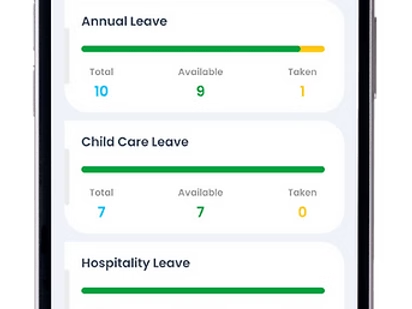
As a business owner, you want to ensure continuity and avoid disruptions to your daily operations. How can you do this while still accommodating employees who need time off for cultural or religious celebrations? A cloud-based leave management system can help you achieve these goals. With this system, you can easily approve leave requests and monitor attendance or absences to support seamless operation and employee well-being. This feature is available in Adaptive Pay’s comprehensive HRMS. Unlike other HR software solutions, our powerful, all-in-one platform allows you to manage your business from a centralised platform accessible anytime, anywhere. With Adaptive Pay, it’s easier to oversee every critical human resource task — including leave management, payroll, and attendance and roster — to make your HR processes much more efficient.  How can a cloud-based HRMS help your business navigate Singapore public holidays?  Singapore’s multicultural landscape is shaped by its Chinese, Indian, and Malay populations, alongside a growing number of foreigners, creating a cosmopolitan society where each ethnic group preserves its unique lifestyle in harmony with others. This diversity enriches Singapore with a wide range of celebrations and holidays — from socio-cultural to athletic and religious events. Adaptive Pay simplifies the process for employees who wish to participate in these celebrations by streamlining leave requests and approvals. Through our leave management system — which is  accessible via app or browser — employees can submit leave requests and attach necessary documents. Managers receive instant notifications and can approve or deny requests on the go, with employees promptly informed of the decision. Approved leaves are automatically integrated into Adaptive Pay’s HRMS for payroll and attendance calculations. Employees can also view their remaining leave entitlements on our app, helping them plan ahead and ensuring they’re aware of their available leave entitlements.  Singapore public holidays to know Here are the annual public holidays in Singapore:  New Year’s Day (January 1) Lunar New Year (Chinese New Year, usually between the final week of January and early February) Good Friday Labour Day (May 1) Vesak Day (Full moon day of the fourth lunar month, usually in May) Hari Raya Puasa or Eid Ul Fitr (Usually in September or October) National Day (August 9th) Hari Raya Haji (Eid Al Adha or Feast of the Sacrifice, usually in November or December) Deepavali (Festival of Lights, usually in October or November) Christmas Day (December 25) Whether you’re a manager or business owner, keeping tabs on Singapore’s public holidays can help you anticipate when employees are likely to file a leave, so you can prepare and adjust workloads as necessary. Aside from providing a reliable leave management system, Adaptive Pay also includes a cloud-based time attendance system to support your rostering needs.  Let Adaptive Pay support your leave management, attendance, and rostering Our leave management system automatically integrates with our platform’s payroll and attendance modules to ensure the leaves are reflected in employee payslips. It can eliminate manual updating and simplify your workflow. With Adaptive Pay’s time and attendance module, you can remind employees about shift timings and changes in advance through the app. Additionally, you can use Adaptive Pay’s leave management system to create custom workflows to simplify leave filings and approval and arrange custom leave entitlements for various teams. Managers can control leaves according to employment type or department to prevent short staffing and configure leaves based on hours or days.  Making leave management a breeze  Try Adaptive Pay and experience how our leave management system can support your business during critical times. If you’re satisfied with our demo, be sure to buy our HRMS software solution as soon as you can for a chance to get 50% off the yearly subscription.

Singapore HR Updates

Demystifying Work Permit Requirements in Singapore’s Process Sector: A Comprehensive Guide

Compliance regulations in the process sector require specific steps beyond just completing safety courses and adhering to quotas. There are additional specific steps your business must take to ensure that you are hiring legally. An HRMS Singapore solution streamlines new hire onboarding and tracks payroll, attendance, rostering, and leave management to eliminate the guesswork.  Adaptive Pay can help you navigate these complexities. Our HRMS solution in Singapore will streamline your workflows and productivity by automating crucial HR processes, including tax filings and payroll processing. With our platform, you can focus on other important matters, such as fulfilling the work permit requirements to hire qualified migrant workers. This blog explores the work permit requirements in Singapore’s process sector, specifically focusing on Process Construction and Maintenance (PCM) services. In addition to the general guidelines, there are specific regulations for your business activity, the worker’s nationality, quotas, and mandatory safety training. Key Takeaways • Businesses hiring foreign workers for Singapore’s process sector must comply with MOM work permit requirements, quotas, levies, and industry-specific regulations.• Process Construction and Maintenance (PCM) contractors must meet additional eligibility requirements, including ASPRI-related requirements where applicable.• Employers should ensure workers meet nationality, age, skills, and safety training requirements before applying for a Work Permit.• HR software can help businesses manage employee records, payroll, attendance, and compliance more efficiently. What business activities fall under the process sector? The process sector encompasses factories that manufacture essential products like petroleum, petrochemicals, pharmaceuticals, and speciality chemicals. Production in these industries relies heavily on specialised machinery and equipment. Maintaining and building these production units (PCM works) requires a unique skill set that is handled by PCM contractors. These contractors collaborate with plant owners, engineering firms, and construction companies to ensure the safe and efficient construction and maintenance of these units.  What are the company requirements for PCM services? Your business must be a registered member of the Association of the Process Industry (ASPRI). To hire foreign PCM workers, you also need ASPRI endorsement as a PCM contractor and inclusion on the PCM Controlled List. Go to ASPRI’s website for more information on membership and registration.  What are the worker requirements and limitations in the process sector? Migrant workers with PCM work permits can only perform activities related to construction, equipment breakdown, and preventive maintenance. They’re not allowed to participate in plant operations like operating equipment, warehousing, or packing. Similarly, tasks like grass cutting, office cleaning, or waste disposal fall outside their permitted duties.  Who can you hire? Requirement Details Minimum Age 18 years old Eligible Source Countries Malaysia, PRC, NTS, NAS (subject to MOM rules) Maximum Employment Period Depends on nationality and skill level Maximum Working Age Up to 60 years old (subject to applicable rules)   What are the quotas and levies? Hiring migrant workers in Singapore follows a quota system called the dependency ratio ceiling. This means the number of foreign workers you can hire depends on the number of local employees earning a specific minimum salary (Local Qualifying Salary).   Additionally, there’s a government levy charged on top of the salary for each foreign worker. The levy amount varies based on the worker’s skill level (tier) and their source country. Confused by the regulations? Our HRMS software in Singapore simplifies the process by automating calculations related to quotas and levies specifically for the process sector.  What safety courses are required? All process sector workers are required to take these safety courses before they start working: OPSOC (Oil Petroleum Safety Orientation Course) CSOC (Construction Safety Orientation Course)  Keep your workers happy Use Adaptive Pay as your HRMS in Singapore to create a better workplace. Our all-in-one cloud-based HR solution will simplify how you manage your business for a fixed price every year without hidden costs. Request a demo today. Frequently Asked Questions 1. What is a Work Permit for Singapore’s process sector? A Work Permit allows eligible foreign workers to work in Singapore’s process sector, subject to the Ministry of Manpower’s requirements on employer eligibility, worker qualifications, quotas, and levies. 2. Which businesses can hire process sector Work Permit holders? Businesses involved in eligible process sector activities, including Process Construction and Maintenance (PCM) services, may hire Work Permit holders if they satisfy the applicable MOM and industry requirements. 3. Are there nationality restrictions? Yes. The process sector has approved source countries and regions from which employers can recruit eligible Work Permit holders, subject to current MOM regulations. 4. Are safety courses compulsory? Yes. Eligible workers are generally required to complete the mandatory safety courses applicable to their job role before starting work.  

Singapore HR Updates

Navigating the New Norm: Key Changes to Construction Sector Requirements from January 2024

Are you employing migrant workers in your construction company? If so, you must meet specific requirements for their source region, country, levy, and quota. You also need to stay up-to-date with the Ministry of Manpower’s requirements to ensure compliance. Having an HRMS like Adaptive Pay can help simplify how you manage your new and existing employees. Our all-in-one HR software in Singapore will keep you productive and streamline your operations as it lets you work anytime, anywhere. In this blog, we will share some key changes to requirements in the construction sector for hiring migrant workers. You’ll also learn how our comprehensive HRMS platform can help you stay compliant with these new norms. Who’s eligible? You’re only allowed to hire migrant workers who can satisfy the conditions for (1) source regions or countries, (2) maximum period of employment, and (3) age when applying. Here are the basics to take note of. Source regions or countries You can hire migrant workers from: People’s Republic of China Malaysia Non-traditional sources or NTS (India, Myanmar, Philippines, Thailand, Sri Lanka, and Bangladesh) North Asian sources or NSA: Macau, Taiwan, South Korea, Hong Kong Age when applying All non-domestic migrant workers must be at least 18 years old when applying. For work permits, Malaysian workers must be under 58 years old, and non-Malaysian workers must be under 50 years.  Maximum employment period In the construction sector, the maximum employment period for Work Permit holders varies by nationality and skill level: Basic Skilled Workers (R2) from North & South Asia (NTS) and People’s Republic of China (PRC): 14 years Higher-Skilled Workers (R1) or Upgraded Workers from NTS and PRC: 26 years Workers from Non-Traditional Source Countries (NAS) and Malaysia: No maximum period Important Note: Regardless of nationality or skill level, all workers in Singapore can only be employed up to the age of 60. Quota and levy If your company has project contracts or tenders called on or before February 18, 2022, you can use the MYE (man-year entitlement) quotas to hire workers from North & South Asia (NTS) or the People’s Republic of China (PRC). This allows you to employ these workers until December 31, 2024, or the project’s completion date, whichever comes first. If your contracts were tendered or awarded after February 18, 2022, you don’t need prior approvals (PAs) or MYEs to hire PRC or NTS workers. You can hire them directly as long as it falls within your allocated quota. All Work Permit holders are subject to a levy, which is a fee paid to the government. The quota for construction companies is based on a dependency ratio. This means you can employ a certain number of Work Permit holders (typically 5) for every local employee earning a minimum salary (local qualifying salary). The levy rate as of January 1, 2024 is: $500 (Monthly) and $16.44 (Daily) for NTS (Higher-Skilled) $900 or $29.59 for NTS (Basic-skilled) $300 or $9.87 for Malaysia, PRC, NAS (Higher-Skilled) $700 or $23.02 for Malaysia, PRC, NAS (Basic-Skilled) $250 or 8.22 for Off-site construction (Higher-skilled) $370 or $12.17 for Off-site construction (Basic-skilled) If your company has project contracts with the tender called or awarded on or before February 18, 2022, you can apply awarded MYE quotes to employ NTS workers at reduced levy rates: $300 (Monthly) or $9.87 (Daily) for NTS – Higher-skilled (Up to December 31, 2024, or project completion date, whichever comes first) $400 (Monthly) or $16.44 (Daily) for NTS – Higher-skilled (From the project completion date or January 1, 2025, whichever is earlier) $700 (Monthly) or $23.02 (Daily) for NTS – Basic-skilled (From Project Completion Date or up to December 31, 2024, whichever is earlier) $900 (Monthly) or $29.59 (Daily) for NTS – Basic-skilled (From January 1, 2025, or project completion date, whichever comes first). Remember: This is a simplified overview, and specific regulations may change. It’s recommended to consult the Ministry of Manpower (MOM) website for the latest details. Calculating these rates will be easier when you have Adaptive Pay as your HRMS. Our HR software in Singapore is up-to-date with the MOM’s latest requirements for the construction sector in 2024 to ensure your compliance every time. Try our HRMS today and see why it’s the best HR software in Singapore. 

Singapore HR Updates

Navigating Adoption Leave: A Guide to Singapore’s Employment Practices and the Support Available for Growing Families

Approximately 400 adoption applications are filed annually in Singapore. Adoption leave plays a crucial role in this process, offering numerous benefits for both employees and employers. For employees, this leave is essential for bonding with the new child, reducing stress, and improving overall health. For employers, providing adoption leave enhances job satisfaction, aids in employee retention, and fosters a positive public image. Implementing an effective leave management system and utilising a leave app can significantly streamline this process. What are the rules on adoption leave in Singapore? Eligible adoptive mothers—including the self-employed, are entitled to 12 weeks of paid adoption leave. This leave is crucial for bonding and caring for the adopted infants. To qualify for adoption leave, the applicant must meet several criteria: The adopted child must be under 12 months old at the time of formal intent to adopt. Note that this intent is formalised differently for local and foreign children: Through a court application for local children and upon in-principle approval for a Dependant’s Pass for foreign children. The child should be a Singapore citizen, or in cases where the child is foreign, one of the adoptive parents must be a Singapore citizen, and the child needs to acquire Singapore citizenship within six months following the adoption. The adoptive mother must have been employed or self-employed continuously for at least three months prior to the formal intent to adopt. The Adoption Order needs to be finalised within one year of declaring the formal intent to adopt. Entitlement details For formal intents to adopt on or after July 1, 2017, mothers are entitled to 12 weeks of leave, with a cap of $10,000 per every 4-week leave, including CPF contributions. If the intent was before this date, the entitlement is 4 weeks, capped at the same amount. Leave can commence from the formal intent to adopt and must be consumed before the child’s first birthday. The employer pays the usual salary during the leave, which is then reimbursed by the government according to the number of births. Leave arrangements Adoption leave can be taken in different arrangements: By default, without mutual agreement, it is taken continuously from the date of formal intent to adopt. With mutual agreement, flexibility is allowed for the adoption leave. The initial 8 weeks should be taken continuously, commencing between the formal intent to adopt and the grant date of the Adoption Order. The remaining 4 weeks can be utilised flexibly but must be taken before the child’s first birthday. Employers and employees can benefit greatly from an e-leave system to manage these arrangements. How to manage adoption leave in your company. Adoption leave is a vital provision that supports families during the critical period of adopting a child in Singapore. Employers play a key role in this by offering and managing leave effectively. Implementing a leave app and a leave management system is instrumental in managing adoption leave and other leave types. These systems: Provide an organised e-leave platform for leave requests and approvals, ensuring clarity and ease of access Allow for real-time tracking and management of leave balances, essential for planning and resource allocation Facilitate compliance with employment laws and regulations related to leave. Enhance communication between employees and management, leading to better understanding and coordination. For companies looking to manage adoption leave effectively, Adaptive Pay’s leave management system and leave app can provide a streamlined solution. These tools help in efficiently organising and tracking leave, ensuring compliance with regulations, and simplifying the process for both employers and employees. Adaptive Pay’s leave management system not only simplifies the management of adoption leave but also bolsters the overall leave policy framework of an organisation, contributing to a supportive and family-friendly workplace culture.