🇸🇬 2026 National Day Offer : 1-year free subscription!!!! Offer Valid only until: August 31 2026

Terms and conditions apply*

Payroll & Compliance

Get practical guidance on payroll and compliance in Singapore, including CPF, tax, payslips, overtime, payroll laws and statutory requirements.

Payroll & Compliance

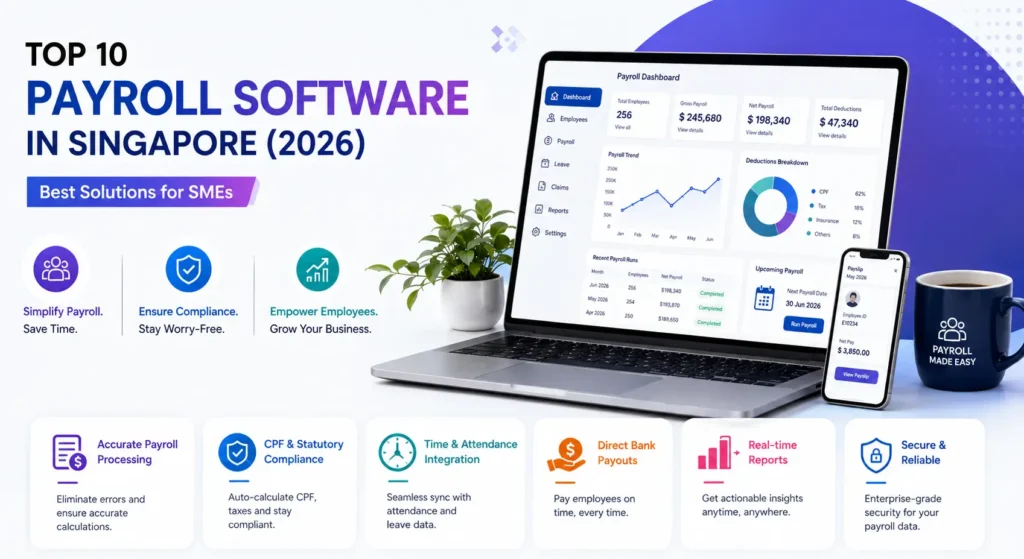
Top 10 Payroll Software in Singapore (2026): Best Solutions for SMEs

Top 10 Payroll Software in Singapore (2026): Best Solutions for SMEs Payroll used to be a weekend job with a spreadsheet. Not anymore — CPF tiers shift by age, and IRAS deadlines don’t care how busy your month was.One missed deduction and an entire payroll run is off, usually caught only when an employee flags a shortfall in their pay. Payroll software fixes this by automating CPF, SDL and tax calculations, pulling attendance and leave data straight into each run.Below, we compare the top payroll software Singapore SMEs are using in 2026 — what each one actually does, not just what its marketing says. Why Businesses Need Payroll Software CPF contribution rates vary by age band and wage ceiling, and getting them wrong — even slightly — can mean compliance issues or an unhappy employee asking questions HR can’t easily answer. Payroll automation removes the manual re-entry that causes most of these mistakes. When attendance management, a leave management system and payroll all sit in one place, a day of unpaid leave or an approved overtime claim reflects in the next pay run without anyone doing the math by hand. It also changes the employee experience. Digital payslips and employee self-service mean staff aren’t emailing HR to check their own pay history. And as a company scales from ten employees to a hundred, payroll software absorbs that complexity instead of multiplying admin work alongside it. Top 10 Payroll Software in Singapore 1. Adaptive Pay Adaptive Pay is a Singapore-built payroll and HR platform designed around how local SMEs actually run, rather than adapted from a global system. Its payroll engine computes CPF, SDL and IRAS-related deductions automatically, and pulls directly from attendance, leave and claims data, so pay runs reflect real workforce activity without manual cross-checking. It’s fully compliant with IRAS, MOM and CPF requirements, and is a pre-approved solution under IMDA’s SMEs Go Digital programme, so eligible businesses can claim up to 50% funding through the Productivity Solutions Grant. What makes it stand out is configurability. Businesses with non-standard shift patterns or claims policies can adjust the system to fit their actual operations, rather than working around fixed settings. It integrates with Xero, QuickBooks and NetSuite, and pricing is a fixed subscription with no hidden annual increases — backed by hands-on local implementation support from day one. 2. Talenox Talenox is a Singapore-founded HRIS built around a payroll engine that automates CPF and SDL calculations and supports IR8A filing. It extends beyond payroll into broader HR functions such as leave management, expense claims and employee records, and offers coverage across Singapore, Malaysia and Hong Kong for businesses with a regional footprint. Talenox may suit SMEs that want a straightforward payroll system with basic HR functionality bundled in, particularly those with some presence outside Singapore. Businesses with more complex shift-based attendance requirements, or those needing deeper integrations, may want to check Talenox’s current module and integration offering against their specific needs before committing. 3. HReasily HReasily is a Singapore-based payroll and HR platform that handles CPF, SDL and IRAS-related compliance alongside a modular set of HR tools, including facial-recognition attendance tracking. Its pricing structure is modular, allowing businesses to select payroll and HR modules separately, and the platform has a presence across several Southeast Asian markets. HReasily may suit SMEs that want attendance tracking closely tied to payroll, or businesses that prefer to add HR modules incrementally rather than adopting a full suite upfront. Businesses should confirm which modules are included at their intended pricing tier, since functionality can vary by plan. 4. JustLogin JustLogin is a Singapore payroll and HR platform that has operated in the market for over two decades. Payroll is offered as one of several modules — including leave, claims and attendance — that businesses can subscribe to individually rather than as a single bundled suite. JustLogin holds Category A IRAS Auto-Inclusion Scheme (AIS) approval for payroll filing. This modular approach may suit SMEs that want to start with payroll alone and add HR modules later, or businesses that prefer not to pay for functionality they don’t yet need. Businesses evaluating JustLogin should map out which modules they require now and later, since costs scale with the modules selected. 5. PayrollServe PayrollServe, part of the Stone Forest group, has provided payroll and HR services in Singapore for decades, built on its proprietary Payday! HRMS platform. It combines payroll processing with CPF, SDL and IRAS-related compliance, and is positioned for businesses that want payroll handled with a degree of managed support alongside the software itself. PayrollServe may suit SMEs and larger businesses that prefer a payroll provider with a long operating history and a managed-service element, rather than a purely self-serve platform. Businesses should clarify what is software-driven versus service-driven in PayrollServe’s offering, since this affects both cost and day-to-day involvement. 6. Darwinbox Darwinbox is a mobile-first HCM (human capital management) platform that includes payroll as one module within a broader suite covering recruitment, performance management and people analytics. It is generally positioned for larger or fast-growing organisations that need HR functionality beyond payroll and leave, and offers native Singapore payroll alongside coverage in several other markets. Darwinbox may suit businesses that are scaling quickly and want a single HCM system to grow into, rather than a payroll-first tool. Smaller SMEs with simpler payroll and HR needs may find the platform’s broader scope more than what they currently require, and should weigh implementation effort against the modules they’ll actually use. 7. Employment Hero Employment Hero combines payroll, core HR and employee benefits within one platform, with CPF compliance for Singapore payroll and integration with accounting software including Xero. It is positioned as an all-in-one HR and payroll system rather than a payroll-only tool. Employment Hero may suit SMEs that want payroll, HR and benefits administration in a single system rather than separate tools. Businesses focused primarily on payroll, without a near-term need for the broader HR and benefits functionality, should assess whether the full platform matches

Singapore Tax Compliance for HR: IRAS & AIS Guide
Payroll & Compliance

Singapore Tax Compliance For HR: IRAS & AIS Guide

HR teams in Singapore are no longer handling only hiring and performance reviews. They are also under increasing pressure to manage tax reporting under the IRAS Auto-Inclusion Scheme (AIS). What used to be a once-a-year task has evolved into a year-round responsibility that requires accurate payroll records, CPF tracking, and seamless employee data management. As IRAS continues to digitise tax processes and tighten compliance enforcement, many businesses find that the traditional spreadsheets and manual systems they have used for many years simply can’t keep up. That’s why successful companies are migrating to HRMS in Singapore (human resource management system — a software suite for coordinating and executing key HR functions, from recruitment to payroll). By centralising payroll and automating statutory filings, these comprehensive solutions keep your HR operations aligned with AIS requirements. Understanding HRMS in Singapore and IRAS In Singapore, tax compliance falls heavily on HR — and your HRMS directly affects how well you meet IRAS requirements. If you’re still managing your payroll manually or if your employee data and pay records are spread across disconnected and outdated tools, you are effectively increasing your risk of reporting errors, late submissions, and non-compliance. Here’s how poor payroll processes can put your business at risk: Compliance area What can go wrong Regulatory consequences How HRMS in Singapore can help Taxable and non-taxable income Misclassifying allowances, benefits-in-kind, or compensation components Leads to inaccurate tax reporting, which may trigger audits or penalties from IRAS Standardises pay element categorisation and applies consistent tax treatment across employee records CPF contributions Errors in calculating Mandatory or Voluntary CPF contributions Affects taxable income declarations and may result in discrepancies between CPF and IRAS filings Automates CPF calculations based on employee age, citizenship, and wage components using the latest statutory rules Tax clearance (Form IR21) Incomplete or outdated payroll data submitted in the IR21 form Can delay the final payout for foreign employees and breach IRAS tax clearance requirements Pulls real-time data into IR21 forms to ensure accurate final tax computations before employment termination In short, an effective IRAS-compliant HRMS in Singapore is a risk mitigation strategy. It supports tax reporting by: Generating employee income data in the correct formats for submission Maintaining a clear audit trail for allowances, bonuses, and benefits-in-kind Ensuring that all benefits are properly classified and reported This level of integration ultimately simplifies your year-end reporting while also helping your HR team stay compliant throughout the year. ⚠ Quick recap Who needs to comply with AIS? Mandatory for: Employers with 5+ employees or those who’ve received a Notice to File from IRAS What you must report: Salaries, bonuses, commissions, directors’ fees, and benefits-in-kind Under the AIS, employers must submit employee income information electronically through IRAS’ myTax Portal. To do this, you’ll need to generate IR8A forms (and Appendix 8A/8B or IR8S if applicable), validate them using IRAS’ validation tool, and upload them by the March 1st deadline. An IRAS-compliant HRMS in Singapore can simplify all of the above, turning your payroll data into AIS-ready formats without you having to manually map income components or calculate statutory deductions. HRMS vs. manual workflow Manual processes may get the job done, but at what cost? Let’s compare. Process Manual workflow With HRMS in Singapore Data collection Multiple spreadsheets and manual updates Centralised, real-time data tracking CPF and benefits tracking Prone to errors, must be updated manually Auto-updated with current rules IR8A / IR21 preparation Manual compilation and formatting Auto-generated and IRAS-compliant Submission validation Requires external IRAS validation tools Built-in format checks and field requirements Audit trail Scattered or incomplete Automatically recorded and accessible Try Adaptive Pay’s HRMS in Singapore Do you need help integrating payroll, HR, and submission workflows so you stay IRAS and AIS-compliant? Schedule a demo today with Adaptive Pay. Call them at +65-6708-9398.

Small Business Owner’s Guide to Payroll Software in Singapore
Payroll & Compliance

Small Business Owner’s Guide to Payroll Software in Singapore

Paying employees accurately and on time is a legal obligation under the Employment Act. More than that, timely wage disbursements can improve employee morale and reduce potential disputes while preventing penalties from the Ministry of Manpower. Using the right payroll software for your small business in Singapore can streamline your statutory submissions and payroll administration so that you maintain compliance and operational efficiency in 2025. What payroll software does Payroll software solutions are engineered to simplify how you manage employee salaries and deductions. It automates calculations and ensures that your business follows local payroll rules. Using a software solution removes the need for manual spreadsheets or handwritten ledgers, which reduces mistakes and frees up time for your HR and finance teams. There are several systems available in Singapore — but choosing one that fits your business needs starts with understanding what these tools actually offer. How payroll software helps small businesses An integrated payroll software for a small business in Singapore creates a central database for all your employees’ salary details. This means once you’ve entered essential information (such as names and tax components), you won’t need to manually repeat those steps every month. What’s the best payroll software for small businesses in Singapore? There’s no shortage of payroll solutions on the market, but if you want something reliable and built for businesses in Singapore, Adaptive Pay ticks all the right boxes. It simplifies everything from payroll calculations to tax filing and connects smoothly with other tools in your HR workflow. Let’s break down what makes it a smart choice for small businesses in 2025. Pull data automatically from leave and attendance With Adaptive Pay, you don’t have to switch between systems to get the information you need. The software automatically draws data from related modules like Attendance and Leave. It can even prorate salaries and allowances based on actual working days to give you precise calculations without extra admin work. Skip the manual math with automatic calculations Our payroll software for your small business in Singapore is always up to date with local tax policies and formats. As an IRAS-listed vendor, Adaptive Pay ensures that your payroll calculations are accurate in 2025, and it will be regularly updated so that you stay compliant even when regulations change in the future. Submit AIS with just one click Need to submit your Annual Income Statements? Adaptive Pay makes it easy. As an approved vendor by IRAS, it allows for fast and simple AIS submission — no extra forms, no extra stress. Customise the system to match your payroll process Every business is different, and Adaptive Pay lets you fine-tune your payroll setup to match your internal structure. Whether you need to set different pay groups or assign custom salary components, it’s all configurable. You can also manage multiple payroll runs according to your schedule. Simplify bank transfers Our payroll software for a small business in Singapore connects directly with major local banks, so you can quickly generate and upload payment files. If you use more than one bank account for payroll, Adaptive Pay can handle that too — helping you manage payouts without delays. Easily integrate with your existing apps You can sync Adaptive Pay with popular accounting tools like QuickBooks and Xero, or connect directly to MOM systems via API for submissions like OED. This keeps everything in one ecosystem and reduces duplicate entries or data mismatches. Access payroll info anytime, anywhere Your employees can access payslips on the web or mobile app — no waiting for HR to send documents. They’ll get notified when payslips are ready and can download them directly. You can also set it up to send payslips via email for extra convenience. Automate tax filing tasks Preparing forms manually each tax season takes time and invites mistakes. Adaptive Pay takes care of it for you by generating IR8A and Appendix A documents automatically. Get started If you want a reliable, easy-to-use payroll system that fits your small business in Singapore, Adaptive Pay is worth exploring. Request a demo today or reach out to speak with one of our experts. Bonus for SMEs: Adaptive Pay is a pre-approved payroll software for small businesses in Singapore under the IMDA SMEs Go Digital programme. That means your business may be eligible for up to 50% funding support through the Productivity Solutions Grant (PSG).

Understanding Payroll Laws in Singapore in 2025
Payroll & Compliance

Understanding Payroll Laws in Singapore in 2025

More than logging hours and sending out paychecks, handling payroll in Singapore is really about meeting statutory requirements and avoiding compliance risks. This can get complicated fast, so small teams often find themselves buried in CPF contributions, regulatory updates, and detailed calculations. And as employment laws shift, staying accurate and compliant takes more time — and more attention — than most businesses expect. How do you keep up without falling behind? To help your business get started, we’ve put together a practical guide that outlines the key rules of payroll processing in Singapore — and how the best software for payroll can make the process more efficient and compliant. Key Takeaways • Payroll compliance in Singapore involves more than salary payments—it includes CPF contributions, overtime, statutory record keeping, and timely salary payments.• Employers must follow the Employment Act when processing payroll and maintaining employment records.• Understanding payroll regulations helps businesses reduce compliance risks and payroll errors.• Payroll software can automate calculations, maintain records, and simplify compliance with Singapore employment regulations. What “payroll” mean for companies in Singapore In Singapore, payroll refers to the system used to compensate employees for their work. It covers everything from basic wages and overtime to allowances and bonuses. On top of that, employers must also manage statutory contributions like the Central Provident Fund (CPF) and other legally required payments. Following Singapore’s employment regulations is not optional. Employers need to maintain proper records and ensure payments are made on time to avoid penalties and maintain staff trust. The best software for payroll can help with that. Salary structure and legal definitions What qualifies as a salary? Singaporean employment law treats “salary” and “wage” as interchangeable. A salary refers to the compensation employees receive under their contract of service. It is the payment agreed upon for the work they perform. What’s included in a salary? A typical salary package may include: What is NOT considered salary? The following items are excluded from the legal definition of salary: These are viewed as additional benefits rather than part of the core pay structure. Payroll compliance essentials for employers Managing payroll demands greater precision as an organisation grows, making it more necessary to use the best software for payroll. Singapore’s labour regulations require companies to pay attention to several key factors: Smart payroll systems like Adaptive Pay can simplify these tasks by automating calculations and maintaining compliance records, so your HR team can focus on strategic initiatives rather than manual tracking. Salary payment frequency in Singapore Under the Employment Act, employers must pay their employees at least once a month, and no later than seven days after the end of the salary period. While monthly payments are the minimum standard, employers may pay more frequently, such as every two weeks, if it fits their business operations. Overtime wages must be paid within 14 days after the close of the salary period. Special rules apply when an employee leaves the company: If the employee resigns with proper notice, the final salary should be paid on the last day of work. In cases of dismissal due to misconduct or sudden contract termination, the final salary must be paid on the last day of employment, or within three working days if same-day payment isn’t possible. Payment is due within seven days from the last working day if the employee resigns without serving the notice period. No national minimum wage—but progressive wage models exist Singapore does not enforce a national minimum wage across all sectors. Instead, wages are typically decided through direct agreements between employers and employees, or through union negotiations where applicable. That said, certain sectors—including cleaning and security—are covered by Progressive Wage Models. These frameworks set minimum wage levels and link pay increases to skills and productivity, offering a structured path for wage growth in specific industries. Understanding overtime pay Employees who work beyond their contractual hours are generally entitled to overtime compensation, depending on their role and salary level. Eligibility for overtime pay includes: Overtime pay is usually calculated at 1.5 times the employee’s hourly basic rate, applying to each hour worked beyond normal contractual hours, excluding rest breaks. Employers can use the Ministry of Manpower’s Overtime Calculator to determine the accurate payout. Keep accurate records Since April 1, 2016, all employers covered under the Employment Act must keep proper records of employment and salary details. These records increase legal compliance and provide transparency in compensation practices. You can simplify that requirement with the best software for payroll. Tools like Adaptive Pay make it easier to stay organised and compliant by automating record-keeping alongside payroll processing. Simplify your payroll with Adaptive Pay The best software for payroll takes the hassle out of routine HR tasks—from calculating salaries to managing tax submissions. Platforms like Adaptive Pay go a step further by integrating payroll with attendance and leave management—all within a single system. Request a demo to see Adaptive Pay in action or chat with one of our experts to learn how our all-in-one cloud HRMS can make payroll simpler and more compliant for your business. Frequently Asked Questions 1. What payroll laws should employers follow in Singapore? Employers should comply with the Employment Act and other applicable statutory requirements, including salary payments, CPF contributions, overtime rules, employment records, and payslip obligations. 2. How often must employees be paid? Under the Employment Act, employees must generally be paid at least once a month, within the required salary payment period. 3. Is CPF mandatory for all employees? CPF contributions are generally mandatory for eligible employees based on CPF regulations. Employers should determine contribution requirements according to the employee’s eligibility and applicable CPF rules. 4. Are employers required to issue payslips? Yes. Employers covered by the Employment Act are generally required to provide itemised payslips to employees.

Avoid These Payroll Mistakes That Could Cost Your Business
Payroll & Compliance

Avoid These Payroll Mistakes That Could Cost Your Business

Payroll errors create back-office headaches — but worse than that, they lead to compliance violations and legal trouble. You may even lose the trust of employees and damage how clients and the public perceive your business. Such mistakes often stem from manual processes and outdated systems that make record-keeping inconsistent and prone to human errors. HRMS payroll software can prevent these problems before they start. Here are six common payroll mistakes — and how the right software can help you avoid them. 1. Miscalculating CPF contributions Singapore’s CPF system requires accurate employer and employee contributions based on variables such as the employee’s age, salary, and residency. Manual calculations can easily go wrong, especially if your workforce is growing and becoming more diverse. Mistakes in CPF account allocations or missed deadlines for payment can result in penalties. HRMS payroll software can automatically apply the correct rates, allocate contributions to the proper CPF accounts, and generate submission files in the approved format to solve this issue. It also updates regularly to reflect new CPF policies so that you can stay compliant without extra admin. 2. Errors in income tax deductions Incorrect income tax deductions often come from using outdated IRAS rates, or misinterpreting tax reliefs, as well as failing to factor in variable pay elements like bonuses or benefits-in-kind. These mistakes can lead to underpayment or overpayment of taxes — both of which create problems for employers and staff. Payroll software uses current IRAS tax rates and brackets to calculate the correct deductions automatically. It factors in employee-specific reliefs and taxable components to ensure accuracy from the start. 3. Poor payroll record-keeping Missing or incomplete records can get you in trouble during audits or inspections. Failing to track working hours, overtime, leave, or CPF and tax contributions also makes it hard to verify payroll accuracy or defend against disputes. HRMS payroll software makes it so much easier to keep a secure digital archive of every payroll transaction. The system logs all changes with audit trails and maintains records for the legally required period so that you’re always prepared. 4. Misclassifying employees Getting an employee’s classification wrong (full-time, part-time, or contract ) may result in serious issues: underpaying CPF, misapplying benefits, or violating employment laws under the Singapore Employment Act. Payroll software allows you to classify employees clearly from the start. Once assigned, the system automatically applies the correct rules for CPF, leave, and other entitlements to remove guesswork and help you avoid compliance mistakes. 5. Incorrect overtime pay Singapore’s Employment Act requires specific rates and limits for overtime pay. Manual missteps — like using the wrong base rate or missing eligible allowances — can lead you to accidentally underpay staff, which creates both financial and legal risk. When paired with a time-tracking system, HRMS payroll software calculates overtime accurately using real-time attendance data and correct hourly rates. It also includes allowances where required by law, so you meet every regulation. 6. Late salary payments Delays in payroll processing can cause financial strain for employees who rely on their salaries, ultimately eroding morale. Salaries must be paid promptly after each pay cycle under the Employment Act. Payroll software can automate your salary disbursements according to set schedules and integrate with bank systems to process payments on time. This can go a long way in reducing the risk of delays and giving employees confidence in your processes. Fix payroll issues with the right solution Each of these mistakes can cost your business both financially and reputationally. The good news? You can avoid them all with the right tools. Adaptive Pay’s HRMS payroll software gives you everything you need: automated calculations, compliance updates, audit-ready records, and seamless bank integrations. Book a demo to see how HRMS payroll software from Adaptive Pay can support your team.

Payroll & Compliance

The Future of Payroll Management: How Payroll Software is Transforming the Workplace

Payroll is one of the critical functions in every business. Your company’s payroll system ensures timely and accurate salaries, benefits, compensation, and bonuses while accounting for other deductions, like taxes. Although it has not always been the focus of innovation, the introduction of cloud payroll software is proof that systems are changing to keep up with newer technologies and work patterns. Ultimately, the goal is to transform payroll processing to make it more seamless, less time-consuming, cost-effective, and precise. Keeping up with the newest payroll trends can empower your HR team to free up precious time and resources to focus on other important tasks, like fulfilling company objectives and strategising. Cloud-based payroll systems can streamline your payroll process with solutions like automation and integrate with other HR processes like attendance, claims management, leave management, and appraisals. How payroll software can improve your workplace Cloud payroll software can make your business future-proof, especially in today’s world, where remote and flexible work conditions are highly appreciated. One of the perks of cloud-based platforms is they are accessible from any device, allowing your HR team to work anytime and anywhere. Some solutions even come with a mobile app for more flexibility. Plus, the app allows employees to view digital payslips, review and dispute discrepancies, or file leaves. All the beneficial features for payroll management Cloud-based payroll software has all the features to help your HR team work more efficiently and save time. Compile data from attendance, leave, and others: The software integrates workflows and automatically performs calculations according to employee records from other modules, such as claims. This way, you can easily prorate allowances and salaries. Automatically calculate SDL, CPF, and Fund: Cloud-based payroll solutions are constantly updated to keep you aligned with evolving taxation formats, policies, and rates. Automated IR8A and tax filings: Cloud payroll software takes the guesswork from manual income tax filing by automatically generating all relevant files and forms. Customisable: The software is customisable to match your payroll processes, especially when there are specific components like deductions, basic salary, and allowances, or you want multiple payroll schedules. Pay with ease: Link the software to Singapore banks to simplify payouts and manage bank transfers quickly. Integration with third-party apps: Modern cloud-based payroll platforms will match your setup and workflows by allowing third-party integrations for other apps, like Quickbooks and Xero. Discover the future of payroll management today Adaptive Pay is the only cloud payroll software you need to transform your workplace and make your business more effective at payroll management. With Adaptive Pay, You might be eligible for government grants when you go digital with your payroll. Learn more about our software by requesting a demo here.