SFEC Support Ends 30 Nov 2026. Get 1-Year FREE AdaptivePay Subscription. (T&C Apply)
SFEC Support Ends 30 Nov 2026. Get 1-Year FREE AdaptivePay Subscription. (T&C Apply)
Getting overtime right is one of the trickiest parts of payroll for SMEs in Singapore — get it wrong, and you’re looking at disputes with employees, compliance risks with Ministry of Manpower, and sometimes penalties that could’ve easily been avoided. Once you understand what Ministry of Manpower actually requires, though, it’s a lot more straightforward than it seems, and it goes a long way in keeping your team paid fairly and your payroll running smoothly. This guide breaks down Singapore’s overtime rules in plain language, walks through real examples, and shows how SMEs can make the whole process simpler to manage.
Ministry of Manpower (MOM) defines overtime as any work an employee does beyond their normal contractual working hours — meal breaks and rest breaks don’t count toward this. Whether an employee is entitled to overtime pay depends on whether they’re covered under Part IV of the Employment Act. For employees who are covered, employers are required to pay at least 1.5 times the employee’s hourly basic rate for every hour of overtime worked. This payment can’t be delayed — it needs to reach the employee within 14 days of the end of the salary period it relates to.
Not every employee in Singapore qualifies for statutory overtime.Employees covered under Part IV of the Employment Act include:
Example: Administrative Executive Sarah works as an administrative assistant and earns a monthly basic salary of $2,400.
Eligible for overtime pay because her salary falls within the non-workman threshold.
Example: Operations Manager
James earns $4,800 monthly and performs managerial duties.
Generally not eligible for statutory overtime under Part IV. His employment terms will be governed by his employment contract.
MOM specifies that contractual working hours generally cannot exceed:
Work Schedule | Maximum Contractual Hours |
5 days or fewer per week | Up to 9 hours per day or 44 hours per week |
More than 5 days per week | Up to 8 hours per day or 44 hours per week |
For alternative work arrangements, different averaging rules may apply.
Example: When Does Overtime Start?
Scenario
An employee works: 8 hours per day, Monday to Friday,Total contractual hours: 40 per week, One day, the employee works until 8 PM instead of 6 PM.
Result
Normal hours: 8, Additional hours worked: 2, Overtime claimable: 2 hours, Since the employee worked beyond contractual hours, the additional 2 hours are considered overtime.
Overtime Pay = Hourly Basic Rate of Pay × 1.5 × Overtime Hours Worked
For monthly-rated employees, the hourly basic rate is calculated using:
Hourly Basic Rate = (12 × Monthly Basic Salary) ÷ (52 × 44)
Example: Overtime Pay Calculation
Employee Details
Formula:
Hourly Basic Rate = (12 × Monthly Basic Salary) ÷ (52 × 44)
Calculation:
= (12 × S$2,400) ÷ (52 × 44)
= S$12.59 per hour
Formula:
Overtime Pay = Hourly Basic Rate × 1.5 × Overtime Hours Worked
Calculation:
= S$12.59 × 1.5 × 10
= S$188.85
Monthly Basic Salary: S$2,400
Overtime Hours Worked: 10 hours
Hourly Basic Rate: S$12.59
Total Overtime Pay: S$188.85
The employee should receive S$188.85 in overtime pay for 10 hours of overtime work, based on the Ministry of Manpower (MOM) overtime calculation formula.
Note: Overtime pay is calculated using the employee’s basic salary only. Allowances, bonuses, commissions, incentives, and other variable payments are generally not included when calculating the hourly basic rate.
Getting overtime right is one of the trickiest parts of payroll for SMEs in Singapore — get it wrong, and you’re looking at disputes with employees, compliance risks with Ministry of Manpower, and sometimes penalties that could’ve easily been avoided. Once you understand what Ministry of Manpower actually requires, though, it’s a lot more straightforward than it seems, and it goes a long way in keeping your team paid fairly and your payroll running smoothly. This guide breaks down Singapore’s overtime rules in plain language, walks through real examples, and shows how SMEs can make the whole process simpler to manage.
For eligible non-workmen, overtime calculations are capped at a salary level of $2,600, equivalent to an hourly overtime calculation cap of $13.60 per hour.
Example
An employee earns $2,600 monthly and works 2 overtime hours.
Calculation:
1 $13.60 × 1.5 × 2
2 = $40.80
This is the example provided by MOM.
Employers should monitor overtime carefully.MOM limits eligible employees to:
Example: Retail SME During Peak Season
A retail business experiences high sales during year-end promotions.
Without an approved exemption, the employer risks exceeding the statutory monthly OT limit. SMEs should monitor overtime proactively to avoid compliance issues.
Employees generally cannot work more than 12 hours per day. Exceptions may apply for emergencies, urgent machinery repairs, national security requirements, unforeseen interruptions, or approved overtime exemptions.
Example: Manufacturing Breakdown
A production machine unexpectedly fails and urgent repair work is needed to fulfil customer orders.The employer may require employees to work beyond normal hours due to unforeseen operational interruptions, subject to MOM requirements.
Employers must provide:
MOM differentiates between:
Work requested by the employer, Work requested by the employee
Hours worked beyond normal daily working hours.
Example: Employer Requests Work on a Rest Day
Employee’s normal workday: 8 hours Employee works: 6 hours on scheduled rest day, Since the work was requested by the employer and exceeds half the normal daily hours: Employee is entitled to 2 days’ salary.
Example: Work Beyond Normal Daily Hours on Rest Day
Employee works: 10 hours on a rest day, Normal workday is 8 hours
Result:
2 days’ salary for the rest day work
Additional overtime pay for the extra 2 hours beyond normal daily working hours.
1. Using Gross Salary Instead of Basic Salary
Overtime must be calculated using the employee’s basic salary, not gross salary including allowances and bonuses.
2. Forgetting OT Deadlines, OT payments must be paid within 14 days after the salary period ends.
3. Manual Spreadsheet Errors, Many SMEs still rely on spreadsheets, increasing the risk of: Formula errors, Incorrect OT multipliers Payroll discrepancies,
Compliance issues
4. Not Tracking Monthly OT Limits, Without automated tracking, businesses may unknowingly exceed the 72-hour monthly overtime limit
Maintain Accurate Time Records
Use digital attendance and time tracking systems to capture actual hours worked.
Automate Overtime Calculations
Automation reduces human error and ensures correct application of MOM formulas.
Monitor Compliance Proactively
Track:Overtime eligibility,OT limits,Rest day work,Payroll deadlines,
Conduct Regular Payroll Reviews
Review payroll reports monthly to identify anomalies before salary processing.
Understanding Singapore’s overtime regulations is essential for SMEs that want to remain compliant, maintain employee trust, and avoid payroll disputes. By accurately tracking working hours, applying the correct OT formulas, and ensuring timely payment, businesses can create a fair and transparent workplace while reducing administrative burdens.
Simplify Overtime and Payroll with Adaptive Pay
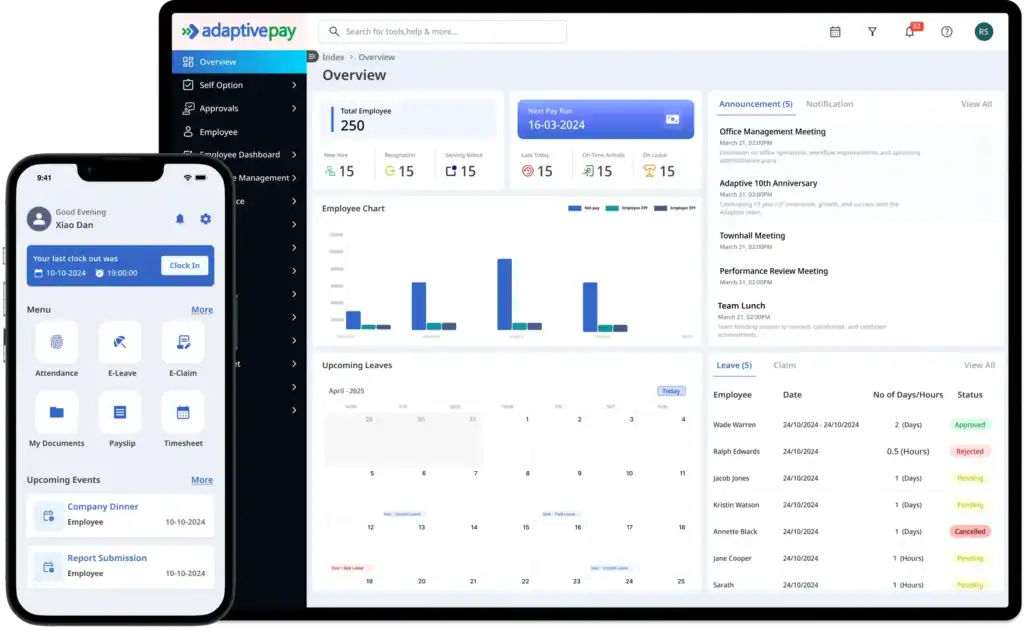
Calculating overtime manually can become complex as your workforce grows. Adaptive Pay helps Singapore SMEs accurately calculate overtime based on MOM guidelines, automate payroll processing, reduce compliance risks, and ensure employees are paid correctly and on time. With automated calculations, attendance integration, and streamlined payroll workflows, Adaptive Pay makes payroll management simple, accurate, and stress-free for growing businesses.
Manage HR, payroll, attendance, leave, and employee operations in one powerful HRMS platform to improve efficiency and simplify workforce management.
A smarter way to manage payroll, attendance, claims and appraisals – all in one seamless platform





Copyright © 2026 – Adaptive Cloud Systems Pte Ltd