September 9, 2026
PSG Support Ends 29 Sep 2026 ! | SFEC Support Ends 30 Nov 2026. Get 1-Year FREE AdaptivePay Subscription. (T&C Apply)
Attendance management challenges in Singapore can affect payroll accuracy, overtime tracking, shift planning, and employee records. Attendance sounds like it should be the simplest part of HR — people clock in, people clock out. In practice, it’s often where things quietly go wrong: a missed clock-out that turns into an overtime dispute, a shift swap that never made it into the roster, or a leave day that doesn’t match what payroll processed.
This article walks through the attendance management problems Singapore SMEs run into most often, why they matter more than they might seem, and what a properly configured attendance system can actually do about them.
These attendance management challenges in Singapore can become more difficult for SMEs when attendance records are maintained manually or across multiple systems. Connecting attendance, leave, and payroll data can reduce the need for repeated manual checks.
Attendance data isn’t just a record of who showed up — it’s the foundation for payroll accuracy, overtime compliance, and workforce planning. When attendance records are incomplete or inconsistent, the effects ripple outward:
A few recurring issues show up across SMEs, particularly those still relying on manual or semi-manual processes:
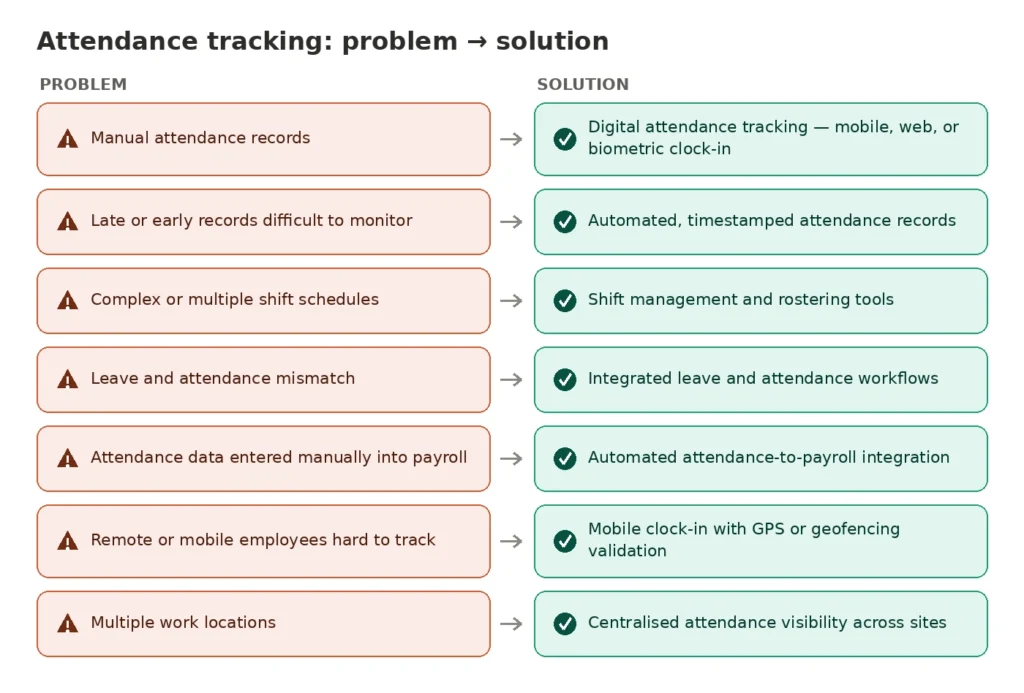
Manual attendance records. Paper timesheets or basic spreadsheets require someone to manually collect, transcribe, and reconcile data — a process that’s slow and prone to transcription errors, especially across a growing team.
Late arrivals and early departures. Tracking lateness or early leaving manually often means relying on a supervisor’s memory or a handwritten log, which makes consistent enforcement of company policy difficult.
Overtime tracking. Without a system that captures exact clock-in and clock-out times, calculating overtime accurately — and staying within MOM’s caps — becomes a manual, error-prone exercise, particularly when multiple shift patterns are in play.
Shift management. SMEs running multiple shifts, especially in retail, F&B, or logistics, often struggle to keep rosters updated and communicated when last-minute changes happen.
Leave and attendance mismatches. If leave applications are tracked in one system (or not tracked digitally at all) while attendance is recorded elsewhere, discrepancies are common — an employee marked present who was actually on approved leave, for example.
Remote or mobile employees. Field staff, delivery workers, or employees who don’t work from a fixed location are difficult to track with traditional time clocks, leaving gaps in attendance records.
Attendance data errors. Manual re-entry of attendance data into payroll systems introduces a category of error that wouldn’t exist if the data flowed automatically between systems.
Multiple locations. SMEs operating across several outlets or sites often lack centralised visibility into attendance, making it hard to get a single accurate picture of the whole workforce at once.
Payroll discrepancies. All of the above tend to surface at the same point: payroll. An employee questioning why their pay doesn’t match their hours worked is often the first sign that attendance data wasn’t accurate to begin with.
These attendance management challenges in Singapore can become more difficult for SMEs when attendance records are maintained manually or across multiple systems. Connecting attendance, leave, and payroll data can reduce the need for repeated manual checks.
Attendance and payroll are directly linked, which means an attendance problem rarely stays contained to attendance — it becomes a payroll problem too.
Consider a simple example: if a supervisor forgets to log an employee’s late clock-in on a paper sheet, that missing record either goes unnoticed (meaning no deduction is applied when one arguably should be) or gets caught weeks later during a payroll review, requiring a correction and possibly a difficult conversation with the employee. Multiply this across a growing team, and manual reconciliation between attendance sheets and payroll spreadsheets becomes a significant, recurring source of both errors and administrative time.
Overtime calculations compound this further. Since overtime pay must be calculated at 1.5 times the hourly basic rate and tracked against a monthly cap, inaccurate attendance data doesn’t just risk an incorrect payment — it risks a compliance issue if the actual hours worked exceeded MOM’s limits without anyone catching it in time.
Modern attendance management software addresses these issues by capturing accurate data at the source and letting it flow automatically into downstream processes, rather than relying on manual transcription at each step:
For SMEs, addressing attendance management challenges in Singapore often starts with replacing manual attendance processes with a connected digital system.
Not every system offers every feature — here’s what’s genuinely worth prioritising when evaluating options:
Attendance and payroll work best as a connected process rather than two separate systems that need manual reconciliation. When attendance data — clock-ins, overtime, leave — flows directly into payroll, several things improve at once: overtime is calculated using the actual recorded hours rather than an estimate, no-pay leave deductions reflect actual approved leave rather than requiring manual cross-checking, and payslips can be generated with confidence that the underlying data is accurate.
This connection also supports MOM’s itemised payslip requirements, since deductions and overtime pay need to be clearly itemised — which is much easier to do consistently when the source data is accurate and automatically fed through, rather than manually compiled each cycle.
A practical evaluation checklist for SMEs comparing options:
1.What’s the difference between attendance software and a time clock?
A basic time clock simply records when someone clocks in and out. Attendance software goes further — it stores that data digitally, applies rules (like overtime calculations or shift schedules), integrates with leave and payroll, and generates reports.
2.How does attendance software help with overtime compliance?
Attendance software captures accurate time-in/time-out data and applies configured overtime rules automatically, which makes it easier to track hours against MOM’s caps — the 44-hour work week, 12-hour daily limit, and 72-hour monthly overtime cap for covered employees. This doesn’t remove the employer’s responsibility to comply, but it reduces the manual tracking burden that often leads to accidental breaches.
3. Can attendance software track remote or field employees?
Yes, many systems support mobile clock-in with GPS or geofencing, allowing employees to log attendance from approved locations even if they’re not working from a fixed office. This is particularly useful for delivery staff, sales teams, or businesses with employees working across multiple client sites.
4.Does attendance data need to integrate with payroll?
It doesn’t strictly have to, but integration significantly reduces manual work and the errors that come with re-entering data between systems. If attendance and payroll are handled by separate, disconnected systems, someone still needs to reconcile the two manually each cycle.
Attendance management challenges in Singapore rarely stay isolated — a missed clock-in or an unreconciled leave day tends to surface later as a payroll discrepancy or a compliance question. Getting attendance right at the source, with accurate digital tracking that flows directly into payroll, removes a category of manual error before it has a chance to cause downstream problems.
For SMEs evaluating their options, Adaptive Pay’s attendance and roster software supports multiple clock-in modes — including mobile app, QR code, GPS with geofencing, and facial recognition — along with configurable shift and overtime rules that integrate directly with payroll and leave management within the broader Adaptive Pay HRMS. Whatever system you choose, the underlying goal is the same: attendance data that’s accurate enough to trust the moment it reaches payroll, rather than something that needs fixing after the fact.
Manage HR, payroll, attendance, leave, and employee operations in one powerful HRMS platform to improve efficiency and simplify workforce management.