SFEC Support Ends 30 Nov 2026. Get 1-Year FREE AdaptivePay Subscription. (T&C Apply)
SFEC Support Ends 30 Nov 2026. Get 1-Year FREE AdaptivePay Subscription. (T&C Apply)
An employee needs to check their payslip, apply for leave, update their mobile number, or submit a claim for a client dinner. In a lot of Singapore SMEs, each of these still goes through HR individually — an email here, a WhatsApp message there, maybe a printed form for the claim. HR ends up handling the same handful of requests over and over, for every employee, every month.
An Employee Self-Service Portal changes that by giving employees a place to handle these routine tasks themselves, without needing HR to step in each time. It sounds like a small shift, but for a growing company, it can free up a surprising amount of HR’s time.
This becomes more noticeable as headcount grows. What was manageable for 15 employees becomes a lot more repetitive at 60, and by the time a company reaches 100 or more, HR can spend a good part of the week just answering the same kinds of questions. This article looks at what an ESS portal actually does, how it fits into day-to-day HR work, and what Singapore SMEs should think about before adopting one.
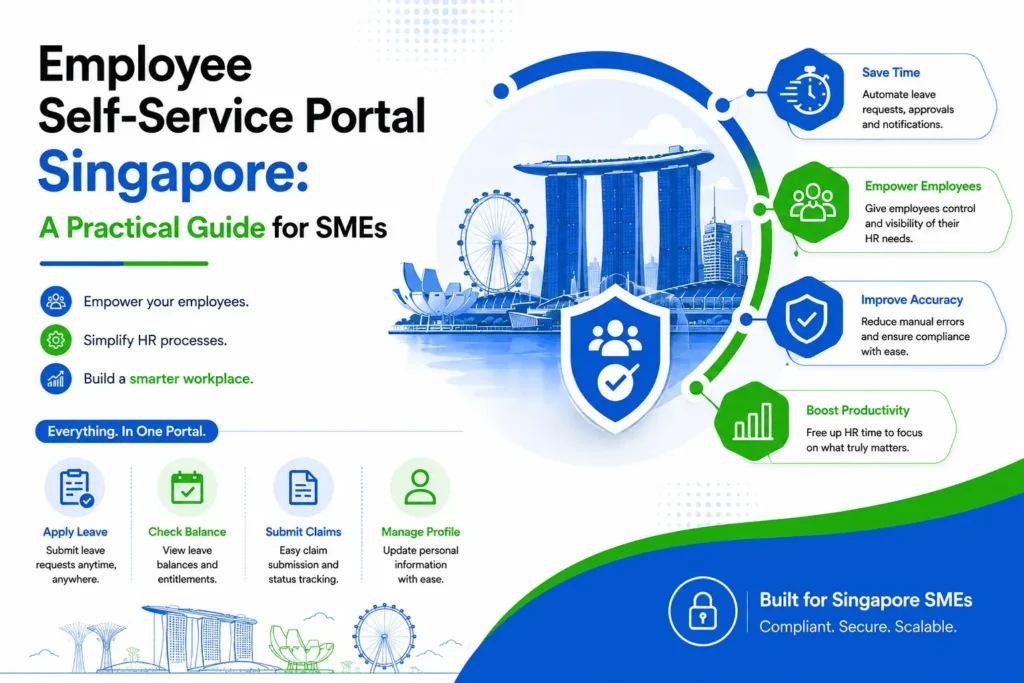
An Employee Self-Service Portal is a system that lets employees access and manage selected HR information and requests on their own, instead of relying on HR for every routine task. It typically covers things like leave applications, payslips, personal information updates and claims, all in one place employees can log into whenever they need to.
In practice, this usually includes:
Employee self-service software isn’t meant to replace HR’s judgment — approvals, policy decisions and sensitive matters still go through a person. What it does is remove the repetitive, low-value parts of the process, so HR isn’t the middleman for every single request.
Not every SME runs into the same problems, but a few patterns show up often enough to be worth naming. HR ends up fielding the same repetitive questions — “how many leave days do I have left,” “can you resend my payslip,” “did you get my claim.” Leave requests get handled through email or WhatsApp, which means there’s no single record of who applied for what, or whether it was actually approved. Payslips get generated and then manually sent out one by one each month. Employee information, like a change of address or bank details, gets updated by hand whenever someone remembers to tell HR. Claims often involve a fair amount of back-and-forth just to confirm receipts were received and are being processed.
None of this is necessarily a sign that something’s wrong. Plenty of small teams run this way without much friction. But as employee numbers increase, the volume of these requests grows too, and HR starts spending more time on administrative back-and-forth than on the parts of the job that actually need a person’s judgment.
The general flow is fairly simple: an employee logs in, views the relevant information, submits a request if needed, the request goes to a manager or HR for review, the system updates the record once it’s processed, and the employee sees the updated status. The details vary depending on what’s being requested.
An employee logs in, checks their current leave balance, and submits a leave request without needing to email or message HR directly. The request goes to their manager for approval, and once approved, the balance updates automatically. This connects closely with dedicated Leave Management Software Singapore, which handles the approval workflow and balance tracking behind the scenes.
Instead of HR generating and individually emailing payslips every month, employees can log in and access their own payslips whenever they need them — useful for things like loan applications or simply keeping personal records.
Employees can review their own details and, depending on what the company allows, update certain information themselves — like a change of address or emergency contact — rather than sending HR a message and waiting for it to be manually keyed in.
Employees can submit expense claims with supporting documents through the portal and track whether they’ve been approved, rejected, or are still pending, instead of having to follow up separately to check.
Where the system supports it, employees can view their own attendance-related information, such as clock-in records, which is useful for spotting and flagging discrepancies early rather than only at payroll time.
Task | Traditional HR Administration | Employee Self-Service Portal |
Leave requests | Email/WhatsApp, manually logged | Submitted and tracked online |
Payslips | Sent individually by HR | Accessed directly by employees |
Employee information | Updated manually by HR | Updated by employees, within set limits |
Claims | Back-and-forth via email | Submitted and tracked in-system |
Request tracking | Often unclear or informal | Visible status at each stage |
HR workload | Higher, more repetitive | Lower for routine tasks |
Employee access | Depends on HR availability | Available anytime |
Company size alone isn’t really the deciding factor. A five-person team with straightforward leave policies and simple payroll may not feel much pain from manual processes yet. What matters more is the actual HR workload — how many employees there are, how often leave requests and claims come in, how complex payroll and leave policies are, what employees have come to expect from previous employers, and whether the company is planning to grow.
For example, a 15-person design studio with one leave policy and monthly claims might genuinely be fine with a shared spreadsheet for now. A 15-person logistics company running multiple shifts, several leave types, and frequent claims might already be finding manual processes harder to keep up with, even at the same headcount. It’s worth judging based on actual workload rather than employee count alone.
AdaptivePay includes employee self-service as part of its broader HRMS software in Singapore. Employees can apply for leave and check their leave status directly, view attendance-related information, submit claims, and access payslips where applicable, without needing to go through HR for each request individually.
Because these functions sit within the same system as payroll and attendance, information doesn’t need to be re-entered manually at each stage — approved leave, for instance, can flow through to attendance and payroll records rather than being tracked separately. Mobile access is also available where applicable, which is useful for teams without a dedicated HR presence on-site every day.
If your HR team is still handling routine employee requests manually — leave applications, payslip requests, claims, or personal information updates — AdaptivePay’s employee self-service features can help centralise these processes alongside the rest of your HR operations.
1. What is an Employee Self-Service Portal?
An ESS portal lets employees manage HR tasks such as leave, payslips, claims and personal details without relying on HR for every request.
2. What can employees do through an ESS portal?
Employees can typically apply for leave, check balances, access payslips, submit claims, view attendance and track requests.
3. Is an ESS portal useful for small businesses?
Yes, especially for businesses with frequent HR requests, multiple policies or plans to grow. Its value depends more on HR workload than company size.
4. What should businesses look for in ESS software?
Look for ease of use, mobile access, leave and attendance integration, claims, payroll integration, permissions and reporting, along with Singapore-specific HR support.
An Employee Self-Service Portal isn’t just another HR feature bolted onto a system — it changes how employees interact with routine HR processes day to day, and how much of that interaction HR has to manage manually.
For growing Singapore SMEs, giving employees direct access to their own leave balances, payslips, claims and information can noticeably reduce administrative back-and-forth and create a more organised, consistent HR workflow. If this is a gap your company is starting to feel, it’s worth having a look at how AdaptivePay’s self-service features could fit into your existing HR setup.
Manage HR, payroll, attendance, leave, and employee operations in one powerful HRMS platform to improve efficiency and simplify workforce management.
A smarter way to manage payroll, attendance, claims and appraisals – all in one seamless platform





Copyright © 2026 – Adaptive Cloud Systems Pte Ltd