SFEC Support Ends 30 Nov 2026. Get 1-Year FREE AdaptivePay Subscription. (T&C Apply)
SFEC Support Ends 30 Nov 2026. Get 1-Year FREE AdaptivePay Subscription. (T&C Apply)
An employee sends a leave request over WhatsApp. HR copies it into a spreadsheet. The manager approves it in a separate email thread, and somewhere along the way, someone forgets to update the leave balance. Two weeks later, payroll is being processed and nobody is quite sure whether the unpaid leave was recorded correctly.
If this sounds familiar, you’re not alone. Most Singapore SMEs start out managing leave this way, and honestly, it works fine when there are ten or fifteen employees. The trouble starts when the company grows, more leave types get added, and HR ends up spending hours each week just keeping records straight.
This is where leave management software comes in. At its core, it’s a system that brings leave applications, approvals, balances and records into one place, instead of scattering them across spreadsheets, emails and chat apps. This article looks at what it actually does, why manual tracking becomes a problem, and what Singapore businesses should consider before choosing a system.
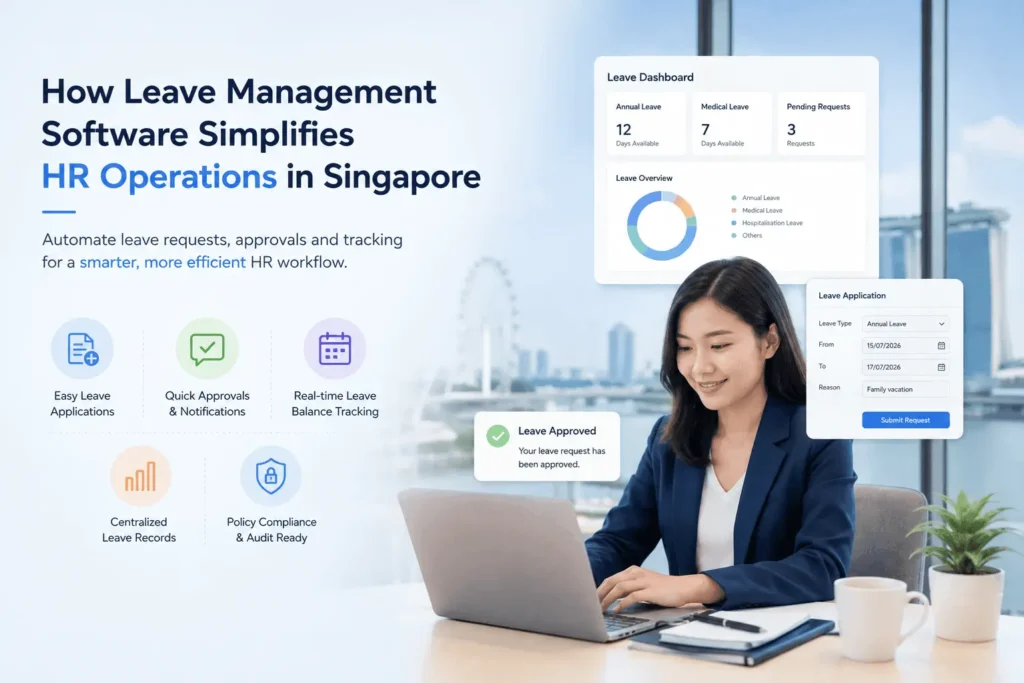
Leave management software is a tool that lets employees apply for leave, lets managers approve or reject those requests, and keeps an accurate, up-to-date record of everyone’s leave balance. In under 60 words: it replaces manual leave tracking with a centralised system that handles applications, approvals, balance calculations and reporting, so HR doesn’t have to manually reconcile spreadsheets and email threads every time someone takes a day off.
A basic leave tracker might just be a shared spreadsheet with some formulas. A proper leave management system goes further. It typically includes:
The difference matters. A spreadsheet can tell you what’s already happened, if someone remembered to update it. A leave management system is built to run the actual process — from the moment someone applies, through approval, right up to how it affects attendance and payroll.
Manual leave tracking works fine for small teams, but the cracks usually show up as headcount grows.
Take a fairly typical case: a Singapore SME started with 20 staff on a shared Google Sheet, and it worked because HR knew everyone personally. By 50–100 employees across multiple departments, the same process broke down. Employees emailed HR just to check their leave balance, since they no longer trusted the spreadsheet. Overlapping leave requests slipped through unnoticed. Year-end carry-forward calculations took HR almost a week, since policies varied slightly by department.
Common friction points at this stage include:
None of this means a company is non-compliant — it just means the process hasn’t kept pace with team size. This is usually the point HR teams start looking at leave management software.
Employees Can Apply for Leave Online
With leave application software, employees submit requests themselves — selecting leave type, checking their balance, and tracking approval status — without emailing or messaging HR. This cuts a large share of routine back-and-forth and reduces “how many days do I have left” questions almost immediately.
Managers Can Approve Requests Faster
Approval workflows route requests automatically: an employee applies, the manager gets notified, approves from their phone, and the balance updates itself — no manual spreadsheet edits, no approvals buried in inboxes.
HR Gets a Centralised View of Leave
HR can see who’s on leave, pending requests, upcoming absences, current balances, and historical records — all in one place, useful for both daily admin and planning around busy periods.
Leave Balances Can Be Tracked Automatically
Software handles balance calculations — carry-forward, pro-rating, leave taken — based on rules HR configures. It applies the rules; it doesn’t guarantee legal compliance on its own. HR still needs to set the policies correctly.
Leave Data Can Connect With Attendance and Payroll
This is often where the biggest practical gains show up. The flow is simple: leave request → approval → updated balance → attendance record → payroll. When approved leave feeds into payroll management, HR spends far less time reconciling numbers, with less risk of unpaid leave being missed at payroll.
Singapore employers generally need to manage several categories of leave, including annual leave, sick leave, maternity leave, paternity leave, and childcare leave, alongside any additional leave the company chooses to offer as part of its own policies. Entitlements and eligibility conditions depend on factors like length of service and the terms of the Employment Act, and these rules can be updated over time.
Because of this, it’s worth being precise about what’s what. Statutory leave refers to the minimum entitlements set by law. Company policy leave refers to anything additional a business chooses to offer, such as extra annual leave or flexible leave days. Software capability refers to what the system can track and calculate based on the rules HR configures — it doesn’t set the rules itself.
For current and accurate statutory leave entitlements and eligibility criteria, employers should refer directly to the Ministry of Manpower (MOM) website, since requirements can change and this article isn’t a substitute for that guidance or for proper legal advice.
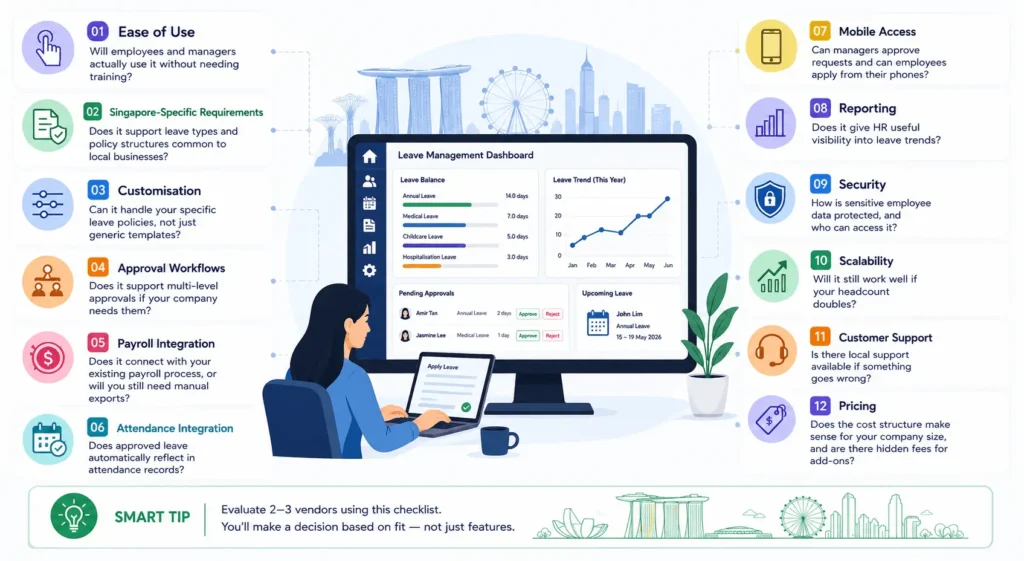
AdaptivePay is built as part of a broader HRMS software in Singapore, and leave management is one part of that. Employees can submit leave applications online and check their balances without needing to contact HR directly. Approval workflows route requests to the right manager, and once approved, leave balances update automatically.
HR gets a centralised view of leave across the company, along with employee records kept in one place rather than scattered across files. Because leave connects with attendance management and payroll processing within the same system, approved leave can flow through to attendance and payroll without HR having to manually re-enter the same information twice. Where applicable, HR tasks can also be managed on the go through mobile access, which is useful for smaller teams without a dedicated on-site HR presence every day.
The aim isn’t to eliminate HR’s involvement in leave management, but to cut down the repetitive, manual parts of it — chasing approvals, updating spreadsheets, and double-checking balances before payroll runs.
If your HR team is still managing employee leave through spreadsheets, emails or manual processes, AdaptivePay can help centralise leave management and other HR operations in one system.
1. What is leave management software?
A system that lets employees apply for leave, managers approve requests, and HR track leave balances and records in one place.
2. Why should Singapore SMEs use leave management software?
It reduces manual work, prevents leave balance errors, speeds up approvals, and gives managers clear visibility of team availability.
3. What features should a leave management system have?
Key features include employee self-service, leave policies, automated balance tracking, approval workflows, leave calendars, and reporting. Payroll and attendance integration are also useful.
4. Can leave management software integrate with payroll?
Yes. Many systems, including AdaptivePay, can connect approved leave with attendance and payroll, reducing manual checks and errors.
Leave management looks like a small HR task until a company grows past a certain point, and then it quietly becomes one of the more time-consuming parts of running HR. Spreadsheets, email threads and chat messages can hold up for a while, but they tend to create more admin work — and more room for error — as headcount increases and leave policies get more varied.
A good leave management software doesn’t remove HR’s judgment from the process, but it does take care of the repetitive parts: applications, approvals, balance calculations and record-keeping, all in one place that both HR and employees can rely on. If leave management has started to feel harder to keep on top of than it should be, it may be worth looking at what a proper system could take off your plate — and Adaptive Pay is happy to walk you through how that could work for your team.
Book a Demo with Adaptive Pay and see if it fits your business.
Manage HR, payroll, attendance, leave, and employee operations in one powerful HRMS platform to improve efficiency and simplify workforce management.
A smarter way to manage payroll, attendance, claims and appraisals – all in one seamless platform





Copyright © 2026 – Adaptive Cloud Systems Pte Ltd