
September 9, 2026
PSG Support Ends 29 Sep 2026 ! | SFEC Support Ends 30 Nov 2026. Get 1-Year FREE AdaptivePay Subscription. (T&C Apply)
Payroll mistakes rarely come from complicated calculations. More often, they come from a well-meaning deduction that turns out to be against the rules — recovering a broken laptop in one go, or deducting a full month’s uniform cost from someone’s pay without realising there’s a cap on that.
Singapore’s Employment Act sets out exactly which salary deductions employers can make, how much they can deduct, and what steps need to happen first. Get this wrong, even unintentionally, and it can lead to MOM enforcement action, back-payment obligations, and a fair bit of employee mistrust.
This guide walks through what’s allowed, what isn’t, and how payroll processes — including payroll software — can help SMEs stay compliant without needing to memorise every clause of the Act.
Salary deductions are amounts an employer subtracts from an employee’s gross pay before releasing the net salary, and under Singapore’s Employment Act, these can only be made for specific reasons set out in law — such as absence, damage or loss, accommodation, recovery of advances or loans, CPF contributions, or with the employee’s written consent. Employers covered by the Act cannot deduct salary for any reason outside this list, and even permitted deductions are subject to caps and procedural requirements. [MOM – Allowable salary deductions]
Under the Employment Act, salary deductions fall into two broad categories: those an employer may be required to make, and those an employer is permitted to make under specific conditions. [Singapore Employment Act 1968 – Sections 26–32]
Employers may be required to deduct salary when:
Outside of these mandatory situations, an employer can only deduct salary for the reasons explicitly listed in the Act — not for any deduction the employer personally considers reasonable. This is a common misunderstanding among SMEs: unless a deduction fits one of the recognised categories, it isn’t lawful, even if both parties seem to agree it’s fair at the time.
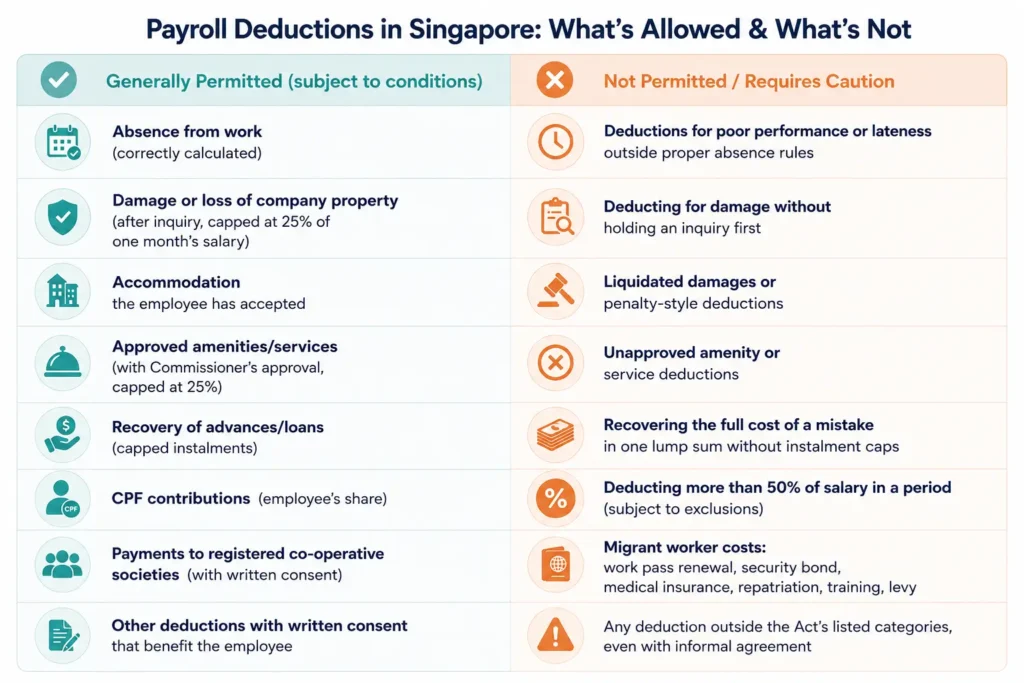
The Employment Act permits deductions only for the following categories:
[MOM – Allowable salary deductions] | [Employment Act 1968]
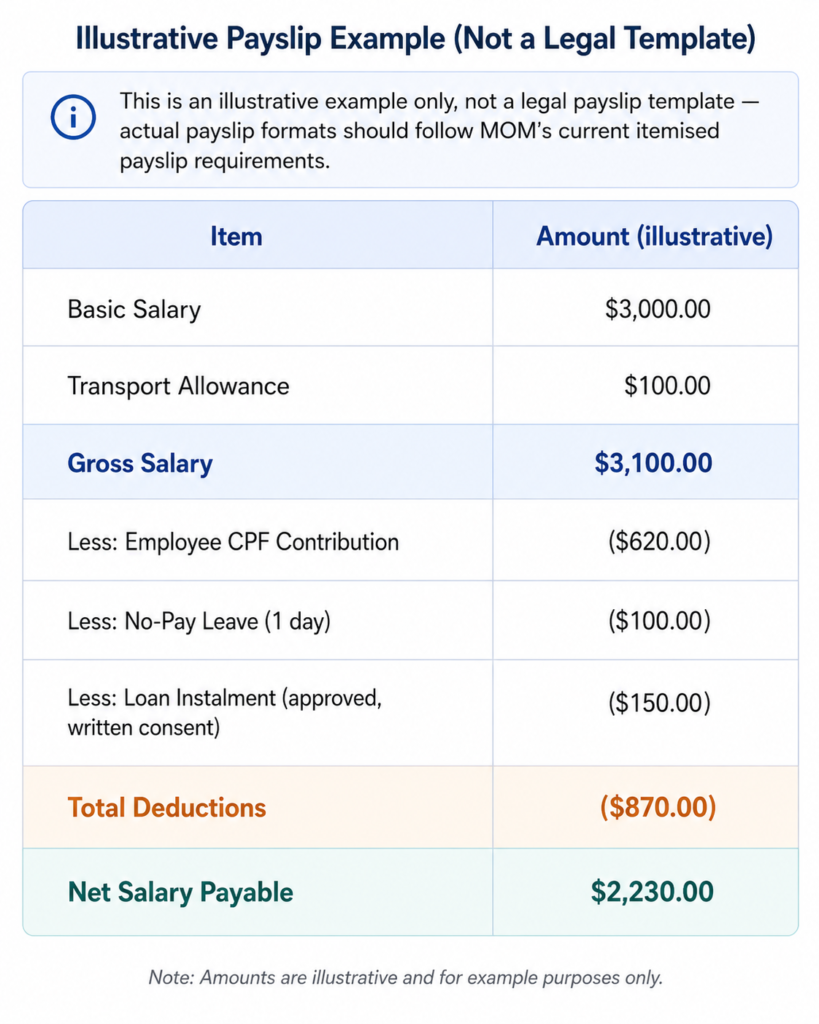
Under MOM’s itemised payslip requirements, every deduction made from an employee’s salary must be clearly itemised on their payslip — not bundled into a vague “adjustments” line. This means the payslip should show each deduction separately: CPF contributions, any absence-related deduction, loan or advance recovery instalments, and so on, alongside the gross salary and resulting net pay.
This isn’t just good practice — it’s a compliance requirement. An itemised payslip that omits or vaguely groups deductions can put an employer in breach of MOM’s payslip rules, separate from whether the underlying deduction itself was lawful. For SMEs, this makes accurate, itemised payroll records essential, not optional.
Manually tracking deduction categories, caps, and consent records across a growing headcount is where errors tend to creep in. Payroll software can reduce this risk by applying deduction rules consistently and keeping records organised in one place.
Based on verified capabilities, Adaptive Pay’s payroll software auto-calculates salary components — including allowances, deductions, and statutory CPF contributions — based on configured payroll rules, and generates itemised payslips showing detailed breakdowns of earnings, deductions, and contributions as required by MOM. Because the system compiles data from linked modules like leave, attendance, and claims, deductions such as no-pay leave can flow through automatically rather than being calculated by hand each cycle.
This kind of automation doesn’t replace the employer’s responsibility to apply the Employment Act correctly — a payroll system still needs accurate rule configuration — but it does reduce the manual re-entry and calculation errors that often lead to compliance issues in the first place.
1.Is there a maximum amount an employer can deduct from salary in one month?
Generally, total authorised deductions cannot exceed 50% of an employee’s salary payable in one salary period. Certain deductions — such as those for absence, or recovery of advances, loans, or overpaid salary — are excluded from this particular cap. Upon termination, the total deduction from a final salary payment may exceed 50%
2.Do salary deductions need to be shown on the payslip?
Yes. MOM’s itemised payslip requirements mean any deduction must be clearly itemised, not grouped into a vague line item. This applies whether the deduction is for CPF, absence, loan recovery, or another approved category.
3. Can an employer deduct a migrant worker’s salary for levy or work pass costs?
No. The Employment of Foreign Manpower Act specifically prohibits recovering these costs — including work pass renewal, security bonds, medical insurance, repatriation, compulsory training, medical fees, and levy payments — through salary deductions, regardless of any agreement between employer and employee
4.What should an employer do if a deduction was made in error?
Any wrongly deducted amount should generally be corrected and repaid to the employee. If an employee believes a deduction was unauthorised, they can raise this with MOM directly. Employers should review their payroll process to identify how the error occurred and prevent it from recurring.
Salary deductions in Singapore are governed by a specific, limited list of permitted reasons, each with its own conditions, caps, and procedural steps. Getting this right protects both the employee’s take-home pay and the employer from compliance risk — and it starts with knowing which category a deduction actually falls under before processing it.
For SMEs handling payroll in-house, keeping deduction rules, caps, and consent records organised across a growing team can get complicated quickly. An HRMS platform that ties payroll, leave, and attendance data together can help apply these rules consistently and keep itemised records audit-ready — reducing the chance that a well-intentioned deduction turns into a compliance issue. Whatever system you use, the underlying rule stays the same: when in doubt about a deduction, check it against the Employment Act before it hits the payslip.
Ministry of Manpower (MOM)
Singapore Statutes Online
CPF Board
Manage HR, payroll, attendance, leave, and employee operations in one powerful HRMS platform to improve efficiency and simplify workforce management.
Enquire now to learn how we can build a solution for your business needs or speak with us for a free demo.
SMEs are eligible for up to 50% Productivity Solutions Grant (PSG) support for the adoption of Adaptive Pay, a Pre-Approved solution under the IMDA SMEs Go Digital programme.
A smarter way to manage payroll, attendance, claims and appraisals – all in one seamless platform





Copyright © 2026 – Adaptive Cloud Systems Pte Ltd