
PSG Support Ends 29 Sep 2026 ! | SFEC Support Ends 30 Nov 2026. Get 1-Year FREE AdaptivePay Subscription. (T&C Apply)

Author name: Adaptivepay

5 Tips to Improve HR Productivity with Cloud Payroll Software
HR Tips

5 Tips to Improve HR Productivity

One of the common challenges HR teams face in Singapore is maintaining productivity, especially when routine tasks like payroll, leave and claims management rely on outdated manual processes. These inefficiencies slow things down and can also lead to costly mistakes. That’s why more human resources departments are turning to cloud payroll software in Singapore. These solutions automate routine tasks and centralise data to streamline HR workflows and improve overall efficiency. In this blog, we’ll break down how HR technology — particularly integrated systems like HRMS with built-in payroll — can make your HR department much more productive. Automate routine tasks Aside from being time-consuming and inefficient, manually managing routine HR tasks also increases the risk of errors, which may lead to even bigger problems like compliance issues and employee dissatisfaction. Cloud payroll software in Singapore automates key calculations using data from areas like claims and attendance to keep processes running smoothly. It also supports automatic updates for SDL, CPF, and FUND contributions to keep your payroll aligned with the latest policies and tax requirements. Use data-driven insights for decision-making Data analytics helps you spot outdated skills or capability gaps within your team. An HRMS like Adaptive Pay includes an appraisal module that tracks employee performance and highlights areas for improvement to identify where training or upskilling is needed. You can easily create questionnaires and self-assessment forms that employees can then complete via web or mobile, encouraging regular feedback and open communication between managers and staff. This also makes it easier for managers to monitor progress. What’s more, Adaptive Pay includes a leave management module that generates instant reports to give managers a clear view of team availability. This helps prevent short staffing and supports your resource planning efforts. You can also generate critical reports such as KET documents, manpower statistics, and employee turnover with just one click. These reports give you the data you need to make better HR decisions — all from one centralised system. Empower employees with self-service tools Do your employees still have to physically visit or call your HR department to follow up on leave applications? An all-in-one cloud payroll software in Singapore like Adaptive Pay can save them time and effort. Our HRMS lets employees apply for leaves remotely and upload supporting documents using the app, as well as check the manager’s decision to find out if their request was approved or rejected. Managers can also approve and manage leaves remotely. Stay compliant with regular updates Using an IRAS-listed cloud payroll software in Singapore helps your HR team work more efficiently because it simplifies the calculation of salaries, deductions, allowances, and claims. It also keeps your business up to date with changing tax rules and rates, as well as formats. A solution like Adaptive Pay streamlines the AIS submission process, too — you can submit directly to IRAS with just one click.  Use cloud-based solutions for flexibility Be sure to choose cloud payroll software in Singapore that brings all essential HR functions into one platform. With Adaptive Pay, your business gets a complete HRMS that simplifies operations and improves productivity. It’s offered at a fixed price and includes a mobile app, so employees and managers can access payroll, attendance, leave requests, and claims anytime—  even when working remotely. Try Adaptive Pay! You don’t need to buy software for each human resource process when you choose Adaptive Pay. We offer a comprehensive solution for tackling key processes like payroll, attendance, rostering, claims management, and more. Request a demo here and discover why Adaptive Pay is among the best all-in-one cloud payroll software solutions in Singapore. Our platform comes at a fixed subscription fee and is backed by a reliable support team. Plus, it’s a highly customisable HRMS that aligns with your business processes.

Streamline Workforce Management in Construction
Industry HR Solutions

Streamline Workforce Management in Construction / Manufacturing

If you run a construction or manufacturing business in Singapore, then you know how challenging it can be to keep everything running smoothly — juggling multiple sites, different skill sets, and strict safety requirements can make day-to-day operations feel overwhelming. The good news is that using an HRMS solution can make a real difference. This centralised platform helps you simplify and manage these tasks more efficiently, all in one place. Let’s explore how smart all-in-one human resource management software like Adaptive Pay can streamline workforce management. Read on as this blog shares tips on how to improve your operations. Centralised employee database Imagine having a centralised hub where you can find all relevant details about your employees. That’s what an HRMS can bring to your company — it provides a single source of truth that lets you track employee details, work history, and certifications. This enhances workforce visibility and eliminates the need to rummage through hundreds of folders and files. Platforms like Adaptive Pay offer an all-in-one solution where you can track key HR processes like payroll and leave management. Plus, it lets you customise appraisal, rostering, and claims management to suit your company’s standards. Digital onboarding process A human resource management platform automates document collection with digital signatures. It can also prepare induction checklists to ensure each worker is site-ready. This ultimately saves time and effort while ensuring compliance with labour laws. Project-based resource allocation You can assign workers to specific worksites based on certifications, availability, and skills to boost efficiency. Adaptive Pay has an attendance and roster module to simplify resource application to specific construction sites and manufacturing facilities. Compliance tracking for safety certifications A smart HRMS solution also takes the guesswork out of monitoring WSH certifications. It will send you automatic alerts about expiring certifications to ensure no worker enters any worksite without valid credentials. Mobile access Site managers don’t have to be in the office or on-site to approve leaves, update workers, or track employee status. A cloud-based platform like Adaptive Pay is accessible anywhere, even on mobile phones. This means site managers can easily manage and approve leaves, track attendance, or handle urgent updates while on the go. Additionally, workers can check for approval on the app. Meanwhile, managers can generate quick reports and check staffing availability at a glance to improve company resource management. Automated payroll Handling payroll for multi-site operations will be a lot easier with a highly customisable HRMS platform that increases the flexibility of your business. Some solutions even support third-party accounting apps to align with your preferred setup and workflow. Adaptive Pay has a payroll module that automatically calculates salaries based on attendance, overtime, and site allowances. It simplifies CPF or tax deductions and allows you to set multiple payroll schedules based on your company’s requirements. It’s IRAS-listed, meaning it’s constantly up-to-date on changing policies, rates, and taxation formats. Moreover, it allows direct AIS submissions. Incident and risk reporting Some platforms support reporting for on-site incidents to maintain proper records and enhance safety standards. With this feature, HR teams can act immediately and resolve concerns and issues in construction sites and manufacturing facilities. Conclusion With the right HRMS, you can keep your workforce compliant, safe, and productive. Unlike manual systems, this digital solution leverages cloud technology, analytics, and automation to optimise and simplify key HR processes. If you need one, look no further than Adaptive Pay.   Streamline workforce management with Adaptive Pay Adaptive Pay is an all-in-one cloud HRMS that is customisable and easy to scale to your needs. Contact us to get this comprehensive HR management platform at a fixed price and see how it streamlines workforce management in your construction or manufacturing company. You may also request a demo here.

Singapore HR Updates

Navigating Work and Celebrations: Your Ultimate Guide to Singapore Public Holidays with Adaptive Pay

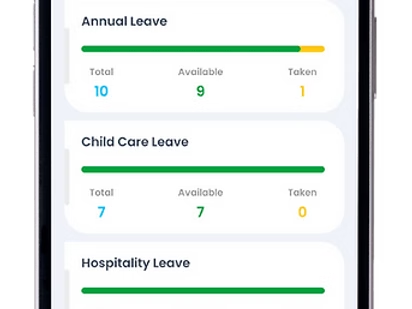
As a business owner, you want to ensure continuity and avoid disruptions to your daily operations. How can you do this while still accommodating employees who need time off for cultural or religious celebrations? A cloud-based leave management system can help you achieve these goals. With this system, you can easily approve leave requests and monitor attendance or absences to support seamless operation and employee well-being. This feature is available in Adaptive Pay’s comprehensive HRMS. Unlike other HR software solutions, our powerful, all-in-one platform allows you to manage your business from a centralised platform accessible anytime, anywhere. With Adaptive Pay, it’s easier to oversee every critical human resource task — including leave management, payroll, and attendance and roster — to make your HR processes much more efficient.  How can a cloud-based HRMS help your business navigate Singapore public holidays?  Singapore’s multicultural landscape is shaped by its Chinese, Indian, and Malay populations, alongside a growing number of foreigners, creating a cosmopolitan society where each ethnic group preserves its unique lifestyle in harmony with others. This diversity enriches Singapore with a wide range of celebrations and holidays — from socio-cultural to athletic and religious events. Adaptive Pay simplifies the process for employees who wish to participate in these celebrations by streamlining leave requests and approvals. Through our leave management system — which is  accessible via app or browser — employees can submit leave requests and attach necessary documents. Managers receive instant notifications and can approve or deny requests on the go, with employees promptly informed of the decision. Approved leaves are automatically integrated into Adaptive Pay’s HRMS for payroll and attendance calculations. Employees can also view their remaining leave entitlements on our app, helping them plan ahead and ensuring they’re aware of their available leave entitlements.  Singapore public holidays to know Here are the annual public holidays in Singapore:  New Year’s Day (January 1) Lunar New Year (Chinese New Year, usually between the final week of January and early February) Good Friday Labour Day (May 1) Vesak Day (Full moon day of the fourth lunar month, usually in May) Hari Raya Puasa or Eid Ul Fitr (Usually in September or October) National Day (August 9th) Hari Raya Haji (Eid Al Adha or Feast of the Sacrifice, usually in November or December) Deepavali (Festival of Lights, usually in October or November) Christmas Day (December 25) Whether you’re a manager or business owner, keeping tabs on Singapore’s public holidays can help you anticipate when employees are likely to file a leave, so you can prepare and adjust workloads as necessary. Aside from providing a reliable leave management system, Adaptive Pay also includes a cloud-based time attendance system to support your rostering needs.  Let Adaptive Pay support your leave management, attendance, and rostering Our leave management system automatically integrates with our platform’s payroll and attendance modules to ensure the leaves are reflected in employee payslips. It can eliminate manual updating and simplify your workflow. With Adaptive Pay’s time and attendance module, you can remind employees about shift timings and changes in advance through the app. Additionally, you can use Adaptive Pay’s leave management system to create custom workflows to simplify leave filings and approval and arrange custom leave entitlements for various teams. Managers can control leaves according to employment type or department to prevent short staffing and configure leaves based on hours or days.  Making leave management a breeze  Try Adaptive Pay and experience how our leave management system can support your business during critical times. If you’re satisfied with our demo, be sure to buy our HRMS software solution as soon as you can for a chance to get 50% off the yearly subscription.

Employment & MOM Guidelines

An Overview of Singapore’s Flexible Work Arrangements (FWA) Guidelines

Did you know that 80% of workers globally want to work at home or remotely at least 3 times a week? To cater to this trend, the TG-FWAR has established guidelines on (1) how employees should request and (2) how employers should manage FWA. Singapore-registered companies with at least 30% local ownership can also apply for the PSG to fund FWA tools — such as remote collaboration software, video conferencing platforms, and project management tools — as long as those tools are used within Singapore. If you haven’t adopted flexible work arrangements yet, now is a good time to do so. Here at Adaptive Pay, we offer an all-in-one cloud HRMS in Singapore to support your transition to a flexible work setup. Our platform is meticulously updated and managed to help you fulfil local labour laws such as the Employment Act and tripartite guidelines. Read on as we share an overview of these guidelines and how our HRMS solution can help your organisation comply. Understanding flexible work arrangements FWAs are based on mutual agreements between you and your employees to deviate from standard work arrangements. This could mean allowing employees to work from home or any location outside the traditional office as long as they meet their responsibilities. FWA can also include adjustments to work hours or workloads to accommodate individual employee preferences and needs. The importance of FWA Technological advancements and an evolving society are changing how we work, resulting in FWA becoming a strategic way to attract top talent, foster employee satisfaction, and enhance your company’s agility. Essentially, it encourages a more adaptable and inclusive work environment. On April 16, 2024, the Tripartite Alliance for Fair and Progressive Employment Practices (TAFEP) issued and announced the latest Tripartite Guidelines on FWA Requests. These guidelines became effective on December 1, 2024, and mandated the minimum requirements for Singapore employers to consider formal requests from employees regarding FWA. Adaptive Pay HRMS in Singapore can help your organisation adopt flexible work arrangements and comply with the TAFEP. Types of FWA Flexible work arrangements in Singapore fall into one or more of these categories. Flexi-place allows employees to work flexibly from different locations besides the usual office, as in the case of working from home or telecommuting. Flexi-time lets employees adjust their work schedules, choosing when they start and finish work, as long as they complete their required total hours and workload. Flexi-load (often used for part-time work or job-sharing arrangements) lets employees choose their work hours and workload, with corresponding adjustments to their pay. Which flexible work arrangements are you adopting? Regardless of your choices, make sure you have a reliable HRMS in Singapore to keep track of payroll, claims, attendance, and more, even when your employees are not in the office. Who qualifies for FWA? The new guidelines state that all organisations and non-probation employees are eligible to request flexible work arrangements. This shows Singapore’s inclusive approach and commitment to empowering workers and honing an innovative and flexible workplace culture. Recommendations for Tripartite Guidelines on FWA Requests Singapore’s government approved several recommendations from the Tripartite Workgroup to establish sufficient expectations and norms on flexible work arrangements. These guidelines also outline the process for requesting FWAs and how supervisors and employers can manage requests. Here are some of the key recommendations: Establish clear workplace norms for FWA requests and approvals to manage expectations for everyone involved. Use the Tripartite Guidelines on Flexible Work Arrangement Requests (TG-FWAR) as the primary resource for handling FWA requests. Consider FWA requests based on legitimate business reasons while also encouraging employees to use FWAs responsibly. Formalise the FWA request process by using the TG-FWAR and documenting all relevant information for informed decision-making. The TG-FWAR guidelines apply to all employees who have completed their probation period. While job seekers aren’t required to request FWAs during the hiring process, employers are encouraged to share their FWA policies in job interviews and advertisements. Ensure your organisation’s FWA policies are inclusive and accessible to all employees. Provide employees with training and resources on how to effectively request and utilise FWAs. Considerations when implementing FWA How will you handle benefits and salaries when employees’ responsibilities or workloads change under an FWA? Prorated compensation may be necessary. Traditional performance reviews may need to be adapted for remote or flexible work. Consider implementing online performance evaluation and appraisal systems. Clear KPIs and expectations are essential for successful FWAs. Determine how you’ll measure performance and what criteria employees must meet to be eligible for and maintain their FWA. Ensure smoother FWA adoption with Adaptive Pay Let Adaptive Pay take the guesswork out of implementing flexible work arrangements. Learn more about our HRMS in Singapore by requesting a demo here.

Leave & Benefits

Navigating Unpaid Infant Care Leave: A Comprehensive Guide for Parents in Singapore

On 1 January 2024, the provision for unpaid infant care leave increased by an additional six days per parent per year—a major enhancement in the support for working parents with infants. This adjustment means each parent is now entitled to 12 days of unpaid infant care leave annually during their child’s first two years. In this guide, we discuss the updated policy, its implications for families and employers, and the crucial role of efficient leave management systems and e-leave apps in facilitating this transition. Eligibility for unpaid infant care leave in Singapore To qualify for unpaid infant care leave, parents must meet several criteria: The child must be below two years of age, including legally adopted children or step-children. The child must be a Singapore citizen. The parent must have been employed for a continuous period of at least three months. How to apply for unpaid infant care leave in Singapore Parents wishing to take unpaid infant care leave must notify their employer and obtain approval. Employers are encouraged to grant leave for critical matters such as immunisations and medical appointments. A streamlined leave management process can significantly ease this step. The importance of unpaid infant care leave The government’s decision to increase unpaid infant care leave to 12 days per parent annually marks a significant step towards supporting working families. It acknowledges the crucial early years of a child’s development and the challenges parents face in balancing work and family life. Strengthens the parent-child bond – Additional leave allows parents to spend more quality time with their newborns, fostering emotional and social well-being. Supports early childhood development – More time at home contributes to nurturing care and engaging activities that boost cognitive, social, and emotional growth. Improves maternal health – Extended leave can reduce stress and anxiety for mothers. Promotes gender equality – The benefit encourages fathers to take an active childcare role and support balanced family responsibilities. Benefits the economy – Enhanced childcare support keeps parents active in the workforce, contributing to economic growth. Implications for employers The expansion of unpaid infant care leave also presents implications for employers. On a positive note, these family-friendly policies can boost loyalty and, reduce turnover and may even make a company more appealing to job seekers. Supporting working parents also promotes diversity and inclusion.

Leave & Benefits

Empowering Parenthood: Understanding Shared Parental Leave in Singapore and Supporting Work-Life Balance

Shared parental leave is an essential policy that supports work-life balance and empowers parents in Singapore. This type of leave allows fathers to actively engage in childcare and child development. It increases their bonding time with their children, reduces stress, improves mental health, and can even positively impact career advancement. For mothers, it offers shared responsibility in childcare, reduces pressure, and enables them to return to work faster. It is regarded as a progressive step towards promoting gender equality. Understanding and supporting shared parental leave is essential for creating a family-friendly workplace. By utilising leave management systems, leave apps and e-leave solutions, employers can support their employees in balancing work and family commitments, leading to a more satisfied and productive workforce. These tools not only aid in compliance but also enhance the overall efficiency of managing parental leaves, contributing significantly to a positive work culture. Understanding shared parental leave Shared parental leave enables working fathers in Singapore to participate in childcare by sharing up to 4 weeks of the mother’s 16 weeks of Government-Paid Maternity Leave. This shared approach underscores the importance of both parents’ involvement in the early stages of a child’s life, fostering a more balanced family dynamic. Eligibility and entitlement Fathers, including self-employed, are eligible if: Their child is a Singapore citizen. The child’s mother qualifies for Government-Paid Maternity Leave. They are legally married to the child’s mother. Fathers may also be entitled to Government-Paid Paternity Leave (GPPL). For children born on or after 1 Jan 2024, eligible fathers can take up to 4 weeks of GPPL. This has to be taken within 12 months of the child’s date of birth. For children born before 1 Jan 2024, eligible fathers can enjoy up to 2 weeks of GPPL, also within 12 months of the child’s date of birth. Leave arrangements Shared parental leave can be taken in two ways: By default, without an agreement, in a continuous stretch within 12 months after the child’s birth. By mutual agreement, flexibility is allowed for taking blocks of weeks or days within 12 months after the child’s birth. The leave is based on the father’s working days, capped at 6 days per week. For example, if a father works 6 days a week, he can take up to 24 working days of leave. Using technology to manage shared parental leave Employers can facilitate shared parental leave through the use of a leave management system and a leave app. These tools streamline the application and tracking process, ensuring compliance and providing flexibility. Benefits of a leave management system Efficiency – A leave management system simplifies the process of managing and tracking shared parental leave. Clarity – Both employers and employees can easily access leave balances and entitlements through an e-leave app. Compliance – A leave app also helps ensure adherence to legal requirements and company policies. Flexibility – With a leave management system, employers can facilitate various leave arrangements to make better planning and resource allocation decisions. Why use a leave app? Accessibility – Leave apps provide on-the-go access to leave information, making it easier for employees to apply for and track their leave. Communication – It enhances interaction between employees and HR, allowing for smoother leave management. Integration – Leave apps can integrate with other HR systems for a holistic approach to employee management. What is the best leave management system and leave app? Adaptive Pay’s state-of-the-art leave management system app streamlines your leave processes with customisable e-leave workflows and seamless remote applications and approvals. Employees can effortlessly apply for leave through the mobile or web app, attaching any necessary documents. Managers are promptly notified and can approve leave requests with ease (even through multiple approval levels). Upon approval, the system automatically updates the attendance and payroll modules. Plus, employees can conveniently track their remaining leave days and entitlements anytime, anywhere, through the app. Choose Adaptive Pay for a smoother, more efficient leave management experience. Book a demo today.

Singapore HR Updates

Demystifying Work Permit Requirements in Singapore’s Process Sector: A Comprehensive Guide

Compliance regulations in the process sector require specific steps beyond just completing safety courses and adhering to quotas. There are additional specific steps your business must take to ensure that you are hiring legally. An HRMS Singapore solution streamlines new hire onboarding and tracks payroll, attendance, rostering, and leave management to eliminate the guesswork.  Adaptive Pay can help you navigate these complexities. Our HRMS solution in Singapore will streamline your workflows and productivity by automating crucial HR processes, including tax filings and payroll processing. With our platform, you can focus on other important matters, such as fulfilling the work permit requirements to hire qualified migrant workers. This blog explores the work permit requirements in Singapore’s process sector, specifically focusing on Process Construction and Maintenance (PCM) services. In addition to the general guidelines, there are specific regulations for your business activity, the worker’s nationality, quotas, and mandatory safety training. Key Takeaways • Businesses hiring foreign workers for Singapore’s process sector must comply with MOM work permit requirements, quotas, levies, and industry-specific regulations.• Process Construction and Maintenance (PCM) contractors must meet additional eligibility requirements, including ASPRI-related requirements where applicable.• Employers should ensure workers meet nationality, age, skills, and safety training requirements before applying for a Work Permit.• HR software can help businesses manage employee records, payroll, attendance, and compliance more efficiently. What business activities fall under the process sector? The process sector encompasses factories that manufacture essential products like petroleum, petrochemicals, pharmaceuticals, and speciality chemicals. Production in these industries relies heavily on specialised machinery and equipment. Maintaining and building these production units (PCM works) requires a unique skill set that is handled by PCM contractors. These contractors collaborate with plant owners, engineering firms, and construction companies to ensure the safe and efficient construction and maintenance of these units.  What are the company requirements for PCM services? Your business must be a registered member of the Association of the Process Industry (ASPRI). To hire foreign PCM workers, you also need ASPRI endorsement as a PCM contractor and inclusion on the PCM Controlled List. Go to ASPRI’s website for more information on membership and registration.  What are the worker requirements and limitations in the process sector? Migrant workers with PCM work permits can only perform activities related to construction, equipment breakdown, and preventive maintenance. They’re not allowed to participate in plant operations like operating equipment, warehousing, or packing. Similarly, tasks like grass cutting, office cleaning, or waste disposal fall outside their permitted duties.  Who can you hire? Requirement Details Minimum Age 18 years old Eligible Source Countries Malaysia, PRC, NTS, NAS (subject to MOM rules) Maximum Employment Period Depends on nationality and skill level Maximum Working Age Up to 60 years old (subject to applicable rules)   What are the quotas and levies? Hiring migrant workers in Singapore follows a quota system called the dependency ratio ceiling. This means the number of foreign workers you can hire depends on the number of local employees earning a specific minimum salary (Local Qualifying Salary).   Additionally, there’s a government levy charged on top of the salary for each foreign worker. The levy amount varies based on the worker’s skill level (tier) and their source country. Confused by the regulations? Our HRMS software in Singapore simplifies the process by automating calculations related to quotas and levies specifically for the process sector.  What safety courses are required? All process sector workers are required to take these safety courses before they start working: OPSOC (Oil Petroleum Safety Orientation Course) CSOC (Construction Safety Orientation Course)  Keep your workers happy Use Adaptive Pay as your HRMS in Singapore to create a better workplace. Our all-in-one cloud-based HR solution will simplify how you manage your business for a fixed price every year without hidden costs. Request a demo today. Frequently Asked Questions 1. What is a Work Permit for Singapore’s process sector? A Work Permit allows eligible foreign workers to work in Singapore’s process sector, subject to the Ministry of Manpower’s requirements on employer eligibility, worker qualifications, quotas, and levies. 2. Which businesses can hire process sector Work Permit holders? Businesses involved in eligible process sector activities, including Process Construction and Maintenance (PCM) services, may hire Work Permit holders if they satisfy the applicable MOM and industry requirements. 3. Are there nationality restrictions? Yes. The process sector has approved source countries and regions from which employers can recruit eligible Work Permit holders, subject to current MOM regulations. 4. Are safety courses compulsory? Yes. Eligible workers are generally required to complete the mandatory safety courses applicable to their job role before starting work.  

A Guide to 2024 Public Holidays in Singapore
Leave & Benefits

Plan Your Year: A Guide to 2024 Public Holidays in Singapore

Holidays in Singapore are opportunities for employees and employers to rest, enjoy leisure, spend time with family, and/or fulfil religious or cultural obligations. All workers have 11 paid public holidays every year per the Employment Act. However, if you want your employees to work on a public holiday, you can either grant them off in lieu or pay their salary for that extra day. Calculating their salary will be easier with Adaptive Pay as your HRMS software. Our platform has powerful and reliable attendance, rostering, and leave management solutions to simplify these aspects with automation and cloud-based access. What are Singapore’s public holidays in 2024? As an employer, you need to be aware of these official days off to effectively plan staff schedules and avoid disruptions to work continuity. Here’s a list of public holidays to take note of in 2024: New Year’s Day – January 1 (Monday) Chinese New Year – February 10 and 11 (Saturday and Sunday). February 12 (Monday) will be a public holiday if the rest day is on February 11. Good Friday – March 29 (Friday) Hari Raya Puasa – April 10 (Wednesday) Labour Day – May 1 (Wednesday) Vesak Day – May 22 (Wednesday) Hari Raya Haji – June 17 2024 (Monday) National Day – August 9 (Friday) Deepavali – October 31 (Thursday) Christmas Day – December 25 (Wednesday)  What do you need to know about Singapore holiday pay? In Singapore, employees are entitled to receive their full gross rate of pay for a public holiday if they meet these two conditions: They were not absent from work on the working day immediately before or after the public holiday without a valid reason or your permission. They were on approved leave (paid annual leave, sick leave, or unpaid leave) on the day before or after the holiday. If an employee’s approved unpaid leave falls on a public holiday itself, they will not be entitled to public holiday pay for that specific day. However, if their approved unpaid leave falls on the day before or after the holiday, they will still be eligible for public holiday pay.  What if the public holiday falls on their non-working day or rest day? Based on the Employment Act, your employees can get another day off or an extra day’s salary in place of that public holiday at the gross pay rate. If the public holiday is on their rest day, the next working day is considered a paid public holiday. In cases where the Employment Act doesn’t apply to the employee, you can decide their pay or day off based on the terms of their employment contract. Whether they’re covered by the Employment Act or not, Adaptive Pay can help with attendance, payroll, and leave management.  Working on a public holiday By default, if you require your employees to work on a public holiday in Singapore, you need to compensate them with an additional day’s pay on top of their regular salary. However, there are alternative options available (provided that both you and the employee agree): Time off in lieu (for employees not covered by Part IV of the Employment Act) – This allows the employee to take a day off in place of working on the public holiday. This option is only applicable to employees whose terms of employment are not governed by Part IV of the Employment Act (typically executives, managers, and professionals). Public holiday in lieu – The employee can be granted another day off as compensation for working on the public holiday. This substitute day off can be scheduled at a mutually agreed-upon time.  Calculating public holiday pay Adaptive Pay takes the guesswork out of calculating your employee’s public holiday pay. Our cloud HRMS software is compliant with MOM, IRAS, and CPF regulations and automatically integrates employee data to simplify attendance, payroll, and leave management for processing. It even has a pre-payroll acknowledgement feature so employees can report discrepancies they find on their paychecks before you process the payroll. Use Adaptive Pay and see how it can simplify your payroll and leave management, no matter your industry. Our customisable and flexible platform is also ready to integrate with third-party accounting apps and makes it easier to configure payroll components like deductions, basic salary, and allowances. Request a demo today!

Leave & Benefits

Maximising Employee Benefits: The Strategic Approach to Leave Encashment in Singapore

Whether you are an HR professional or a business owner, understanding laws regarding employee benefits is crucial to employee satisfaction and, therefore, to your company’s overall success. Establishing a strategic and transparent approach to leave encashment is a great way to maximise employee benefits. The good news is it doesn’t have to be difficult when you use Adaptive Pay. With our solution, employees can file an eleave using a mobile app or a web browser. Our app also simplifies leave management by integrating it with payroll and attendance modules. Key Takeaways • Leave encashment allows employees to receive payment for eligible unused annual leave, subject to company policy and employment terms.• Singapore employers should clearly define whether unused leave will be encashed, carried forward, or forfeited.• Leave encashment calculations should follow the company’s policy and applicable MOM guidelines.• Automating leave and payroll processes helps improve accuracy, transparency, and compliance.     Adaptive Pay’s leave app is designed to make leave management more convenient by eliminating manual updating and providing a full view of resources. Employees can access its features anytime and anywhere, allowing them to apply for an eleave and upload supporting documents when necessary. And if you’re considering a leave encashment policy, Adaptive Pay can provide insights into your resource allocation so you can decide if it’s a good fit for your company.     In this blog, we will share strategic approaches to leave encashment and how our leave management solution can support it. Understanding leave encashment Leave encashment is a process where an employee gets money in exchange for their unused leaves each year. Instead of using those leaves to take time off, employees may opt for financial compensation for unused leave days. How to handle unused leaves Should you encash, forfeit, or carry forward unused leaves? Your decision can depend on your employment contract. So, be sure to check it under the following conditions: The number of days of unused annual leaves is greater than statutory entitlements or Part IV of the Employment Act does not cover your employees. Calculating leave encashment The Ministry of Manpower (MOM) recommends this formula when calculating leave encashment: (12 months x Monthly gross rate of basic pay) / (52 weeks x Average working days weekly) x (Number of unused leave days) Using Adaptive Pay as your leave app, you won’t need to worry about getting the wrong calculations or doing the math manually. When an employee files an eleave, our app simplifies leave management by calculating MOM-based leave encashments, ensuring compliance and efficiency. Should you base leave encashment on gross or basic salary? Each organisation has its own guidelines and policies when it comes to calculating leave encashments. Some companies base it on the employee’s basic salary, while others consider the gross salary. Many companies also have specific rules for leave encashment that go beyond the Ministry of Manpower guidelines. Some of them set limits on the amount of leave that can be cashed out or use custom formulas for calculating the value. Certain allowances might be included or excluded from the encashment calculation. Leave encashment might also be limited to specific situations, such as termination or resignation. No matter the case, our leave app can adapt to your company’s unique requirements. Do CPF contributions apply? In Singapore, leave encashment is considered part of your employee’s additional wages. This means CPF contributions are mandatory for both employers and employees on the encashment amount. Adaptive Pay’s leave app takes care of the CPF contribution calculations for you. How do you calculate leave encashment when an employee resigns? Employees who are terminated are typically eligible to encash their unused annual leave. Make sure to calculate the encashment amount based on the employee’s gross rate of pay according to their most recent salary. However, if an employee is terminated due to misconduct, you may forfeit their unused leave in some cases. Leave Encashment vs Carry Forward vs Forfeiture Scenario Is Leave Encashment Usually Applicable?* Employee resigns Yes, subject to the employment contract and company policy. Employee retires Usually, depending on company policy. Employment is terminated May apply, depending on the reason for termination and employment terms. Employee continues employment Depends on whether the company allows leave encashment during employment. Here is the MOM formula to calculate leave encashment upon resignation: (12 months x monthly gross pay rate) / (52 weeks x average working days weekly) x (number of unused leave days) With Adaptive Pay, you don’t have to worry about leave management and encashments, even when your employees file an eleave. It automatically does the calculations to eliminate the guesswork. Should you consider Leave encashment in your company? Allowing your employees to encash their annual leaves can be beneficial in the following ways: More financial flexibility for employees who might need additional income. Minimised leave liability More control over their work-life balance Better employee morale Frequently Asked Questions 1. What is leave encashment? Leave encashment is the process of paying employees for eligible unused annual leave instead of requiring them to take the leave, subject to the company’s leave policy and employment terms. 2. Is leave encashment mandatory in Singapore? No. The Employment Act does not require employers to provide leave encashment in every situation. Whether unused leave can be encashed depends on the employment contract, company policy, and the circumstances of the employee’s departure or leave entitlement. 3. Can unused annual leave be carried forward instead of being encashed? Yes. Many employers allow unused annual leave to be carried forward to the following leave year, often with a limit on the number of days that can be transferred. The rules should be stated in the company’s leave policy. 4. Does CPF apply to leave encashment? In many cases, leave encashment is treated as additional wages, and CPF contributions may apply in accordance with CPF regulations. Employers should ensure payroll calculations comply with the applicable CPF requirements. If you’ll allow your employees to encash their annual leave, make sure you have Adaptive Pay as your leave management platform to support this policy. It’s the best eleave app that generates reports with just one click. Plus, you can access all