🇸🇬 2026 National Day Offer : 1-year free subscription!!!! Offer Valid only until: August 31 2026
Terms and conditions apply*
🇸🇬 2026 National Day Offer : 1-year free subscription!!!! Offer Valid only until: August 31 2026
Terms and conditions apply*
A growing SME might have every basic in place — signed employment contracts, payroll running on schedule, employees applying for leave through some kind of system. And yet, when you actually look closely, there can still be gaps: employment records that are incomplete, payslips missing a required field, personal files scattered across old folders, or an offboarding process that was never really written down.
HR compliance in Singapore isn’t only about paying salaries correctly, though that’s certainly part of it. It also covers documentation, record-keeping, leave administration, data handling and a handful of administrative processes that are easy to overlook once a company gets past its first few hires. This article walks through what HR compliance actually covers, area by area, so you can use it as a working checklist rather than a legal reference.
A quick note before we go further: this article isn’t legal advice, and it doesn’t cover every obligation for every business. Requirements can depend on your employee types, industry, work arrangements, and other company-specific factors — so treat this as a starting point for review, not a substitute for checking directly with the relevant authority.
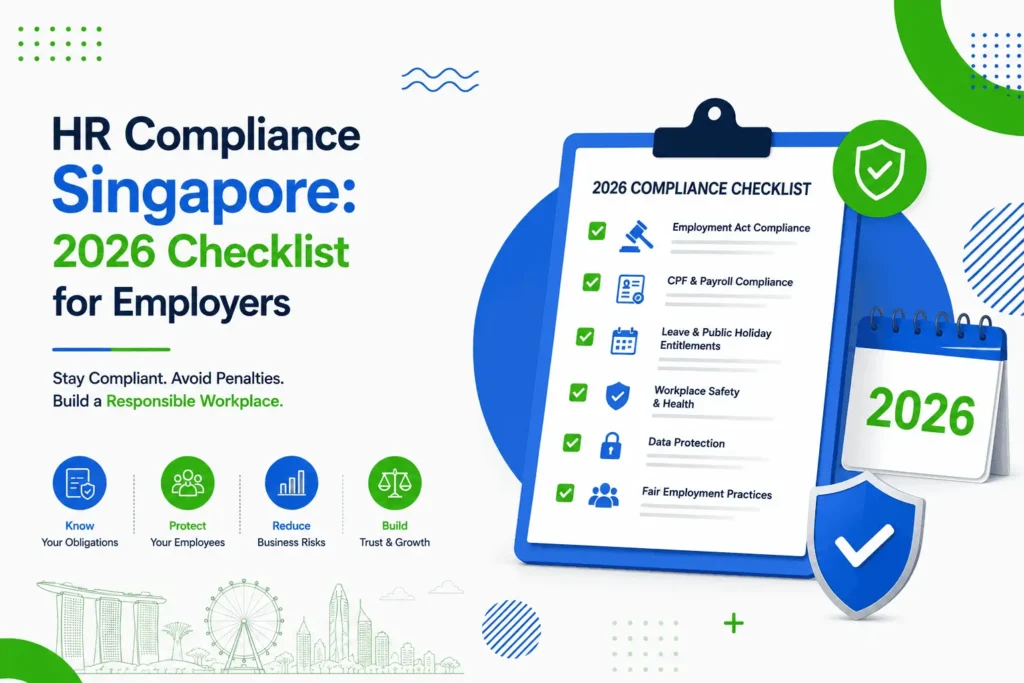
HR compliance in Singapore refers to following the employment laws, regulations and administrative requirements that apply to how a business manages its employees — from employment contracts and payslips to leave, CPF contributions and record-keeping. What applies to a given business can vary depending on its workforce composition, industry, and how it structures work arrangements, so HR compliance Singapore isn’t a single fixed checklist that fits every company identically.
In practice, it means having the right documentation in place, keeping accurate and complete records, paying employees correctly and on time, and staying reasonably current on requirements as they’re updated.
The following areas come up repeatedly when businesses review their HR processes. None of this replaces professional advice for your specific situation, but it’s a reasonable starting point for a self-review.
Employers are required to provide Key Employment Terms (KETs) in writing to employees covered by the Employment Act, generally within 14 days of the employee starting work. MOM’s key employment terms page sets out what needs to be included — things like job title, salary details, working hours, leave types and notice periods. It’s worth checking your current contract templates against this list rather than assuming an older template still covers everything required.
Employers covered by the Employment Act are expected to maintain proper employment records, including basic employee information, salary details, and information such as leave taken. MOM’s guidance on what employee records you need to keep sets out what’s generally expected. For a growing SME, this is often where gaps first appear — leave records living in one spreadsheet, salary adjustments noted informally in emails, and no single place where a complete employee file actually sits.
Employers must provide itemised payslips to employees covered by the Employment Act. This isn’t just a courtesy document — it needs to include specific salary components. Rather than guessing at the format, it’s worth referring directly to MOM’s official guidance on itemised payslip requirements, and checking whether your current payslip template — whether generated manually or through software — actually includes everything expected.
This covers the basics: calculating salary accurately, applying overtime correctly where it applies, handling deductions properly, running CPF-related payroll processes, and keeping the underlying salary records organised. None of this is unusual for a functioning payroll process, but it’s easy for small inconsistencies to creep in as headcount grows — a rate that wasn’t updated after a raise, a deduction applied inconsistently, or a payroll record that doesn’t quite match what was actually paid.
Requirements around working hours, overtime and rest days depend on which employees are covered under Part IV of the Employment Act — broadly, this doesn’t apply to managers and executives, and coverage depends on salary thresholds that can change over time. Rather than relying on a rule of thumb, it’s worth checking MOM’s page on hours of work, overtime and rest days directly, since coverage and thresholds can be updated.
Employers generally need to manage several leave categories — annual leave, sick leave, and other statutory leave types such as maternity, paternity or childcare leave where applicable — alongside any additional leave the company chooses to offer as a matter of policy. Exact entitlements and eligibility depend on factors like length of service and employee category, so rather than listing specific numbers here, it’s worth checking current details directly with MOM. What matters operationally is having a clear, consistent way to track and record leave. This is one of the areas where a dedicated Leave Management Software Singapore system tends to help — centralising applications, balances and approval records instead of leaving them scattered across email and spreadsheets.
Employers are generally required to make CPF contributions for eligible Singapore Citizen and Permanent Resident employees. Contribution rates depend on factors like age group and wage level, and these rates are reviewed periodically — the CPF Board’s employer obligations page and its contribution rate guidance are the right place to confirm current figures rather than relying on a number from a previous year. What matters for HR is having a consistent monthly process: confirming CPF liability, submitting on time, and reconciling contributions against payroll records.
Singapore employers are expected to follow the Tripartite Guidelines on Fair Employment Practices, which set out principles around merit-based recruitment, fair treatment, and non-discriminatory HR practices. This isn’t only a hiring consideration — it extends to how performance, promotion and other HR decisions are documented and applied consistently.
Employee personal data — NRIC numbers, salary details, medical information, and similar — falls under Singapore’s Personal Data Protection Act (PDPA). At a high level, this means limiting who can access sensitive employee information, having a reasonable basis for collecting and retaining it, and being able to explain how it’s used. The PDPC’s guide for organisations and Data Protection Officers is a reasonable starting point if this hasn’t been formally reviewed. This is a general awareness point rather than legal advice — businesses with more complex data handling should get proper guidance.
When an employee leaves, there are usually a few loose ends worth tidying up deliberately rather than letting them trail off: final salary and leave records, confirmation of employment status changes, return of company property, and retaining the relevant documentation for the period your business determines appropriate. Disorganised offboarding tends to be where record-keeping gaps become visible later — for instance, if a former employee’s leave balance or final pay is queried months after they’ve left.
HR software can help centralise employee records, leave, attendance, payroll and payslips. It can also provide approval workflows, access controls, reporting and audit trails, making HR processes more consistent and easier to manage. However, software supports compliance—it does not guarantee
1. What is HR compliance in Singapore?
HR compliance means following applicable employment laws and requirements covering contracts, payslips, leave, CPF and employee records.
2. What records must Singapore employers maintain?
Employers generally need to maintain employee, salary and leave records as required under the Employment Act and current MOM guidelines.
3. What should an HR compliance checklist include?
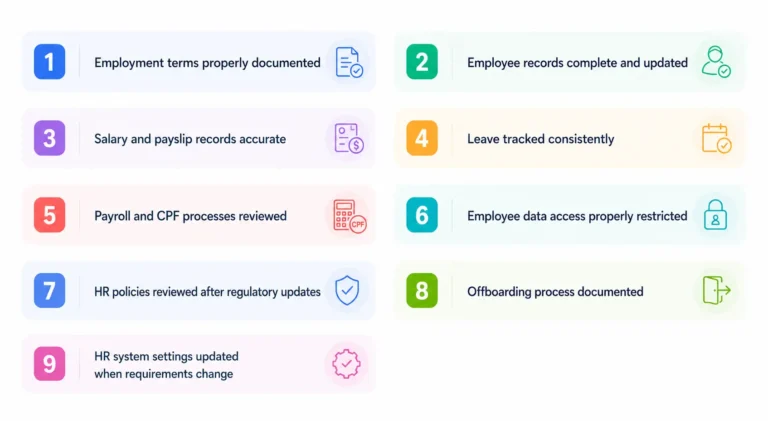
It should cover contracts, employee records, payslips, payroll, leave, CPF, working hours, data handling and offboarding.
4. Can HR software help with compliance?
Yes. It can organise records, payroll, payslips, leave tracking and reporting, but it does not automatically guarantee compliance.
HR compliance in Singapore isn’t a one-time project you finish and file away — it’s closer to an ongoing habit of keeping records accurate, processes consistent, and documentation current as your company and the regulatory landscape both evolve. For growing SMEs, the real goal isn’t memorising every requirement; it’s building repeatable HR processes that make it easier to maintain records, run payroll correctly, manage leave, and adjust when requirements change.
If your HR processes are still spread across spreadsheets, email threads and personal files, it might be worth looking at how a centralised system like AdaptivePay could make this kind of ongoing review more manageable.
Manage HR, payroll, attendance, leave, and employee operations in one powerful HRMS platform to improve efficiency and simplify workforce management.