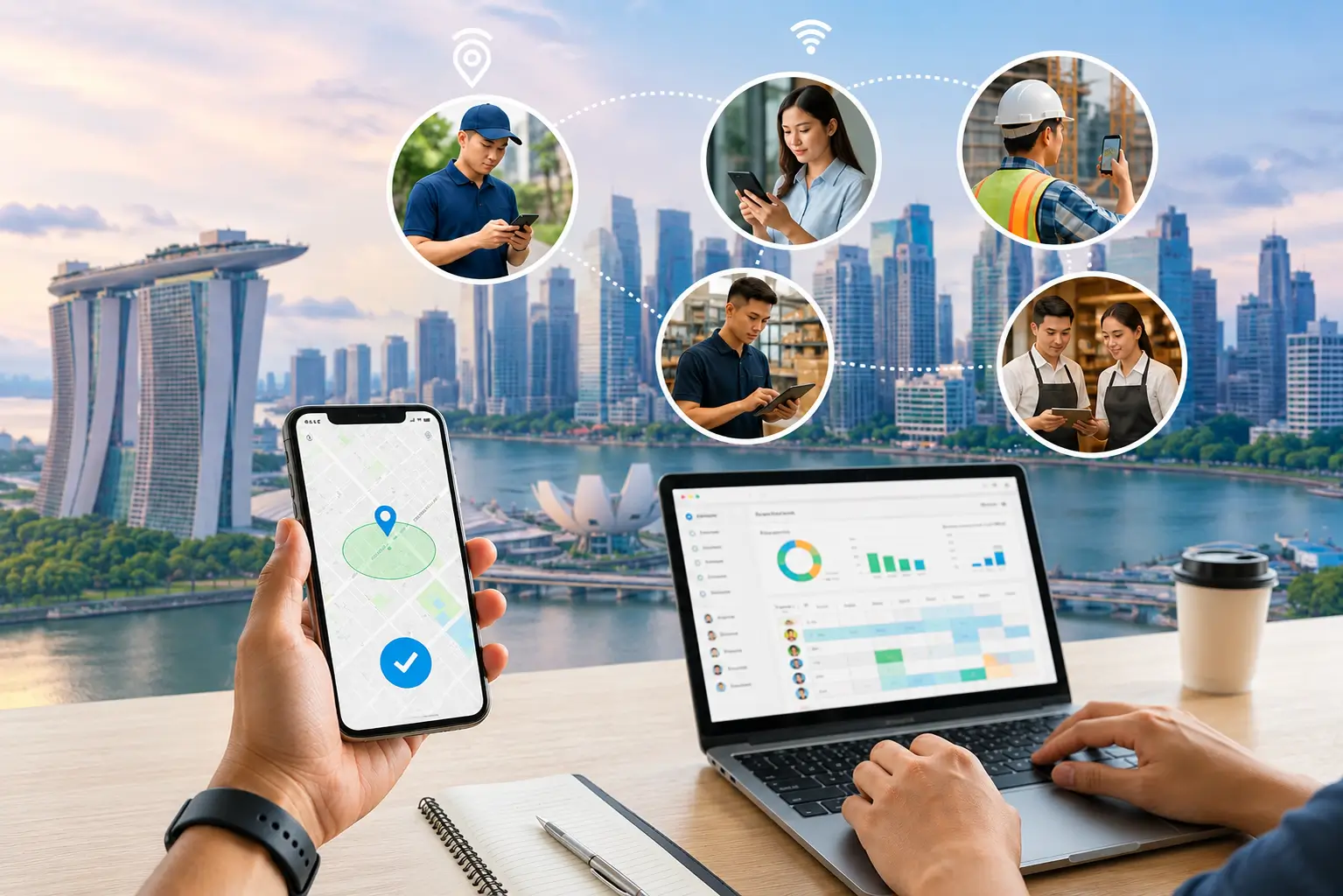
Real-time attendance tracking for Singapore SMEs isn’t just a “nice-to-have” feature—it’s one of the fastest ways to cut payroll-related admin, reduce disputes, and improve workforce visibility across sites, shifts, and mobile teams. When clock-ins and clock-outs sync instantly, you stop relying on end-of-month memory, messy WhatsApp messages, and spreadsheet patchwork.

Real-time attendance tracking for Singapore SMEs: what it actually means
In practical terms, real-time attendance tracking means attendance data is captured and updated immediately (or near-immediately) when an employee clocks in/out—via mobile app, web, or devices like biometric/face recognition. Managers and HR can view live status (present/late/absent), while rules for hours and overtime can be applied consistently rather than reconstructed later.
Modern systems also support location validation like GPS and geofencing, which can be especially useful for multi-site, project-based, or field-service teams. For example, Adaptive Pay describes GPS clock-ins, geofencing, and even fake GPS detection as part of a location-verified attendance approach. (adaptivepay.com.sg)
Why real-time attendance tracking matters (beyond “tracking hours”)
1) You catch issues before they become payroll problems
When attendance is only checked at month-end, errors become expensive: missing punches, wrong shift assumptions, or misapplied break times can trigger back-and-forth and delayed payroll prep. With real-time attendance tracking, supervisors can fix exceptions while the day is still fresh—often before overtime compounds or a dispute escalates.
2) You reduce time theft and “buddy punching” risk
Singapore SMEs with mobile or multi-site teams often face a visibility gap—especially when supervisors can’t physically verify every start time. Real-time attendance tracking paired with stronger validation (GPS location, geofencing boundaries, QR check-in, selfie/face verification) makes fraudulent clock-ins harder to pull off and easier to investigate.
If you’re evaluating location-based setups, Adaptive Pay’s overview of its GPS attendance system for Singapore is a useful reference for how geofencing and site/project attendance can work in practice.
3) Overtime and shift premiums become more defensible
Overtime disputes usually come down to one thing: “What time did I actually start and finish?” Real-time capture creates a clearer audit trail of attendance records. When a system automatically calculates hours and overtime from actual clock data (instead of manual timesheet math), your numbers are easier to explain to employees—and less likely to break when a manager changes.
4) Managers get live staffing visibility (especially for shift teams)
For F&B, retail, logistics, healthcare support, and other shift-based environments, real-time attendance tracking is operational, not just HR. Managers can see who has arrived, who is late, and who is missing—then redeploy staff, call backups, or adjust task assignments immediately.
5) You spend less time “chasing timesheets” and more time running the business
Manual attendance processes create repeat work:
- Employees submit timesheets late
- Managers verify via chat messages
- HR re-keys hours into payroll
- Finance queries anomalies after the fact
Real-time attendance tracking reduces these loops by capturing data once and syncing it centrally. Many platforms also generate one-click reports (daily attendance, overtime summaries, exceptions), so you’re not building management reports from scratch. (adaptivepay.com.sg)
Common SME scenarios where real-time attendance tracking pays off fast
Multi-site teams (outlets, warehouses, client premises)
If you manage staff across multiple locations, real-time attendance tracking helps you confirm presence and punctuality without relying on manual sign-in sheets at each site. GPS/geofencing can add location proof where appropriate. (adaptivepay.com.sg)
Mobile/field teams (service crews, sales, project workers)
When employees start their day from the road (not the office), real-time attendance tracking supports clock-ins from mobile while capturing the context needed for verification and job costing.
Fast-growing SMEs hiring quickly
Growth usually breaks “simple” admin processes first. Real-time attendance tracking makes it easier to standardize rules (shifts, breaks, lateness) and onboard new managers into a consistent workflow instead of personal spreadsheets.
What to look for in a real-time attendance tracking system (SME checklist)
- Multiple clock-in methods: mobile app, web, and optional biometric/face devices for different roles and environments. (adaptivepay.com.sg)
- Location controls (if needed): GPS, geofencing, QR, selfie/face validation—especially for site-based work. (adaptivepay.com.sg)
- Clear exception handling: easy ways to flag missing punches, late clock-ins, and edits with approval trails.
- Overtime/shift rule automation: configurable rules that match how your teams actually work.
- Reporting that managers will actually use: daily attendance, overtime, timesheet summaries, and export options. (adaptivepay.com.sg)
- Integration into HR and payroll workflows: fewer re-entries and fewer “version conflicts” between systems.
How to roll out real-time attendance tracking without employee pushback
- Explain the “why”: focus on fairness, accuracy, and faster issue resolution—not surveillance.
- Start with one team or site: pilot for 2–4 weeks, refine rules, then expand.
- Define edit rules upfront: who can amend attendance, what evidence is needed, and how approvals work.
- Train supervisors first: they’re the ones handling real-time exceptions.
- Use reports weekly, not monthly: small corrections early prevent end-of-month chaos.
Where Adaptive Pay fits (attendance, HR, and payroll in one flow)
If your goal is to reduce double-entry, consider solutions that connect attendance with the wider HR stack. Adaptive Pay positions its platform to sync modules like attendance with HRMS and payroll so hours and related calculations can flow through more cleanly. (adaptivepay.com.sg)
To explore the feature set, you can review the product overview on the official Adaptive Pay page: Time & Attendance Software Singapore.
If you’re already on Adaptive Pay (or considering it), you can also start from an internal link like Adaptive Pay HRMS and navigate to attendance features relevant to your team setup.
FAQ: Real-time attendance tracking for Singapore SMEs
Does real-time attendance tracking only benefit large companies?
No. Singapore SMEs often benefit sooner because they have fewer admin resources to absorb recurring timesheet problems. Real-time attendance tracking reduces rework, helps supervisors act faster, and keeps payroll preparation simpler.
Is GPS attendance necessary for every SME?
Not always. If everyone works from one fixed location, a simple in-office clock-in method may be enough. GPS/geofencing is most valuable when staff work across outlets, project sites, or customer locations. (adaptivepay.com.sg)
What’s the biggest mistake SMEs make with attendance systems?
Choosing a tool that captures clock-ins but doesn’t support real operational workflows—like shift patterns, approvals, exception handling, and usable reporting. Real-time attendance tracking only works when managers can act on the data.
Conclusion
Real-time attendance tracking for Singapore SMEs helps you run day-to-day operations with fewer surprises: managers get live visibility, HR spends less time reconciling timesheets, and payroll becomes less error-prone. The sooner you can see attendance exceptions, the easier they are to fix—before they turn into disputes, overtime blowouts, or month-end admin overload.