SFEC Support Ends 30 Nov 2026. Get 1-Year FREE AdaptivePay Subscription. (T&C Apply)
SFEC Support Ends 30 Nov 2026. Get 1-Year FREE AdaptivePay Subscription. (T&C Apply)
Explore Adaptive Pay’s HRMS and payroll features for Singapore businesses.
Simplify attendance, leave and employee management with one integrated system.
Get answers to common questions about HR, payroll and workforce management with Adaptive Pay.
Adaptive Pay is a cloud-based HRMS and payroll software solution designed for businesses in Singapore. It brings employee management, payroll, attendance, leave, claims, appraisals, HR analytics and AI-powered insights together in one platform. By connecting these HR processes, Adaptive Pay helps businesses reduce manual administration and manage employee information more efficiently.
Adaptive Pay is designed for businesses that need to manage employee information, payroll and everyday HR processes through one system. It can support different workforce structures, including office-based, shift-based, mobile and multi-site teams. The platform is particularly relevant to Singapore businesses looking to centralise HR and payroll operations.
Yes. Adaptive Pay is designed to support Singapore businesses, including SMEs that need integrated HR and payroll management. Instead of maintaining separate systems for employee records, payroll, attendance, leave and claims, businesses can manage these processes through one connected HRMS. Adaptive Pay is also listed as an eligible solution under the IMDA SMEs Go Digital programme, subject to applicable requirements.
Yes. Adaptive Pay is a cloud-based HRMS that allows authorised users to access supported HR functions online. Its platform connects employee management, payroll, attendance, leave, claims and reporting in one system. Employees can also access supported self-service functions through the web portal and mobile app, depending on the organisation’s configured permissions.
Adaptive Pay can help businesses reduce their reliance on spreadsheets for many recurring HR processes. Employee records, payroll, attendance, leave, claims and other HR information can be managed within the platform. By connecting these processes, businesses can reduce duplicate data entry and make it easier for authorised users to access consistent employee information.
An integrated HRMS connects different HR processes instead of managing each function separately. With Adaptive Pay, employee information can connect with payroll, attendance, leave, claims, appraisal and reporting. This can reduce repetitive administration, improve access to workforce information and give HR and management teams a more connected view of employee and payroll-related data.
Yes. Adaptive Pay provides employee self-service through a mobile app as well as a web portal. Depending on the permissions and features enabled by the organisation, employees can access functions such as attendance, leave, payslips, HR documents and other employee-related information. This gives employees convenient access to supported HR services without relying entirely on HR administrators.
Adaptive Pay helps reduce manual HR administration by bringing recurring processes into one connected HRMS. Employee information, payroll, attendance, leave, claims and reporting can be managed through the platform, reducing the need to maintain multiple spreadsheets and manually transfer information between systems. Automation and employee self-service can further reduce routine administrative tasks.
Protecting employee information is important when selecting HRMS software because HR systems contain sensitive employment and payroll data. Adaptive Pay provides controlled access to HR information through user permissions and role-based access. Businesses can configure access according to user responsibilities, helping ensure employees, managers and administrators only access the information relevant to their roles.
Businesses can start by reviewing the HR and payroll functions they need, such as employee management, payroll, attendance, leave, claims and reporting. The Adaptive Pay team can then help businesses understand the platform and determine the appropriate setup for their requirements. This approach allows organisations to evaluate the HRMS before moving forward with implementation.
Manage HR, payroll, attendance, and employee operations through one connected platform built for Singapore businesses.

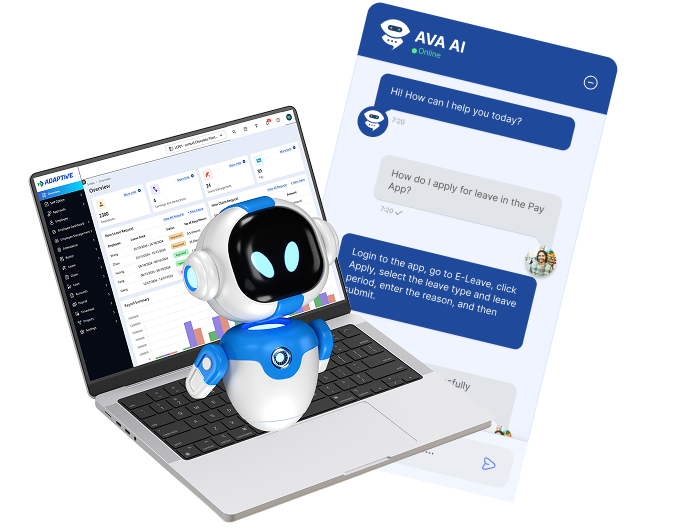
AI-powered HR software uses artificial intelligence to analyse HR data, identify patterns and provide useful insights alongside traditional HR functions. Adaptive Pay combines HRMS and payroll capabilities with IVY AI, which can analyse workforce and payroll information, identify potential anomalies and provide HR insights to help teams review information more efficiently.
Adaptive IVY AI is the AI capability built into Adaptive Pay to provide HRMS insights and payroll intelligence. It can analyse available employee, attendance, leave, claims and payroll information, help identify potential anomalies and provide summaries or insights. IVY AI works alongside Adaptive Pay’s connected HRMS rather than operating as a separate HR system.
IVY AI can analyse available payroll and workforce information within Adaptive Pay to provide insights and help identify areas that may require review. It can work with information such as employee records, attendance, leave, claims and payroll data, helping HR and management understand workforce information without relying entirely on manual data analysis.
Yes. Adaptive Pay positions IVY AI as a tool that can identify potential anomalies and unusual patterns in available HRMS and payroll information. It can help review payroll-impacting information, attendance, leave and workforce data. These insights are intended to support HR and payroll teams in identifying information that may need further review.
AI can help reduce manual analysis by processing available HR and workforce data and presenting relevant insights or summaries. Within Adaptive Pay, IVY AI can analyse employee, attendance, leave, claims and payroll information and provide HRMS insights. This can help HR and management review large amounts of workforce information more efficiently.
HR analytics software helps businesses analyse workforce information such as employee data, attendance, leave, claims, payroll and workforce costs. Adaptive Pay’s BI Analytics & HRMS Reports provide dashboards, charts, summaries and reports that help HR, payroll, finance, operations and management teams monitor trends and make more informed workforce decisions.
Adaptive Pay can provide reports covering employee management, attendance, leave, payroll, overtime, claims, reimbursements, workforce costs, approvals and other HR and operational activities. Its BI Analytics module can present this information through dashboards, charts, summaries and reports, with views designed for different business roles.
Yes. Adaptive Pay’s BI Analytics & HRMS Reports module provides dashboards that can bring together payroll, attendance, leave, claims, employee and workforce information. Dashboards can be configured according to user roles and reporting requirements, helping different teams focus on the metrics and information relevant to their responsibilities.
HR analytics helps businesses turn workforce data into information that can support decision-making. Adaptive Pay can analyse areas such as attendance, leave, claims, payroll costs and employee information through dashboards and reports. This can help HR and management monitor workforce trends, identify areas requiring attention and review operational or payroll-related issues.
Combining AI and HR analytics can help businesses move from simply viewing HR reports to identifying patterns and potential issues within workforce data. Adaptive Pay combines BI dashboards and reports with IVY AI capabilities, allowing teams to analyse HR, attendance, leave, claims and payroll information while using AI-supported insights and summaries for faster review.
Transform everyday HR tasks with intelligent automation and AI-driven support from IVY AI
Explore answers about payroll processing, salary calculations, CPF contributions and payslip management.
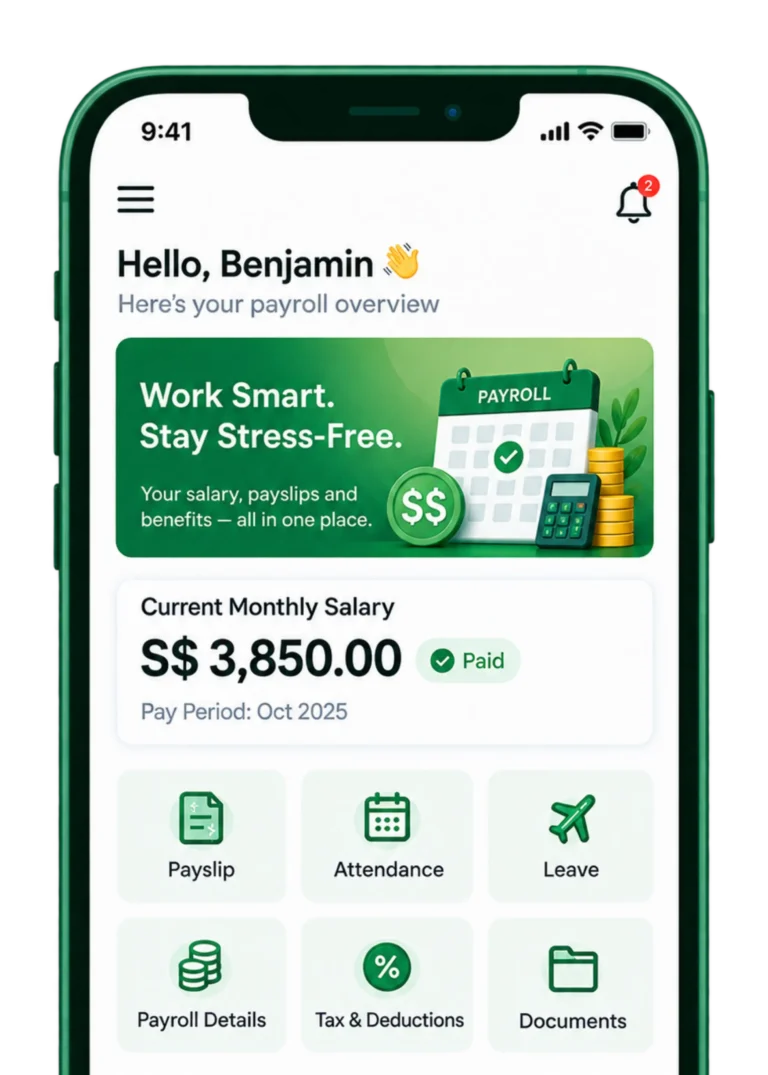
Payroll software automates key payroll tasks such as salary calculations, statutory contributions, deductions, payslip generation and payroll reporting. In Singapore, payroll software can help businesses manage CPF-related calculations and other payroll processes more efficiently. Adaptive Pay connects payroll with employee, attendance, leave and claims information, reducing the need for repetitive manual data entry.
Payroll software can help Singapore businesses reduce manual calculations, improve payroll accuracy, generate payslips more efficiently and connect payroll with other HR processes. Adaptive Pay brings payroll together with employee management, attendance, leave and claims, helping HR and payroll teams work with connected employee information instead of maintaining separate spreadsheets.
Yes. Adaptive Pay supports automated salary calculations, payslip generation and CPF-related payroll processes for Singapore businesses. Payroll can also use information from connected HR modules such as employee records, attendance, leave and claims. This helps reduce repetitive payroll administration and provides a more connected approach to monthly payroll processing.
Yes. Adaptive Pay supports automated CPF contribution calculations and submissions as part of its Singapore payroll capabilities. CPF-related payroll processing can use employee and salary information within the system, helping businesses reduce manual calculation work. Employers should still ensure that their payroll configuration and statutory requirements are kept current
Yes. Adaptive Pay supports employee payslip generation as part of its payroll software. Salary information and payroll calculations can be processed within the system to produce itemised payslips. Employees can also access payslip information through the connected employee self-service experience, subject to their access permissions.
Yes. Payroll software is designed to automate salary-related calculations, including configured earnings, deductions and other payroll components. Adaptive Pay uses employee and salary information within its payroll system to support automated salary processing and payslip generation, helping payroll teams reduce repetitive manual calculations.
Yes. Adaptive Pay connects employee records, attendance, roster information, leave, claims and payroll within one HRMS. This connected approach allows relevant HR information to flow between modules, reducing the need for HR teams to manually consolidate data from separate spreadsheets or systems before payroll processing.
Cloud payroll software can reduce errors by automating calculations and connecting payroll with employee, attendance and leave information. Adaptive Pay also provides payroll reporting and AI-powered capabilities that can help identify potential payroll issues or unusual patterns before finalisation. These tools support review and validation rather than replacing required payroll checks.
Yes. Adaptive Pay is positioned as an HRMS and payroll platform for Singapore businesses, including SMEs. It combines payroll, employee management, attendance, leave, claims and other HR functions in one platform. The website also identifies Adaptive Pay as a pre-approved solution under the IMDA SMEs Go Digital programme.
Businesses should evaluate payroll automation, CPF support, payslip generation, statutory reporting, integration with attendance and leave, security, reporting, implementation and ongoing support. It is also important to check whether the software matches the organisation’s workforce structure and payroll requirements. Adaptive Pay combines payroll with connected HR modules for businesses looking for an integrated HRMS approach.
Streamline payroll processing with automated calculations and Singapore statutory compliance support.
Explore answers about HRMS features, HR automation, employee records and workforce management.
HRMS software is a system that brings multiple human resource processes together in one platform. Depending on the solution, this can include employee management, payroll, attendance, leave, claims and performance management. Adaptive Pay combines these HR functions with analytics and AI capabilities to help Singapore businesses centralise HR information and automate everyday HR processes.
Traditional HR management often relies on separate spreadsheets, documents or systems for different processes. An HRMS connects these processes through one platform, allowing employee information to be reused across HR functions. Adaptive Pay connects employee records with payroll, attendance, leave, claims and appraisal processes, helping reduce duplicate data entry and fragmented HR information.
Cloud-based HR software allows authorised users to access HR information online rather than depending on a single office computer. Adaptive Pay provides web-based HR access and a mobile employee self-service experience, helping HR teams and employees access supported HR functions across different work environments while keeping HR processes connected.
Cloud-based HR software allows authorised users to access HR information online rather than depending on a single office computer. Adaptive Pay provides web-based HR access and a mobile employee self-service experience, helping HR teams and employees access supported HR functions across different work environments while keeping HR processes connected.
Yes. Adaptive Pay is designed to automate and streamline several HR processes, including payroll, leave applications and approvals, attendance, claims and employee information management. By connecting these functions, the system can reduce repetitive administrative work and help HR teams manage employee information and routine HR activities more efficiently.
Yes. Adaptive Pay’s Employee Management module centralises employee profiles, employment information, documents, qualifications, emergency contacts and other HR records. It also supports certificate and passport expiry tracking, custom fields and employee document management, helping HR teams keep important employee information organised within one system.
Yes. Adaptive Pay is designed as a connected HRMS where employee information can be used across payroll, attendance, leave, claims and appraisal processes. This helps businesses avoid maintaining completely separate records for each HR function and gives authorised users a more connected view of employee and workforce information.
Yes. Adaptive Pay provides employee self-service through a web portal and mobile app. Depending on permissions, employees can access functions such as payslips, attendance and roster information, HR documents and leave information. The platform also supports role-based access to HR information, helping users see information relevant to their responsibilities.
Yes. Adaptive Pay is positioned for Singapore businesses and provides an integrated HRMS covering payroll, employee management, attendance, leave, claims and other workforce processes. The platform is also promoted as a pre-approved solution under the IMDA SMEs Go Digital programme, with grant support subject to the applicable eligibility and programme conditions.
Businesses should consider the HR functions they need, payroll and Singapore statutory requirements, integration between modules, employee self-service, reporting, security, scalability, implementation and support. An HRMS should also reduce duplicate data entry rather than simply adding another system. Adaptive Pay connects core HR, payroll and workforce processes in one platform.
Bring employee management, HR processes, performance, documents, and workforce operations together in one platform.

Explore answers about employee records, onboarding, performance, documents and employee information.
Employee management software is a system for organising employee information and supporting HR processes throughout the employee lifecycle. Adaptive Pay centralises employee profiles, employment details, documents, qualifications, statutory information and other HR records, while connecting employee data with payroll, attendance, leave, claims and appraisal processes.
Employee management software helps HR teams centralise employee information, reduce duplicate data entry and access important records more efficiently. Adaptive Pay allows HR teams to manage employee profiles, documents, certificates, employment information and expiry dates while connecting the employee record with other HR processes such as payroll, attendance and leave.
Adaptive Pay maintains a centralised employee database containing information such as personal details, employment information, job details, bank information, statutory information, salary-related information and custom fields. Changes to employee information can remain connected with relevant HR processes across the platform, helping reduce fragmented employee records.
Yes. Adaptive Pay allows businesses to store employee documents directly against employee profiles. Supported records include educational and professional certificates, training certificates, employment documents, passport copies and other work-related attachments. HR teams can also monitor important document expiry dates and create custom expiry categories where required.
Yes. Adaptive Pay supports employee management from joining through employment changes and exit. Employee records can contain onboarding information, employment changes, documents, payroll-related information, leave and other HR data. The platform also supports appraisal and exit-related HR processes, helping businesses maintain a connected employee record throughout employment.
Yes. Adaptive Pay provides employee self-service through its web portal and mobile app. Employees can access supported HR functions such as personal information, payslips, attendance and roster information, HR documents, notifications and leave information. The specific information employees can update or access depends on the permissions configured by the organisation.
Yes. Adaptive Pay supports role-based access to HR information and dashboards. This allows organisations to control what different users can view based on their responsibilities. For example, managers can access relevant team information, while HR, payroll, finance and management users can have access to information appropriate to their roles and permissions.
Centralised employee data reduces the need to repeatedly enter or maintain the same information across separate spreadsheets and systems. In Adaptive Pay, employee information can connect with payroll, attendance, leave, claims and appraisal processes, helping HR teams work from a more consistent employee record and reducing administrative duplication.
Adaptive Pay is designed to support different workforce structures, including office-based, shift-based, mobile and multi-site teams. Its connected HRMS can bring employee, attendance, leave, payroll and other workforce information together. Reporting can also be filtered by relevant organisational parameters such as department, project, site or employee group where supported.
Employee management software can help Singapore businesses centralise employee records, manage documents, monitor expiry dates and connect employee information with payroll and other HR processes. Adaptive Pay also supports employee self-service, KET and MOM OED information management, HR letter generation and Employee 360 AI Analysis within its employee management solution.
Organize employee records, documents, HR activities, and essential workforce information with ease.

Explore answers about attendance tracking, leave management, work schedules and employee rosters.
Attendance management software records and manages employee attendance information, working hours and related workforce data digitally. Adaptive Pay’s HRMS connects attendance and roster management with employee, leave and payroll processes, helping businesses monitor attendance and use relevant workforce information across connected HR operations.
Adaptive Pay includes attendance management and roster capabilities for monitoring employee attendance and workforce schedules. Attendance information can also be connected with other HR processes, including payroll and employee management. This gives HR and management a more connected view of attendance-related information rather than relying only on separate manual records.
Yes. Adaptive Pay includes Attendance & Roster functionality designed to help businesses schedule employee shifts and monitor attendance. This is particularly useful for organisations with shift-based or changing workforce schedules. Roster and attendance information can also be connected with other HR processes within the broader Adaptive Pay HRMS.
Yes. Adaptive Pay connects attendance information with payroll as part of its integrated HRMS. Attendance and related workforce information can be used alongside employee and payroll data, helping reduce the need for manual reconciliation between separate attendance records and payroll spreadsheets.
Adaptive Pay’s connected HRMS includes attendance, roster and payroll-related information, while its reporting capabilities include overtime data. This allows HR and payroll teams to review relevant attendance and overtime information as part of workforce and payroll processes. Actual overtime calculations and rules depend on the organisation’s configured payroll setup.
Leave management software helps businesses manage employee leave applications, approvals, balances and related records digitally. Adaptive Pay provides leave management as part of its integrated HRMS, allowing leave information to connect with employee records and payroll. This helps HR teams reduce manual leave tracking and manage leave processes more efficiently.
Yes. Adaptive Pay provides employee self-service through its web portal and mobile app, including access to leave balances and leave requests. This allows employees to use supported leave functions without depending on HR for every routine request, while authorised HR and managers can manage the associated approval processes.
Yes. Adaptive Pay includes leave applications and approval workflows as part of its Leave Management functionality. Managers and authorised users can manage relevant leave requests within the system, helping reduce manual approval processes and giving businesses a centralised record of employee leave activity.
Integrated attendance and leave management reduces the need to maintain separate records for employee attendance, leave and related HR processes. Adaptive Pay connects attendance, roster and leave information with employee and payroll data, helping HR teams reduce manual reconciliation and gain a more consistent view of workforce information.
Adaptive Pay provides leave management with leave applications, approvals, balance tracking and holiday management. The exact leave types and approval workflows available to an organisation depend on its configured HR policies and system setup. This allows businesses to structure leave processes around their operational and workforce requirements.
Manage attendance, leave, shifts, and rosters efficiently with connected workforce management tools.

A smarter way to manage payroll, attendance, claims and appraisals – all in one seamless platform





Copyright © 2026 – Adaptive Cloud Systems Pte Ltd