
PSG Support Ends Sep 29! Get 1-Year FREE AdaptivePay Subscription. SFEC Support Ends Nov 30, 2026. (T&C Apply)
MOM OED Submission From Your HRMS
Managing OED information should not mean repeatedly extracting employee information, updating spreadsheets and checking employment data manually.
Adaptive Pay connects your employee records, job information, attendance and payroll data within one HRMS, helping HR teams prepare and submit Occupational Employment Dataset information to MOM more efficiently.
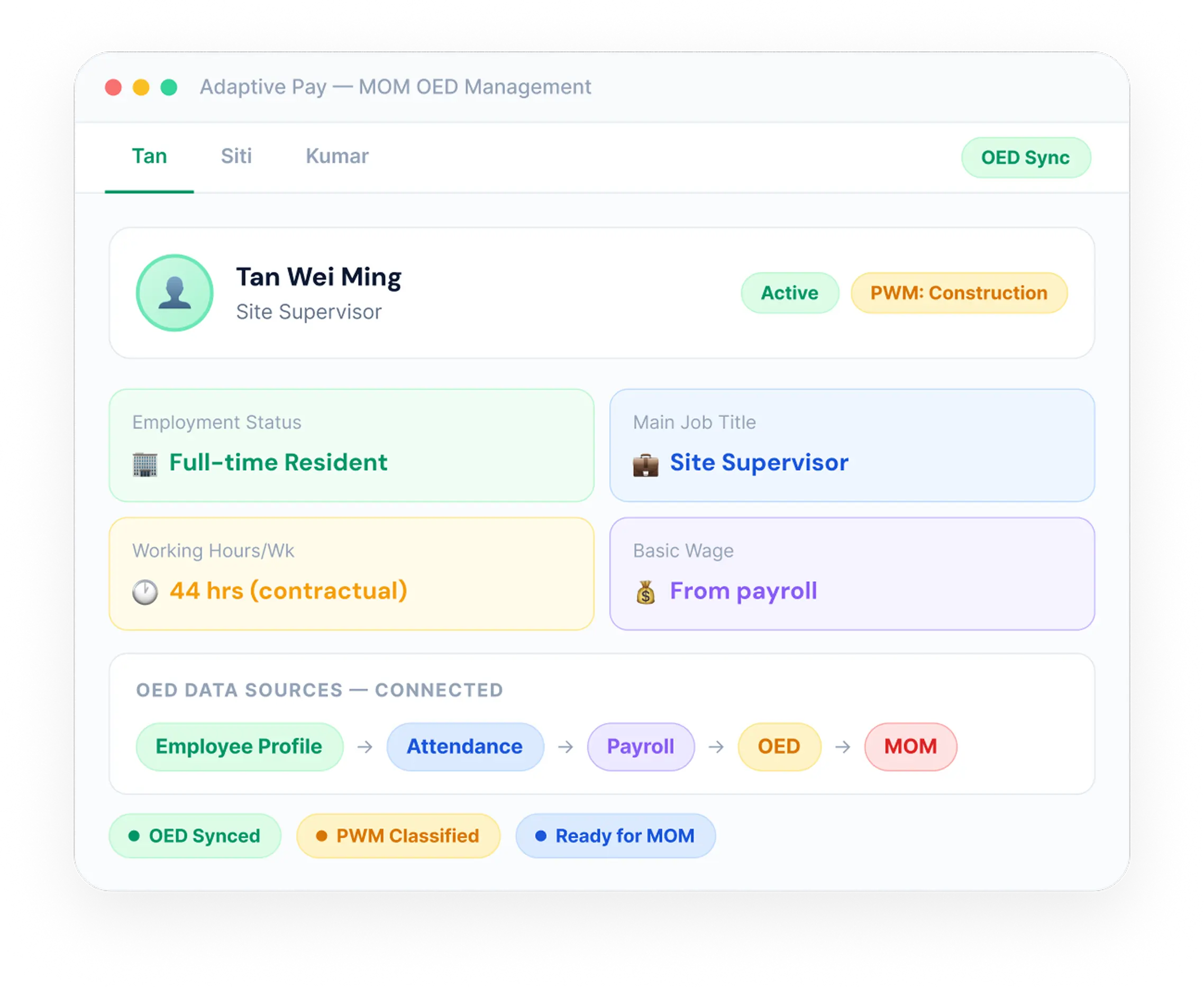
The Occupational Employment Dataset (OED) is an online registry that collects occupational and employment data of current workers in Singapore. Registered businesses are required to provide current occupational and employment details for employees under their payroll.
Manage OED information alongside your everyday HR and payroll processes instead of maintaining a separate dataset.
Who Reports
All registered businesses employing staff under their payroll.
Who Is Covered
Singapore Citizens, Permanent Residents and foreign employees.
Also Used For
Progressive Wage (PW) and Local Qualifying Salary (LQS) assessments.
All four OED information categories maintained within the same employee and payroll records.
Employee Information
Occupational Information
Working Time Information
Payroll Information
Rather than creating a separate set of records only for MOM reporting, OED draws from information already maintained in Adaptive Pay.
👤
Employee Profile
Employee and employment records
💼
Job & PWM Information
Job duties and applicable PWM details
🕐
Attendance & Working Hours
Working time and overtime information
💰
Payroll & Wages
Salary and relevant employment income
📋
OED Information
Connected data for OED reporting
📤
MOM Submission
Submit occupational and employment information
OED information is already spread across your HR and payroll systems. When it is maintained separately, the same employee information is entered, updated and reconciled multiple times.
|
FRAGMENTED — WITHOUT ADAPTIVE PAY
|
CONNECTED — WITH ADAPTIVE PAY
|
|---|---|
|
Separate spreadsheet per employee
|
OED data synced automatically
|
|
Exported manually each reporting period
|
Updated in real time across HR & payroll
|
|
Pulled from payroll software separately
|
No manual exports or reconciliation
|
|
Manually checked against job information
|
Job information maintained within the HRMS
|
MOM’s standard OED process, and the automated option available to HR software providers.
Complete Core Data
Employee identity, employment status, job title and core occupational information.
Complete Secondary Data
Working hours, wages, PWM job details and additional employment information.
Provide Additional Data Items
Provide additional data items where available to complete the OED submission.
Submit and Verify Records
Review, submit and verify OED records with MOM via your preferred submission method.
OED Submission Flow
HR Database
SFTP
MOM
MOM supports an Automated Data Transfer (ADT) process where organisations can submit employee occupational and employment information electronically via SFTP directly to MOM — instead of manual portal uploads.
When to Update OED
Update OED when employee occupational or employment information changes.
Employee Change → HRMS Update → OED Update
Built for construction, field services and any business with mobile or multi-site employees.
👥
Centralised Employee Information
Maintain employee occupational and employment information within the same HRMS used for everyday employee administration.
💼
PWM Job Details
Maintain PWM-related job information against employee records where applicable.
🕒
Attendance Integration
Use connected attendance, working-hour and overtime information.
🔄
Reduce Repetitive Administration
Keep wage and payroll information within the same system used for OED preparation.
✓
Improve Payroll Accuracy
Avoid repeatedly maintaining employee information across separate HR, payroll and reporting files.
📈
Suitable for Growing Businesses
Manage OED alongside other Singapore HR and payroll requirements including CPF, IRAS AIS and KET.
Part of One-Stop Payroll
MOM describes One-Stop Payroll as a collaboration between MOM, IRAS, CPF Board and GovTech designed to simplify payroll and employment-related regulatory requirements.
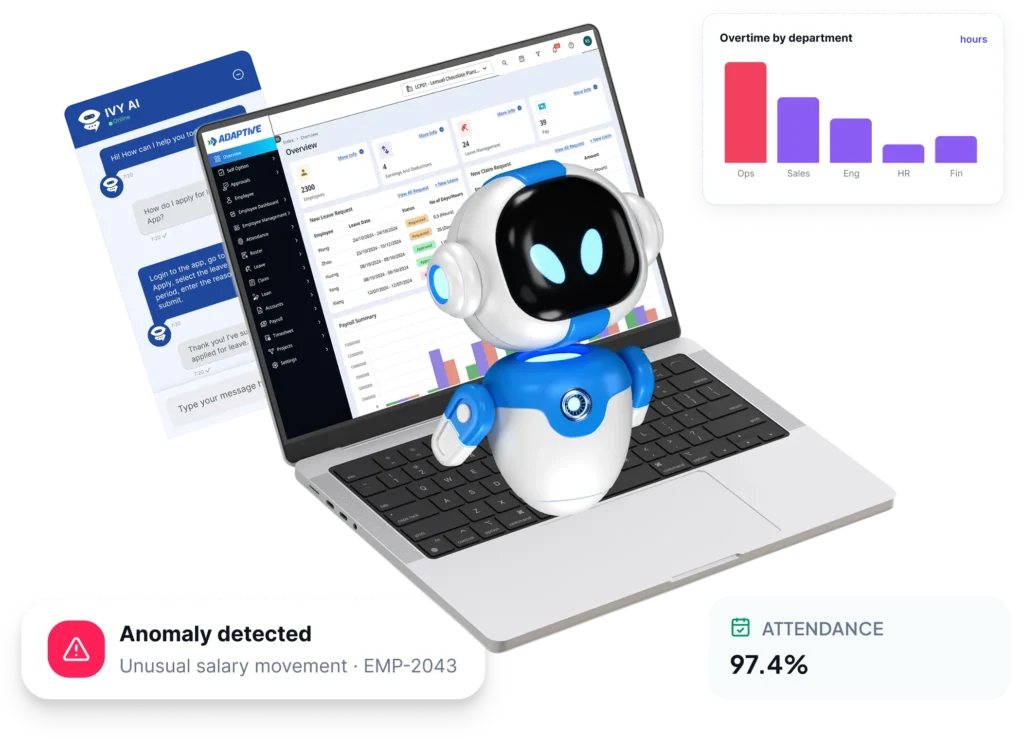
Get instant HRMS insights, analyse data, identify anomalies, and validate payroll-impacting information — all within Adaptive Pay. Gain quick visibility into employee records, attendance, leave, claims, and payroll data.
HR Assistance
Real-time Reports
Smart Insights
Request a Personalized Quote
Fill in the details below and our HR consultants will contact you shortly.
Expert Consultation
Speak with our HR specialists about your specific needs.
Customized Demo
See how AdaptivePay fits into your existing workflow.
Detailed Proposal
Receive a transparent, itemized quote for your business.
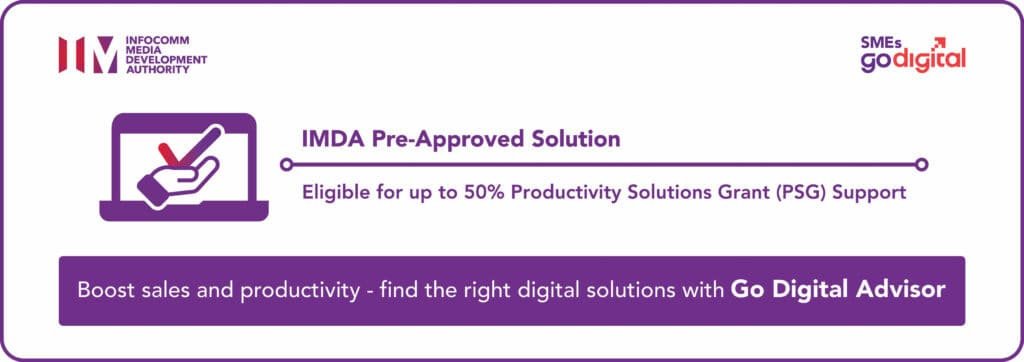
SMEs are eligible for up to 50% Productivity Solutions Grant (PSG) support for the adoption of Adaptive Pay, a Pre-Approved solution under the IMDA SMEs Go Digital programme.
Find answers to common questions about MOM OED Submission compliance.
OED is an online registry maintained by MOM that collects occupational and employment information relating to current workers in Singapore. Registered businesses are required to provide current information about employees under their payroll.
MOM states that all registered businesses must provide the latest occupational and employment information for employees under their payroll, including Citizens, Permanent Residents and foreigners.
Organisations should update OED when there are changes to employees’ occupational or employment information. If there are no new changes, MOM can rely on previously submitted records.
OED information is divided into Core, Secondary and Additional Data Items. Depending on the employee, information can cover identification, job and occupational details, employment information, working days or hours, work location and wage-related information.
Yes. MOM states that OED information is used when assessing applicable Progressive Wage and Local Qualifying Salary requirements.
MOM recommends providing the main job title that best reflects the employee’s primary responsibilities. For employees performing multiple PWM roles, the role occupying most of their working time should generally be used.
Yes. MOM provides an Automated Data Transfer service that connects an organisation’s HR database with MOM using SFTP to transfer relevant information directly.
Yes. Adaptive Pay supports OED-related employee information, including PWM job details, and direct OED submission as part of its HR and payroll platform.
Adaptive Pay connects employee, attendance and payroll information, helping HR maintain relevant working-hour, overtime, employment and wage information within the same HRMS.
Yes. MOM includes Occupational and Employment Data within the One-Stop Payroll initiative involving MOM, IRAS, CPF Board and GovTech.
MOM states that employees cannot access their organisation’s OED. However, PWM employees can view the PWM Job Level selected for them through the relevant PW portal
Enquire now to learn how we can build a solution for your business needs or speak with us for a free demo.
SMEs are eligible for up to 50% Productivity Solutions Grant (PSG) support for the adoption of Adaptive Pay, a Pre-Approved solution under the IMDA SMEs Go Digital programme.
A smarter way to manage payroll, attendance, claim and appraisals – all in one seamless platform




Copyright © 2026 – Adaptive Cloud Systems Pte Ltd